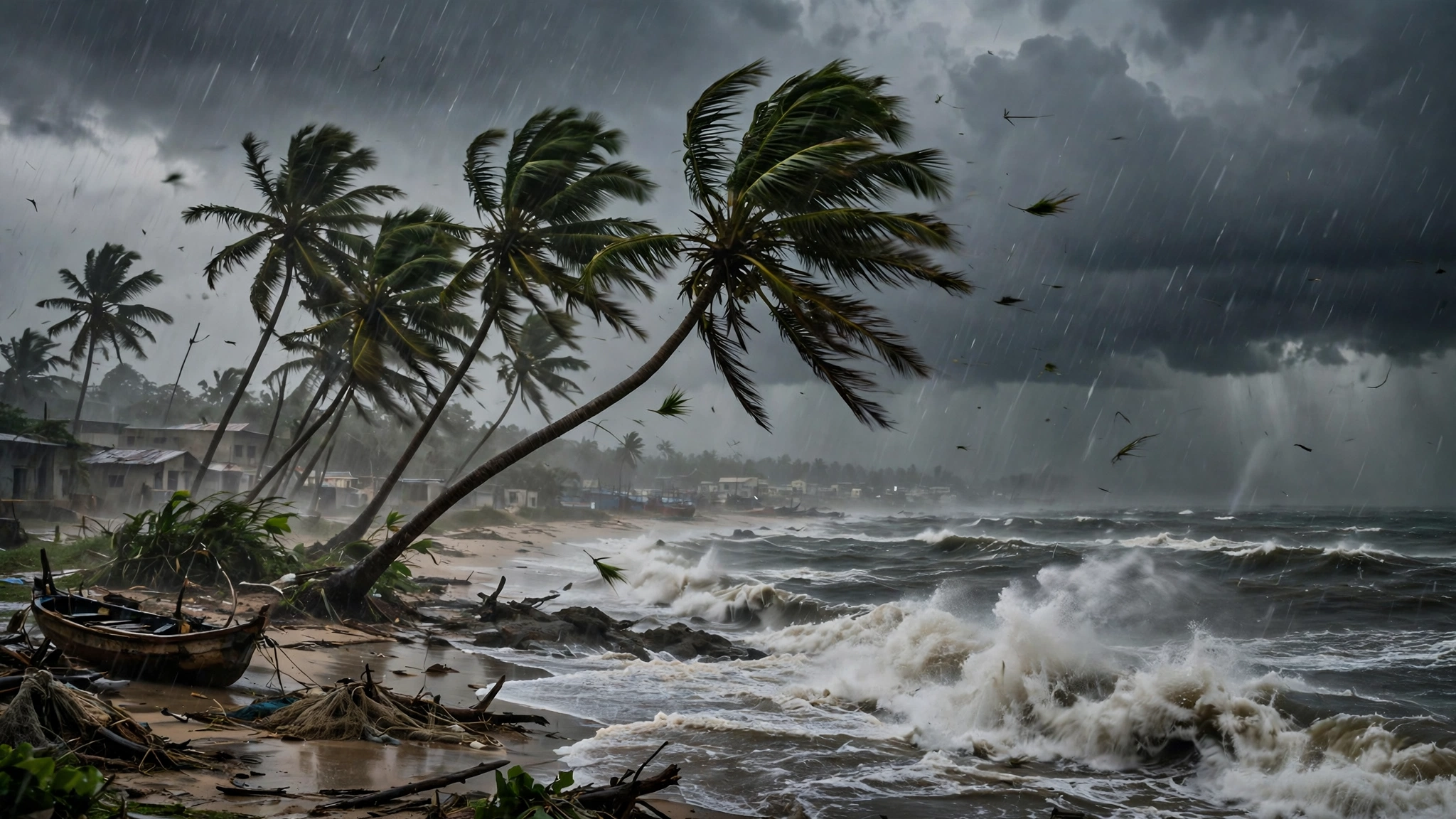
Cyclone Murasu Makes Landfall on India’s Eastern Coast
Cyclone Murasu made landfall on India's eastern coast in the early hours of Tuesday, 3 November, the second storm to hit the region in a week, as authorities evacuated hundreds of thousands of people to safety. The India Meteorological Department (IMD) said the severe cyclonic storm began coming ashore at 1 a.m. local time over the coast of Andhra Pradesh, crossing between 3:30 a.m. and 5:30 a.m. along the south Andhra coast between Nellore and Narsapur, near Ongole in Prakasam district, with sustained winds of 100 to 110 kilometres per hour and gusts of up to 120. No deaths or injuries had been reported by Tuesday morning, although trees and electricity poles were uprooted, and the storm was expected to weaken to a cyclonic storm by noon and to a deep depression by midnight. For coastal communities still clearing up from the last storm, the arrival of another was a test of a disaster system that had only days to reset.
Murasu — a name meaning "war drum", given by India — formed over the Bay of Bengal, one of the world's most cyclone-prone basins, and followed Cyclone Arnab, which made landfall in Andhra Pradesh on Wednesday 28 October as a very severe cyclonic storm, killing at least six people and destroying houses and crops. Murasu was expected to be weaker than Arnab, and the forecasts proved broadly right: the IMD had warned of very heavy to extremely heavy rain, with 115mm to more than 200mm in 24 hours over coastal Andhra Pradesh, and red alerts — the highest warning level — for five districts, Krishna, Guntur, Bapatla, Prakasam and SPSR Nellore. But weaker did not mean harmless. The storm brought strong winds and heavy rainfall across coastal Andhra Pradesh, Rayalaseema and Telangana, with Tamil Nadu to the south also forecast to be badly hit, and the IMD warned that heavy rain would continue for at least another 12 hours after landfall, raising the risk of flooding in low-lying areas even as the winds eased.
The response was evacuation on a large scale, planned in advance. In Andhra Pradesh, authorities began moving people on Monday and planned to move some 30,000 to safety in the districts in the cyclone's path, according to Reuters, with about 2,000 already moved by 2 November. In neighbouring Odisha, which Murasu was not expected to strike directly but which faced heavy rain and gusty winds as the system passed, the state government evacuated more than 160,000 people — 1.6 lakh — from the southern districts of Ganjam, Gajapati, Rayagada, Koraput and Malkangiri, moving them from low-lying and hilly areas to shelters. Taken together, more than 200,000 people were evacuated across the two states. Odisha's experience was raw: farmers in Ganjam, Kandhamal and Gajapati districts were still counting crop damage from flooding caused by Arnab's rains a week earlier, above all to paddy, when Murasu approached. The state put five southern districts on high alert, kept teams from the National Disaster Response Force (NDRF), the Odisha Disaster Rapid Action Force and fire services ready, and advised fishermen not to venture into the sea from 2 to 4 November.
Transport and daily life were disrupted across the region. At least 19 domestic flights were cancelled at Vijayawada, Tirupati and Visakhapatnam airports, with more than 20 cancellations reported in total, and shipping and fishing were suspended off the Andhra coast until Tuesday afternoon. Andhra Pradesh Chief Minister N. Chandrababu Naidu cancelled a visit to Delhi to oversee preparedness, holding teleconferences with district officials and instructing them across south coastal Andhra and Rayalaseema to remain on high alert. The state mapped vulnerable residents, shelters, hospitals and schools through its Cyclone Information Management System, building on the response to Arnab, when authorities opened more than 2,000 shelters across 20 districts, secured over 30,000 fishing boats and deployed nearly 1,100 medical teams. Thirty-seven NDRF teams were deployed across five states for Murasu, and the IMD said the storm's impact could also be felt in Madhya Pradesh, Chhattisgarh, Kerala, Telangana, Karnataka and Maharashtra as the system moved inland.
The wider significance of Murasu lies in its timing. The Bay of Bengal's second cyclone season runs from October to December, and back-to-back storms in a single week strain the very systems — shelters, evacuation routes, crop relief, power restoration — that are meant to absorb them. Odisha and Andhra Pradesh have, over decades, built one of the world's most practised cyclone responses, and the absence of reported casualties by Tuesday morning, if it holds, will owe much to early warning and pre-emptive evacuation rather than to the storm's strength alone. Arnab, by contrast, killed at least six people and destroyed dozens of houses and crops despite a similar mobilisation, a reminder that a weaker storm is not a harmless one. As Murasu's heavy-rain alert was extended to Puri, Kandhamal and Kalahandi districts as well, officials faced the familiar second phase of a cyclone: not the wind, but the water that follows it.
But the damage assessment has barely begun: officials will need to establish how much standing crop has been lost in southern Odisha and coastal Andhra, how many homes and power lines have been damaged, and whether the heavy rain that follows the wind causes the flooding that cyclones most often kill with. For now, the storm is weakening as it moves inland. The counting — of rain, of damage, and of what the second storm in seven days has cost — is only starting.
- Reuters, "Cyclone Murasu begins making landfall on India's eastern coast" — https://www.reuters.com/business/environment/cyclone-murasu-begins-making-landfall-indias-eastern-coast-2026-11-02/
- Devdiscourse, "Cyclone Murasu makes landfall on India's eastern coast" — https://www.devdiscourse.com/article/international/4000964-cyclone-murasu-makes-landfall-on-indias-eastern-coast
- The Hindu BusinessLine, "Cyclone Murasu Highlights: Andhra's Prakasam on high alert; vulnerable groups shifted to safety" — https://www.thehindubusinessline.com/news/cylone-murasu-live-news-updates-november-2-2026/article71655444.ece/amp/
- India Shipping News, "Cyclone 'Murasu' Hits India's Andhra Pradesh Coast" — https://indiashippingnews.com/ports/cyclone-murasu-hits-indias-andhra-pradesh-coast/
- Asia Daily, "Cyclone Murasu Threatens Andhra Pradesh as Evacuations…" — https://asiadaily.org/news/17202/
- Partner link