FBI Examines Nvidia Chief Jensen Huang Over Alleged Chinese Spy Affair as Shares Slide
President Donald Trump said on Monday that the FBI is looking into Nvidia chief executive Jensen Huang's relationship with a Chinese businesswoman suspected by US intelligence of spying for Beijing, deepening a scandal that has already wiped about $250 billion off the world's most valuable chipmaker. Nvidia's shares fell more than 8 per cent in early trading on Monday before closing 4.27 per cent lower, after the company's board announced an independent investigation into whether its chief executive had been targeted by a foreign intelligence effort.
The affair traces back to reporting by the New York Times on 29 October, which said US intelligence agencies had concluded that Alice Huang — also known by her Chinese name, Huang Le — was working as an asset for Beijing. Ms Huang, a Chinese citizen and a former executive at Megaspeed, a Singapore-based data centre company, is alleged to have been recruited by China's Ministry of State Security, with one of her tasks said to be persuading Nvidia to make its most advanced chips available to China. On Sunday, Mr Huang, 63, told employees in a message that he had been unfaithful to his wife, and Nvidia's board announced an investigation led by a committee of independent directors with outside counsel, while saying it had "no reason to believe" that national security or company secrets had been compromised.
Mr Trump, speaking at a White House briefing on Monday, said he had spoken directly with Mr Huang about the allegations. "I know the FBI is looking into it in terms of something else, and I think that he'll be in good shape," the president said, adding that Mr Huang had told him: "I had no idea that she was a spy and I really believe him." Mr Trump also said Mr Huang should not worry about the investigation. The FBI declined to comment on the matter, and it remains unclear whether Mr Huang himself is a subject of the inquiry or whether investigators are examining a broader suspected intelligence operation.
The fallout spread quickly beyond the share price. Shareholders filed a proposed class-action lawsuit in California on Monday accusing Mr Huang and Nvidia of defrauding investors by concealing the relationship, and House Republicans demanded answers from the chief executive, with three House committees requesting a closed-door briefing on 18 November. The Commerce Department's Bureau of Industry and Security had already been investigating Megaspeed and Ms Huang since September 2024, and Megaspeed had previously been suspected of helping divert Nvidia chips to China in evasion of US export controls — allegations Nvidia maintains were probed and debunked. CIA director John Ratcliffe and Director of National Intelligence Jay Clayton gave a closed-door briefing on the affair to congressional leaders on Monday.
China has rejected the espionage accusations outright. Foreign Ministry spokesperson Guo Jiakun said on Monday that the so-called Chinese spy allegation was unsubstantiated and "nothing but smears against China". Ms Huang has not been charged with any crime, and no evidence has been made public establishing that Mr Huang knowingly participated in any intelligence activity. Nvidia told the BBC it had not been aware of US intelligence concerns about Megaspeed, saying: "We trust that if we were the target of a genuine threat, the U.S. government would have notified us."
The timing could hardly be worse for the company or for Washington. Nvidia's stock had already fallen almost 20 per cent over the previous month amid a broader sell-off in AI shares, and the company, valued at about $4.5 trillion, has lost roughly $1.5 trillion in market capitalisation in a little over a month. Mr Huang's personal fortune fell by $6.8 billion on Monday alone, according to Forbes. The episode also lands a week before Mr Trump is due to meet China's President Xi Jinping at the APEC summit in Shenzhen. Online, the reaction has been a mix of disbelief and dark humour: a Hacker News discussion of Mr Huang's apology letter to staff drew more than 1,200 comments, with many readers calling it a rare chief executive apology that actually admits wrongdoing, while a thread on Reddit's r/technology, with more than 2,300 upvotes, debated the uncomfortable question of who could possibly succeed him (r/technology).
- BBC — Nvidia launches investigation into CEO's affair with suspected Chinese spy
- Reuters — Nvidia CEO Huang sued over disclosures related to suspected Chinese spy
- The Hindu BusinessLine — Trump backs Nvidia chief amid alleged Chinese espionage investigation
- AnewZ — FBI probes Nvidia CEO Jensen Huang over alleged spy links
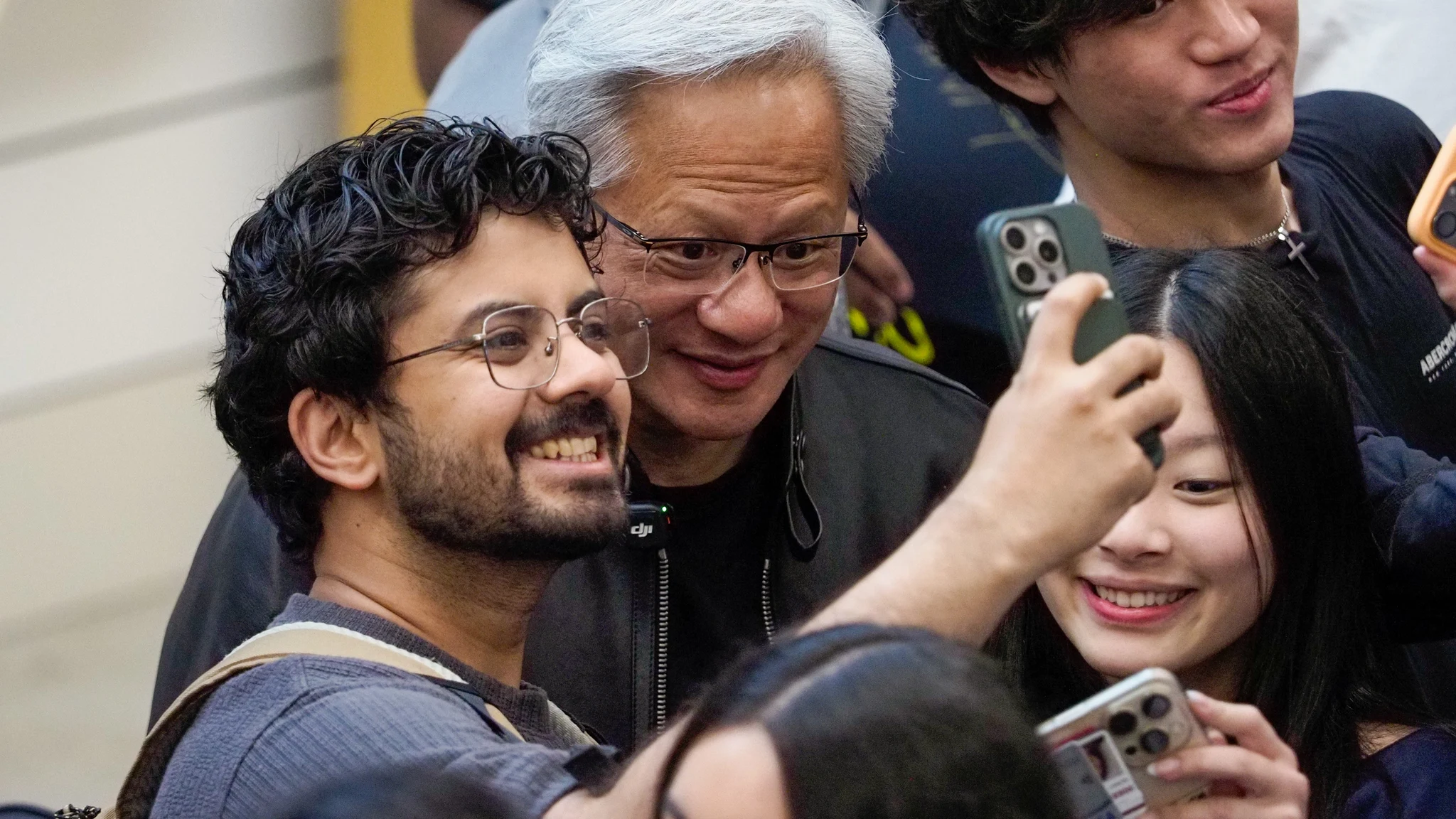
- Cover photo: Jensen Huang with students at Stanford, 30 April 2026 — Anderseidesvik, CC BY-SA 4.0 (Wikimedia Commons)