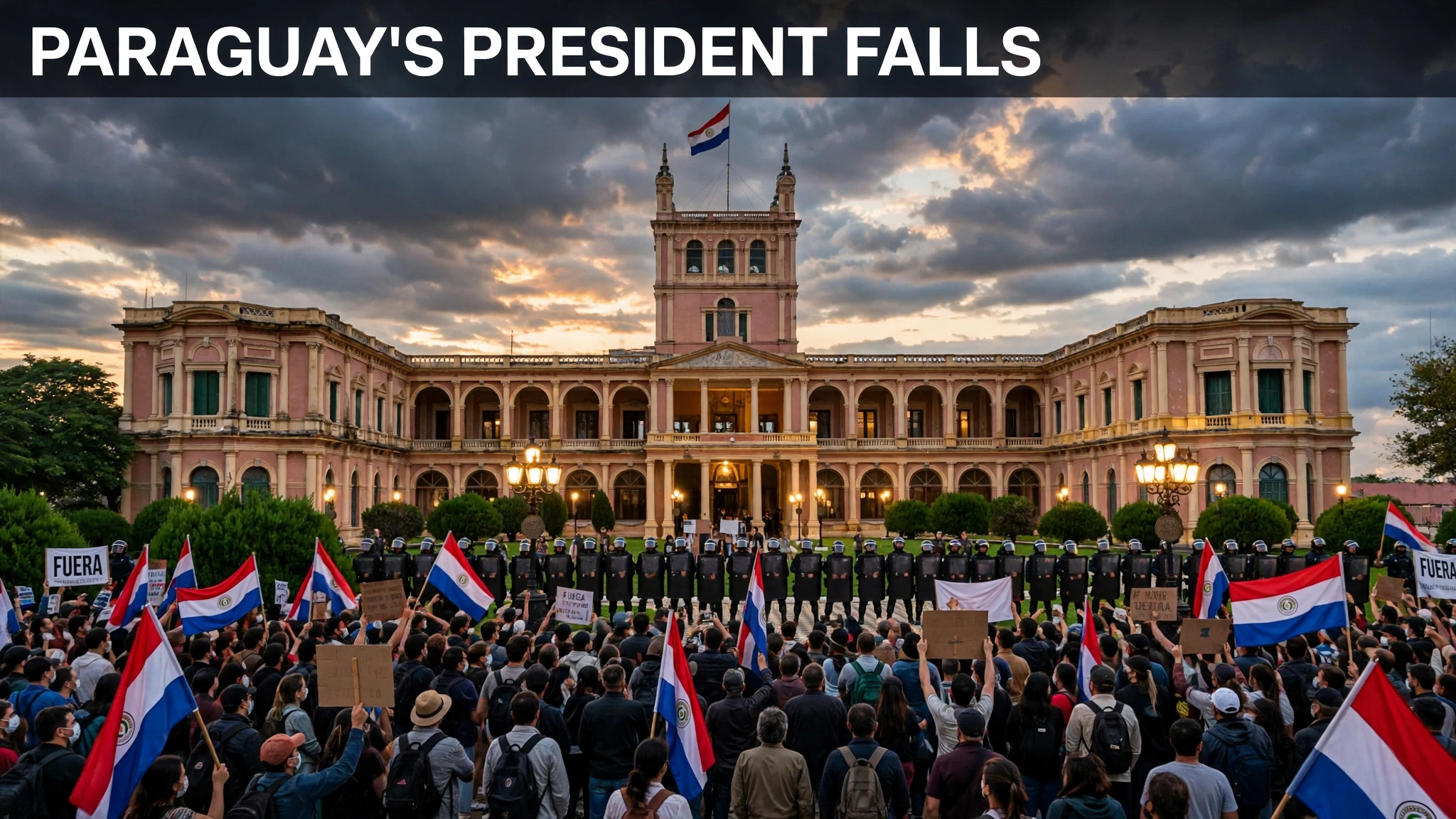
A Bank Collapse Brings Down a President: Paraguay's Santiago Peña Impeached and Under House Arrest
Paraguay's Senate voted on Friday to remove President Santiago Peña from office and place him under house arrest, ending a presidency that collapsed in a matter of days under the weight of a banking scandal that froze the savings of nearly half the country. The vote, 44 in favour with one senator not voting, came after the lower house had voted 78-0 the day before to impeach him over the failure of Ueno Bank, a digital lender with links to his private business interests. Within the hour, police were at Peña's home in Asunción, and his vice-president, Pedro Alliana, was sworn in as the country's 53rd president, to serve until the term ends in August 2028.
The speed of the fall was extraordinary. Peña, a 47-year-old former International Monetary Fund economist who had been welcomed in Washington only weeks ago as a key ally of the Trump administration, offered his resignation on Thursday in a video posted on X, saying he was stepping down for "the stability of our country, social peace and the need to preserve our democratic institutions." Congress refused to accept it. Opposition senators argued that allowing him to resign would preserve his eligibility to become a senator for life, with legal protections that could shield him from prosecution, and instead pressed ahead with a one-day impeachment trial that found him guilty of poor performance in his duties. Prosecutors then ordered his house arrest on suspicion of breach of trust, with further charges, including influence peddling and misappropriation of funds, still being decided. He is due to appear before prosecutors on Saturday morning.
At the centre of the crisis is Ueno Bank, a digital lender that exploded from an obscure finance company into a household name in less than five years, claiming more than 60 percent of Paraguay's adults — around three million people — as customers. Soon after winning its banking licence in 2023, Ueno seemed to be everywhere: it lured customers with generous cash-back offers on groceries, grew to more than 70 branches, sponsored the national football team and plastered its name on the country's main stadium. Government money poured in under Peña, who appointed Carlos Carvallo, the president of Ueno's predecessor company, to run the central bank — the very agency charged with supervising the lender. As of last month, Ueno held roughly $800 million in public deposits, about a quarter of its total, including money from the state pension and health funds and the operators of Paraguay's giant hydroelectric dams.
But worries had been escalating inside the central bank for months. In June, its inspectors found a pattern of risky lending to companies tied to the bank's owners, beyond what the law allows and without enough collateral to cover the debts if they went bad. On Monday, regulators investigating those loans found poorly documented lending and expenses the bank had wrongly counted as assets; once the books were corrected, Ueno's capital — the cushion banks must keep to absorb losses — had fallen to less than half the legal minimum. The central bank announced the lender's seizure on Tuesday. Ueno's app, cards and transfers went dark, its branches locked their doors, and desperate depositors lined up outside while a rush to open accounts elsewhere crashed other banks' mobile apps. Under a law rushed through Congress on Wednesday, a state guarantee fund must repay stranded depositors within five business days, starting with small accounts of up to about $1,600, and insures up to about $36,000 per customer — enough, the central bank says, to cover the full balances of an estimated 97 percent of clients.
The criminal fallout is widening fast. Attorney General Emiliano Rolón Fernández has opened three criminal investigations into the crisis, examining the oversight of the bank, the handling of its failure and the placement of public funds in the lender. On Thursday, a judge ordered six Ueno executives jailed pending trial, including founder Miguel Vázquez and bank president Juan Manuel Gustale, and placed two others under house arrest; prosecutors have charged 27 bank officials and associates with breach of trust and attempted fraud. Peña, who until last year held a stake in a company linked to Ueno, has denied wrongdoing and said he will cooperate with investigators, apologising to the public "if I have failed them at any point" while insisting it was "never my intention to betray the trust they placed in me." As recently as last month, he had defended Ueno and the central bank's oversight, dismissing the concerns as a smear campaign.
The human cost is what turned a financial scandal into a political earthquake. Thousands of Paraguayans marched on Congress in Asunción on Wednesday, and the anger was raw: "Santiago Peña and the Colorado Party have stolen all our savings," said protester Luis Pineda. "We are fed up with 70 years of plunder." The Labor Ministry estimates the collapse has affected about 7,000 direct and indirect jobs at the bank and its related businesses, and Ueno employees, still in their uniforms, burned their credit cards outside the Labor Ministry demanding severance and unpaid wages. Online, the story struck a nerve far beyond Paraguay: a thread on the impeachment in r/news drew more than 19,000 upvotes and nearly 1,000 comments, while in r/Paraguay, users described salaries frozen the day after payday. For a country where only Venezuela ranks worse in South America on Transparency International's corruption perceptions index, the question now is whether the new president, Alliana — himself a Colorado Party figure — can restore trust in a banking system and a political class that millions of Paraguayans now believe failed them together.
- Associated Press — "Paraguay President Peña under investigation, faces removal from office over bank collapse"
- BBC News (via Capital FM) — "Paraguay's President Santiago Peña impeached and arrested"
- CNN (via Indian Economic Observer) — "Paraguay President Peña impeached, placed under house arrest in bank collapse scandal"