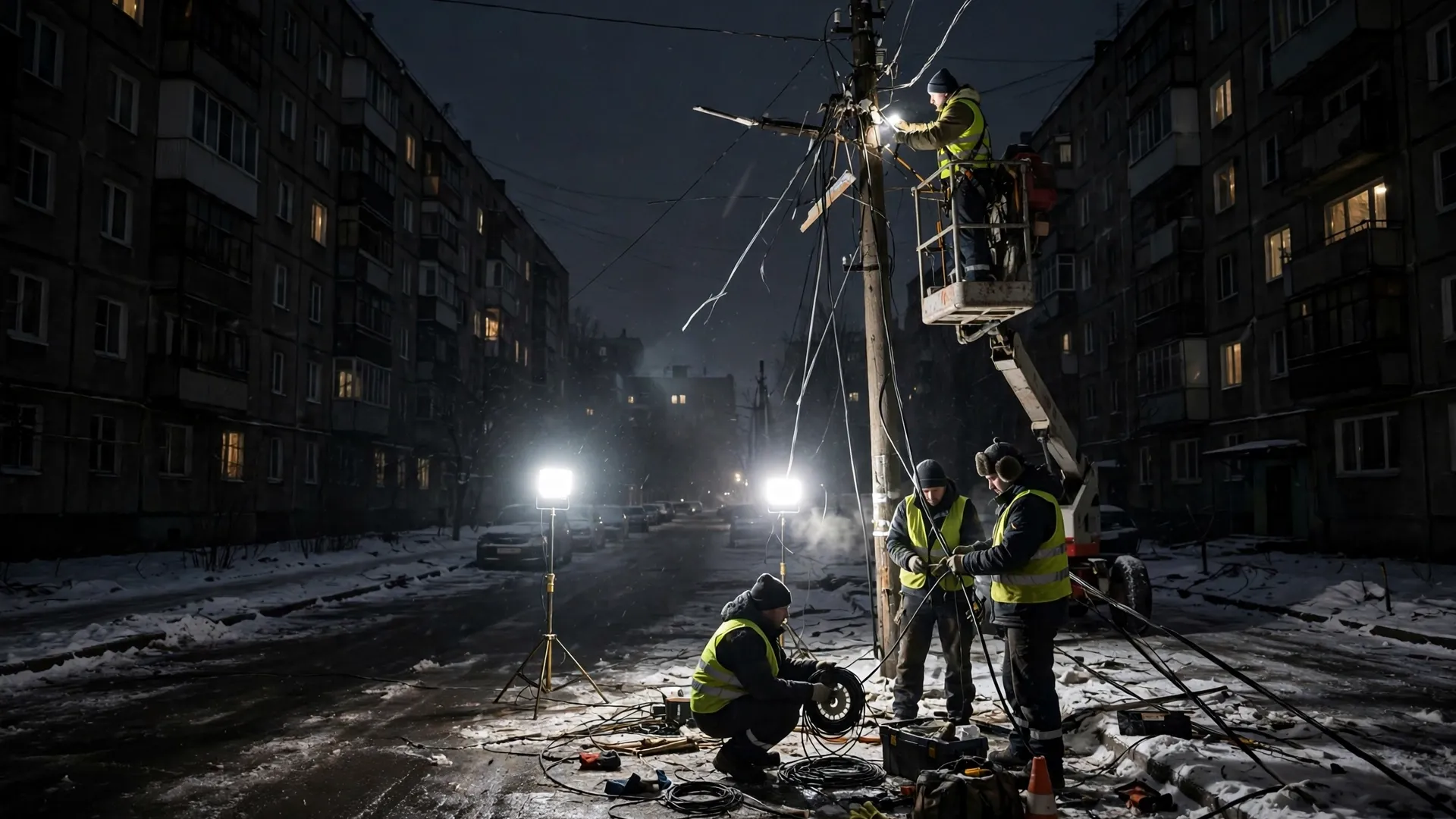
Winter Arrives on the Front Line: Russia Pounds Ukraine's Power Grid as Berlin Promises Help
Russia kept up nearly daily strikes on Ukraine's energy facilities as temperatures fell, hitting two power stations in the Kyiv and Zhytomyr regions on Wednesday, the Russian defence ministry said on Telegram, according to Reuters. The strikes, which also targeted a cargo vessel at sea near Odesa, followed Tuesday's bombardments with missiles and drones that knocked out power to swathes of Ukraine, a week before US-brokered peace talks were set to resume. Elsewhere in Ukraine, Russia hit the regions of Poltava, Dnipro, Kirovohrad and Rivne, in addition to the capital of Kyiv, Ukraine's emergency service and local officials said. On the night of 3–4 November, Russian drones damaged an energy facility in the Ternopil region, and a Russian strike on an enterprise in Dnipro injured two men, according to Ukrainian reporting summarised in the OSNT daily brief. President Volodymyr Zelenskyy said on Tuesday evening that Russian attacks that day had damaged energy facilities in Kyiv and five regions — Vinnytsia, Dnipropetrovsk, Zhytomyr, Volyn and Cherkasy — and appealed to partners to help Ukraine get through the winter.
Tuesday's barrage was one of the largest of the autumn. Ukraine's Air Force said Russia launched 289 drones, 17 ballistic missiles and 59 cruise missiles, with strikes recorded at 23 locations, according to reporting by the Kyiv Post summarised by OSNT; air defences downed 257 of the drones and 49 of the cruise missiles. Energy Minister Denys Shmyhal said Russia directed three drones at a substation critical to the stable operation of the Khmelnytskyi Nuclear Power Plant, and that Kyiv had alerted the International Atomic Energy Agency. The Kyiv Independent reported that Russian attacks across Ukraine killed 38 people and injured 158 on Tuesday, including a missile strike on hospitals in Dnipro, where a hospice was hit. A Russian drone also killed a 14-year-old in the village of Khotiv, in the Kyiv region, the head of the Kyiv regional military administration said, striking a private house that burned down completely and injuring one of the child's parents. Russia does not comment on reports of civilian casualties, and both sides deny deliberately targeting civilians in a war that began with Russia's invasion in 2022.
The toll from an earlier strike also rose. The number killed in the Russian strikes on 2 November on a school being used as a humanitarian aid distribution point in Komyshuvakha, in the Zaporizhzhia region, rose to 33, Mr Zelenskyy said, as reported by The Guardian, up from 26 in his first statements on Monday. Latvia initiated an emergency meeting of the UN Security Council over Russian attacks on Ukrainian civilians, including the Komyshuvakha strike, according to Censor.net. The figures remained provisional while recovery work continued, and Russia had not publicly commented on the strike in the reporting reviewed. The attack, on a building where residents gathered each Monday for food and supplies, and the strikes on hospitals and energy infrastructure in the days that followed, describe a war in which civilian infrastructure continues to bear the direct impact of the fighting even as diplomats prepare to meet.
It was against that background that Mr Zelenskyy made a surprise visit to Berlin on Tuesday, received with military honours at the Chancellery by Chancellor Friedrich Merz. Mr Merz promised more aid and help with energy supplies for Ukraine going into winter, Reuters reported, and said Russia risked further escalation and a global food crisis through attacks in the Black Sea. "Through its attacks in the Black Sea, Russia risks further escalation," Mr Merz said. "Russia is precipitating a global food crisis, to the detriment of the poorest nations and countries in the world." Germany is preparing an additional €200 million winter aid package, according to Politico, with €100 million from the Federal Foreign Office budget and €100 million from development funds, subject to approval by the Bundestag budget committee, which was expected to consider the application the following week. Mr Zelenskyy told reporters in Berlin that Ukraine faces a serious shortage of air defence and urgently needs additional Patriot interceptor missiles — PAC-2 and PAC-3 — and IRIS-T missiles to counter Russian ballistic missile attacks. Mr Merz said he had seen no sign that Russia was serious about negotiating a ceasefire.
Diplomacy now moves to Brussels and then to Abu Dhabi. Mr Zelenskyy said team-level negotiations involving America, NATO, Europe and Ukraine would take place in Brussels on Wednesday, 4 November, in preparation for trilateral talks between Russia, Ukraine and the United States set for 10–11 November in Abu Dhabi, as reported by Meduza and announced by US special envoy Steve Witkoff. Mr Merz invited roughly 30 to 35 states to a meeting of the so-called coalition of the willing in Berlin on 19 November to coordinate further assistance, strengthen air defence and stabilise energy supplies. The United States Air Force, meanwhile, is seeking contractors to mass-produce more than 1,000 Extended Range Attack Munition cruise missiles for Ukraine, according to Defense News. Whether any of this produces a settlement remains open: Kyiv and its European allies worry that Washington has increasingly sided with Moscow, Mr Zelenskyy has insisted any settlement must preserve a capable Ukrainian army and provide enforceable security guarantees with European partners involved, and Russia's attitude to the Abu Dhabi talks, a Kremlin aide said last month, would depend in part on whether Ukraine launched a large-scale attack on Russia's National Unity Day, observed on 4 November. For Ukrainians facing a winter of blackouts, the question is more immediate than the calendar of talks: whether the power stays on.