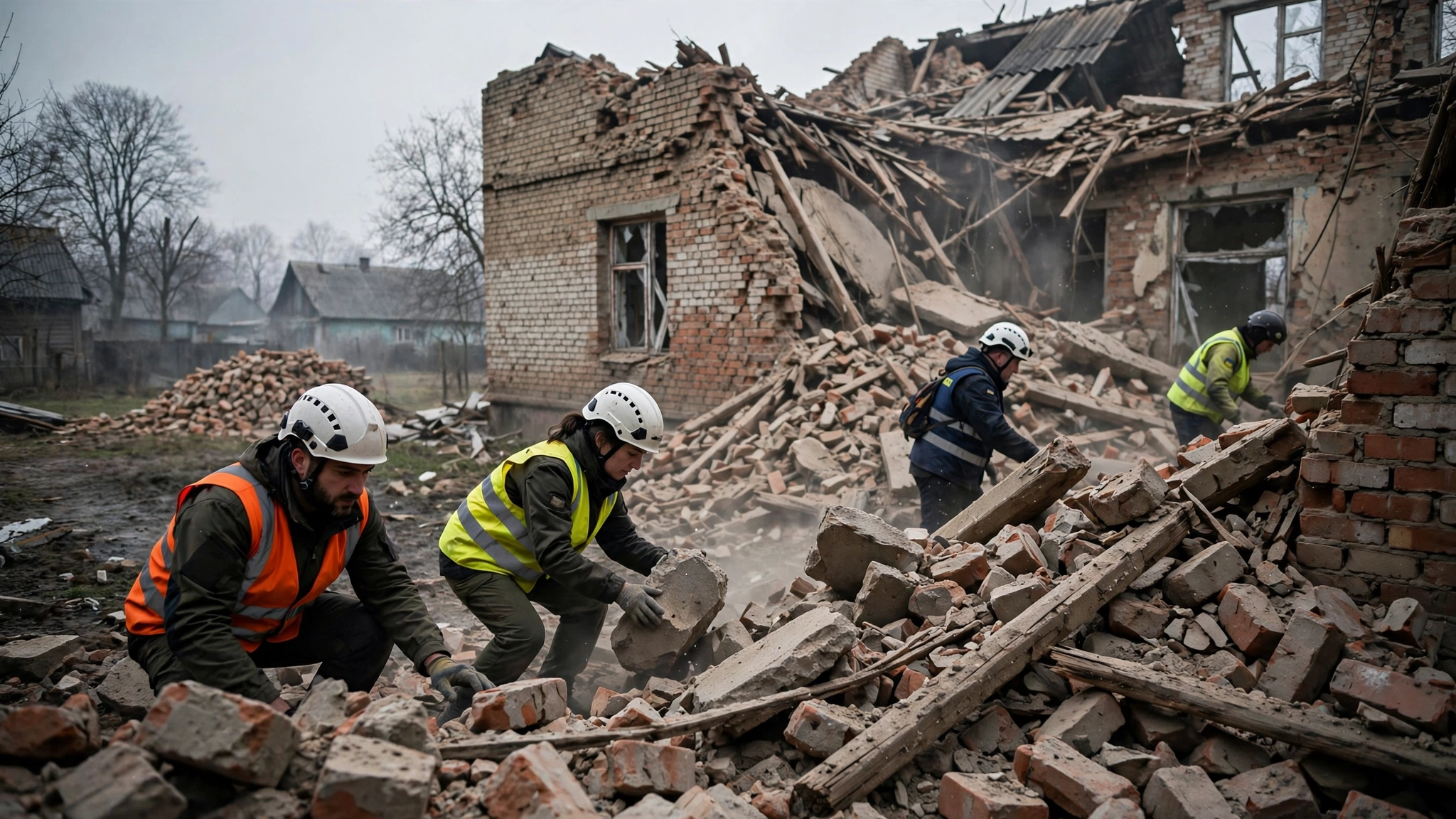
Russian Aerial Bombs Strike Ukraine Aid Site, Killing at Least 26
Russian aerial bombs struck a school being used to distribute humanitarian aid in south-eastern Ukraine on Monday, killing at least 26 people, according to Ukrainian President Volodymyr Zelenskyy and the country's emergency services. The attack hit the village of Komyshuvakha in the Zaporizhzhia region, about 35 kilometres east of the city of Zaporizhzhia and roughly a dozen kilometres from the front line, where residents had gathered for the weekly Monday distribution of food and other supplies. Five people were injured and taken to hospital, including two rescue workers. With rescue teams still searching the rubble into Monday night and dozens initially reported missing, officials warned the toll could rise further. Russia had not publicly commented on the strike in the reporting available on Monday.
The sequence described by Ukrainian officials was a strike in two waves. Mr Zelenskyy said in his nightly video address that Russian forces first dropped aerial bombs on the school, which was used as a shelter and for distributing humanitarian assistance, just as people were arriving. "Then there was a second strike — more air bombs, this time on the shelter. A vile terrorist strike," he said. Reports citing Ukrainian officials said at least nine 3,000-kilogram aerial bombs were used, with more than ten glide bombs in total. There were no classes at the school, Mr Zelenskyy said, because the village lies too close to the front line; instead, the building and the shelter inside it served the humanitarian work that residents who had remained in Komyshuvakha depended on every week. "The Russians could not have been unaware that every week, local residents who had remained in Komyshuvakha received humanitarian aid at that very location," he said, calling the attack "further proof that Russia wants no de-escalation."
Among the dead were two members of a rescue crew and four police officers, the State Emergency Service said, naming the two rescuers, both aged 44, as Denys Konovalenko and Oleksy Sushchevsky. The majority of those killed were civilians who had come for aid or responders who arrived after the first strike. As night fell, emergency workers used torches to search through collapsed buildings, according to photographs and video posted by local officials, while Regina Kharchenko, secretary of the Zaporizhzhia city council, said 27 people had been reported missing. Rescue efforts on Monday evening were hindered, according to Mykhailo Semikin, a military official in Zaporizhzhia, by fresh Russian drone attacks in the area that had been bombed. The confirmed toll itself moved during the day — from 18 in Mr Zelenskyy's first statement, to 24 confirmed by the emergency services, to 26 in his late address — a reminder that the figures remained provisional while recovery work continued.
The strike came a day after a six-day local ceasefire in the neighbouring Kherson region expired. That pause, the longest of the war, had allowed aid deliveries and evacuations around the Russian-occupied city of Oleshky, and Ukrainian officials had hoped it might lead to further humanitarian steps. Mr Zelenskyy said Moscow had instead chosen killing. "If Russia genuinely wanted de-escalation, there was an opportunity following the situation in Oleshky to continue taking humanitarian steps. We proposed this. But Russia continues to kill people," he said. The attack also followed a weekend of mutual cyberattacks on the emergency warning systems both countries' civilians rely on: late on Sunday, users of Ukraine's Air Alert app received false warnings of radiation, chemical and nuclear threats, which Kyiv attributed to Russian actors, while on Monday Mr Zelenskyy told the American broadcaster PBS that Ukraine had hacked Russia's air-raid alert system in retaliation. Neither side's false alerts described a real threat, but both episodes showed how the war is now fought through the channels that warn civilians as well as through bombs.
What happens next is framed by diplomacy that has so far produced no breakthrough. US special envoy Steve Witkoff said on Monday that US-led talks between Russia and Ukraine would resume on 10 and 11 November in Abu Dhabi, with the American delegation also including Jared Kushner, according to reporting of the announcement. President Donald Trump has pushed for a settlement to the war, now in its fifth year, but there has been no breakthrough, and Kyiv and its European allies worry that Washington has increasingly sided with Moscow. The Komyshuvakha strike was not the only attack reported as the new week began. On the night of 2–3 November, a Russian ballistic missile and guided bomb attack on Kharkiv hit a medical facility and injured at least 62 people, according to Oleh Synehubov, head of the Kharkiv regional military administration, as reported by Suspilne News in a daily war brief. That account, like the Komyshuvakha toll, comes from Ukrainian officials and has not been independently verified in the reporting reviewed, and Russia had not publicly addressed either strike. Taken together, however, the two episodes describe a war in which civilian infrastructure — an aid distribution point one day, a medical facility the next — continues to bear the direct impact of the fighting, even as diplomats prepare to meet in Abu Dhabi. For the families in Komyshuvakha and Kharkiv, the distinction between a battlefield and a place of shelter or treatment has, in practice, disappeared.
- The Guardian via EuropeSays, "Russian bombing of Ukrainian aid centre kills at least 26, Kyiv says"
- Deutsche Welle, "Ukraine: At least 26 killed in Russian strikes on aid center" (via Asha News)
- The Business Standard, "Russian attack on Ukraine aid distribution centre kills at least 26"
- Australian Associated Press, "Ukraine hacked Russian alert app in retaliation"
- AmeriLedger, "Russian Bombing of Ukraine Aid Site Kills 26, Officials Say"
- OSNT, "Russia-Ukraine War Brief, Nov 3, 2026" (Kharkiv medical facility report)
- Partner link