US Widens Iran Blockade as Burning Ships and Missile Warnings Roil the Gulf
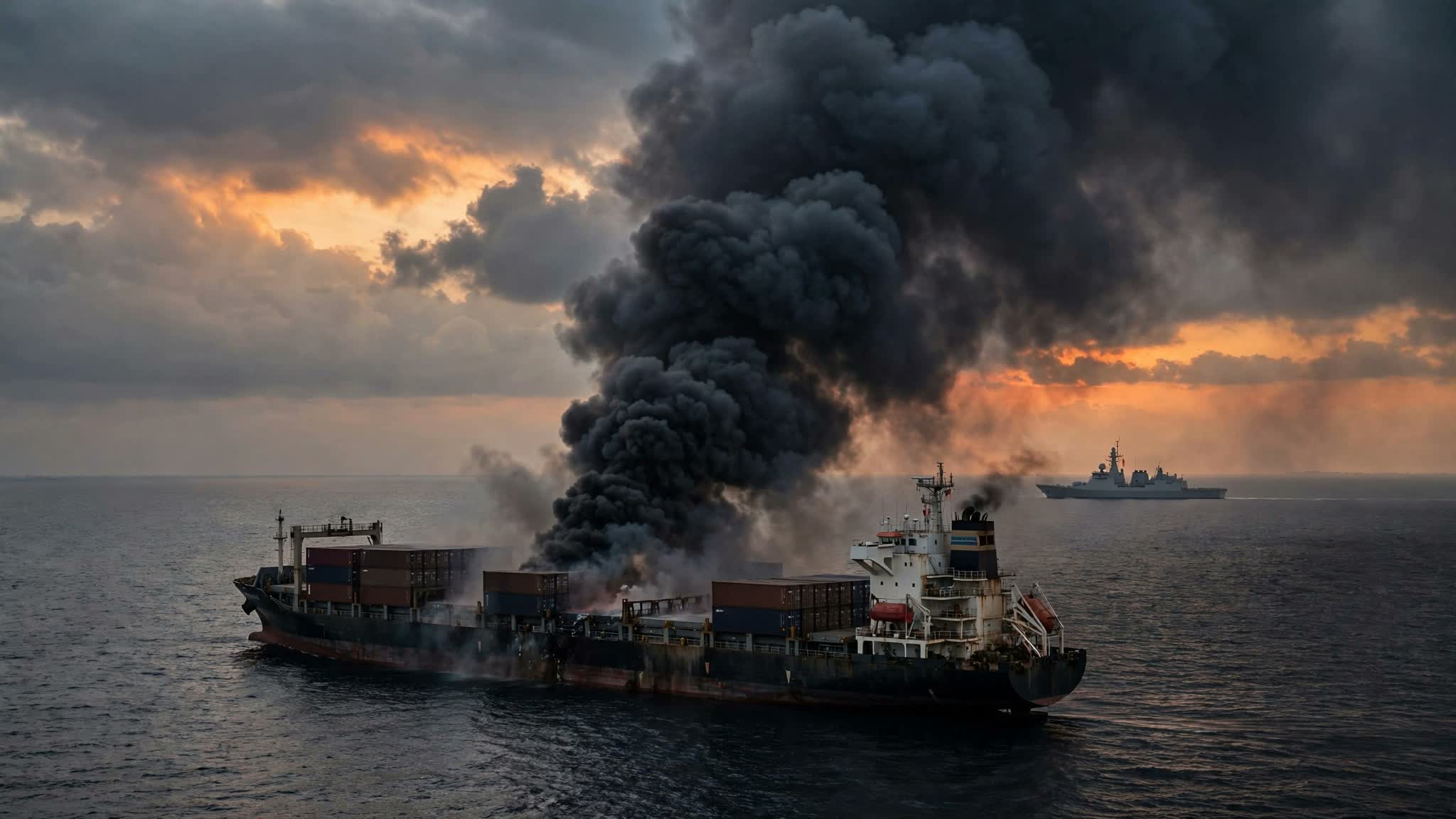
The United Arab Emirates rescued 22 crew members from a burning cargo ship in the Gulf of Oman on Sunday, in a weekend of escalating maritime incidents that has underlined how dangerous the waters around the Strait of Hormuz have become as the United States enforces its naval blockade of Iran.
The UAE National Guard said its Coast Guard division launched the rescue after the ship's crew reported a fire on board, and that all 22 crew members — all Arab nationals — were brought to safety in stable condition after receiving first aid. The Guard did not name the vessel, disclose its flag or operator, or say what caused the blaze, and there was no official indication that the fire resulted from hostile action.
The rescue came hours after the United States confirmed it had used force against a commercial vessel in the same waters. US Central Command said an American military aircraft fired precision-guided munitions at the stern of the St Kitts-flagged cargo ship M/V Huda on Saturday, disabling it after the crew allegedly ignored repeated warnings and attempted to breach Washington's naval blockade. According to Central Command, the vessel had visited an Iranian port before trying to leave regional waters. The UAE authorities did not identify the ship they rescued as the Huda, and no verified information has established any connection between the fire and the American operation.
The incidents are part of a wider pattern of disruption in the world's most important oil chokepoint. The United Kingdom Maritime Trade Operations centre separately reported an incident involving a bulk carrier and military forces about 18 nautical miles east of Khor Fakkan in the UAE on Saturday, and a delayed report of a tanker fire about eight nautical miles north-west of Khasab, Oman, on Saturday evening. Iran's Revolutionary Guard Navy claimed late on Saturday that two oil tankers had caught fire after striking naval mines in or near the Strait of Hormuz, while the United States and several Gulf Arab states have accused Iran of directly targeting vessels with missiles and drones — claims that have not been independently verified.
Washington, meanwhile, is widening the campaign. Central Command said Admiral Brad Cooper had directed the formation of Task Force Iron Gate, a team of around 20 civilian and military personnel based in Tampa, Florida, to prevent Iran from moving advanced weapons and other sanctioned materials across its land borders and the Caspian Sea. The command estimates the maritime blockade has already prevented Iran from exporting more than $25 billion worth of crude oil. Tehran, for its part, has lifted limits on its missile programme and warned that further attacks could prompt retaliation across the region.
The stakes for civilian shipping are already severe. The International Maritime Organization's incident register recorded 129 confirmed incidents across the Strait of Hormuz and the wider Middle East as of 5 November, along with 24 confirmed seafarer fatalities, and the strait has seen a series of attacks on merchant ships since the United States and Israel launched strikes on Iran on 28 February. Prediction markets remain sceptical of a diplomatic way out, pricing a US–Iran Hormuz agreement by 31 December at just 36%, according to Polymarket. With a commercial vessel disabled by American fire, two tankers reportedly burning, and a new task force extending the blockade onto land, the question now is whether the confrontation can be contained to the shipping lanes — or whether it spills further.