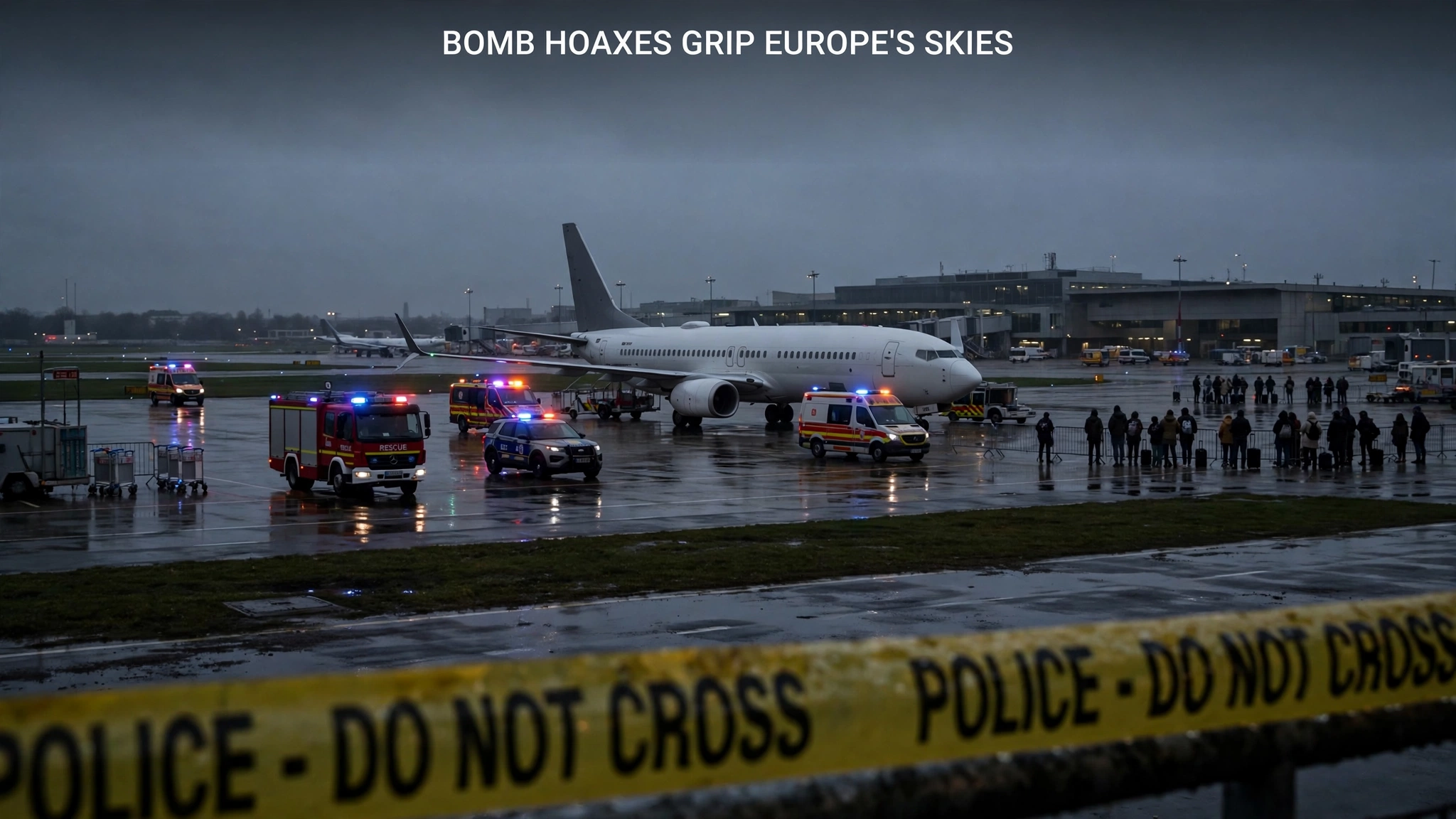
Hoax Bomb Threats Ground Europe's Skies for a Third Day: 18 More Flights Hit as Officials Warn of a Coordinated Campaign
A fresh wave of hoax bomb threats disrupted at least 18 more flights across Europe on Friday, the third day in a week of alerts that have forced emergency landings, fighter-jet escorts and airport evacuations from Dublin to Sofia — and left investigators hunting for whoever is behind what officials increasingly describe as an apparently coordinated campaign. Every affected aircraft landed safely, and searches found no explosive devices on any of them, but the disruption is growing: at least 35 flights were diverted or searched on Tuesday and Thursday alone, and more than 50 across the week.
Friday's alerts hit flights to or from nine countries — Bulgaria, Cyprus, Czechia, France, Hungary, Italy, Portugal, Romania and the United Kingdom. At least nine flights involving Prague were affected, alongside four flights over France, two heading to Sofia and a Lisbon-to-Rome service. A Wizz Air flight from Prague to Rome was diverted to Venice, where passengers were evacuated after landing, and Hungary scrambled fighter jets three times to escort civilian aircraft through its airspace. Four threatened flights over French territory landed safely at Paris Orly. The threats spread beyond aviation, too: Ireland's national broadcaster RTÉ was among the media organisations forced to evacuate, British broadcaster Sky was also targeted, and Danish police investigated a threat against Copenhagen airport, which said it was operating normally.
The scale of the week's disruption is now clear. On Thursday alone, at least 25 flights were hit across 16 countries, from Ireland and the UK to Finland, Greece and Serbia, involving airlines including Ryanair, Aer Lingus, Wizz Air, Finnair, easyJet and LOT Polish. Two Ryanair flights, from Copenhagen and Madrid, made emergency landings in Sofia; an Aer Lingus flight from Dublin to Rome was diverted to Évreux in France, where its pilot was questioned by French authorities; and a Ryanair flight from Pescara in Italy to Brussels-Charleroi was inspected after the word "bomb" was scrawled on a toilet wall. Seven planes were searched or diverted on Tuesday, and the week began on Monday with a Wizz Air flight from London Luton to Sofia diverted to Budapest. Ryanair has been the hardest-hit carrier, with eight reported cases by Thursday. For all the alarm, the disruption remains a tiny fraction of European air traffic: Eurocontrol said 26,709 flights were scheduled across the continent on Friday, meaning the affected services accounted for about 0.07 percent of them.
What makes this week different from the hoax threats airlines deal with almost daily is the pattern. The Irish government has described the wider threats as likely a coordinated campaign of disruption, and the European Union's transport commissioner, Apostolos Tzitzikostas, said 11 further threats against flights were reported on Friday alone, while cautioning that it was too early to determine whether the threats against different aircraft were linked. Aviation-security experts are due to meet in Brussels next week to discuss responses. The campaign has also raised fears of hybrid warfare — the Guardian's reporting on Thursday noted the threats alongside a separate suspected cyber-attack on supermarket freezers across Europe earlier in the week — but investigators have said there is no evidence so far that a terror group or a state such as Russia or Iran is directing the hoaxes, and inquiries are continuing.
Some clues have emerged, but none of them is conclusive. Some bomb threats emailed to airports in Rome and Sofia were signed "fighters of the Male State", a Russian far-right movement founded by Vladislav Pozdnyakov, a supporter of Russia's war in Ukraine — but the group has not commented or claimed responsibility, and it has not been confirmed whether the signatures genuinely belong to it. An email sent to 18 media outlets claimed responsibility for the alerts and warned of attacks on aircraft, cruise ships, metro stations and trains; its authenticity has not been verified. For now, the clearest fact remains the reassuring one: authorities have found no device on any aircraft they checked, and no one has been hurt.
The uncertainty is what is wearing on passengers and airlines. Each alert, however empty, forces a diversion or a search, strands hundreds of travellers, and ties up police, bomb squads and, in Hungary's case, fighter jets — a cheap way to inflict expensive chaos. Online, the reaction has mixed gallows humour with suspicion: a thread in r/europe on Ireland's assessment that the campaign looks coordinated drew hundreds of comments, many of them pointing east, while others urged caution before blaming any state. Until investigators identify who is sending the threats — and how they are choosing their targets — Europe's airlines face the prospect of more disrupted Fridays, and more passengers learning that a single email can ground a plane.
- The Guardian — "Further bomb threats disrupt at least another 18 flights across Europe" (6 November 2026, via World Right Now)
- The Guardian — "Bomb threats disrupt dozens of flights across Europe, raising hybrid war fears" (5 November 2026)
- Associated Press (via Pollar) — "Bomb threats disrupt 18 flights across Europe" (6 November 2026)
- Media Pavilion — "Bomb Threats on European Flights: What Travellers Should Know"