Iran Strikes US Base in Bahrain as Yemeni Forces Abandon the Bab el-Mandeb Strait
Iran and its allies ramped up pressure on the United States and its Gulf partners on two fronts on Sunday, with Saudi-backed forces retreating in their battle against the Iran-aligned Houthis in Yemen and Iran itself firing drones at American bases in Bahrain. In Yemen, Saudi Arabia's campaign against the Houthis suffered a major setback as its allies, fighting on behalf of the internationally recognised Yemeni government, pulled back from the Bab el-Mandeb Strait to defend their temporary capital, Aden, on the southern coast. The announcement signalled the apparent end of a six-week government counteroffensive to drive the Houthis from the mouth of the Red Sea and secure a key oil route.
The Southern Armed Forces, the main force fighting for the government in the south, announced a redeployment of its forces from Dhubab Airport and the Bab el-Mandeb area, west of Taiz governorate. Yemeni military sources said government forces around the strait had redeployed to al-Suqyah, about 150 kilometres (95 miles) west of Aden, though they were still trying to push the Houthis from coastal areas nearby. The retreat is a setback for efforts to reverse the rapid gains the Houthis made in September, when they captured the coast along the Red Sea and the strait that controls access to it. Government forces launched their campaign in October to recapture the strategic coastal areas from the militia, which had pushed south in an attempt to seize control of Yemen's entire Red Sea coast. The lightning offensive brought the Houthis within reach of Bab el-Mandeb, and the withdrawal now hands them greater leverage over one of the world's most important shipping chokepoints — the route for seaborne trade from Asia to Europe via Egypt's Suez Canal.
At the same time, the Houthis have intensified drone and missile attacks on Saudi Arabia, grounding flights with strikes on its main airports and setting global oil markets on edge by targeting energy facilities. On Sunday, the Houthis said they had attacked King Khalid International Airport, a financial centre in Riyadh and two pumping stations on the East-West oil pipeline, though there was no immediate Saudi confirmation. Riyadh has rerouted about four million barrels per day of crude through the East-West Pipeline, roughly four per cent of global oil supply, as the attacks continue. In the highlands north of Aden, Houthi fighters are positioned just outside Tur al-Bahah, around 80 kilometres from Taiz, according to Yemeni military sources, putting further pressure on the southern areas still under government control.
The second front opened in Bahrain, home to the headquarters of the US Fifth Fleet in the Gulf. Bahrain said it had intercepted and destroyed several Iranian aerial attacks, the first such interceptions by its air defences since September, after two warnings of potential threats urged residents to seek shelter. Iran's Islamic Revolutionary Guard Corps said it had attacked a US military base in Bahrain with six drones in retaliation for "hostile US actions", according to Iran's Fars news agency. The Guards said the drones targeted a US air-defence radar at the Al-Rifaa helicopter base. There was no immediate confirmation from US or Bahraini authorities that the base itself had been hit. Two days earlier, the Revolutionary Guards said they had attacked a US early-warning radar facility in Bahrain; the US military denied this, saying it had intercepted two Iranian drones without any damage.
The strikes come as the wider war between the United States, Israel and Iran, which began with joint American and Israeli attacks on Iran in February, remains deadlocked. The United States maintains a naval blockade of Iran's ports while Iran holds its grip on the Strait of Hormuz, where the Revolutionary Guards said on Sunday that two tankers were on fire after striking naval mines. President Donald Trump has said in recent days that he might hold off on attacking Iran if the US faces no new provocations from Tehran or the Iran-backed Houthis, but that he would maintain the blockade. Fresh Iranian strikes on Bahrain, headquarters of the US Fifth Fleet, are likely to put new pressure on Mr Trump to resolve a war he launched nearly nine months ago — and one his Republicans have just been routed in the midterm elections over, in part, its cost. Iran's Foreign Minister Abbas Araqchi will on Tuesday visit Oman, which holds the southern coast of the Strait of Hormuz.
What happens next will be watched in Washington, Riyadh and Aden alike. A US statement confirming or denying damage at the Bahrain base, or a US strike on Iranian territory, would show whether Tehran's claims describe real hits or rhetoric; the reporting so far carries Iran's account only. In Yemen, the question is whether the Houthis press their advantage toward Aden now that government forces have pulled back from the strait, and whether the government can hold the city. And in the Gulf, the tanker fires and the drone attacks suggest Tehran has settled on a tit-for-tat approach to American strikes — a cycle that, with oil already trading at about $96 a barrel, leaves the region one miscalculation from a wider war.
- Reuters — Anti-Houthi forces retreat in Yemen as Iran strikes Bahrain
- The Irish Times — Bahrain intercepts Iranian aerial attacks as Tehran says it attacked US base
- TradersUnion — Yemen government forces retreat from Bab el-Mandeb as Iran escalates Bahrain strikes
- Risk Terminal — Iran and Yemen's Houthis hit US and Saudi targets as Gaza strikes continue
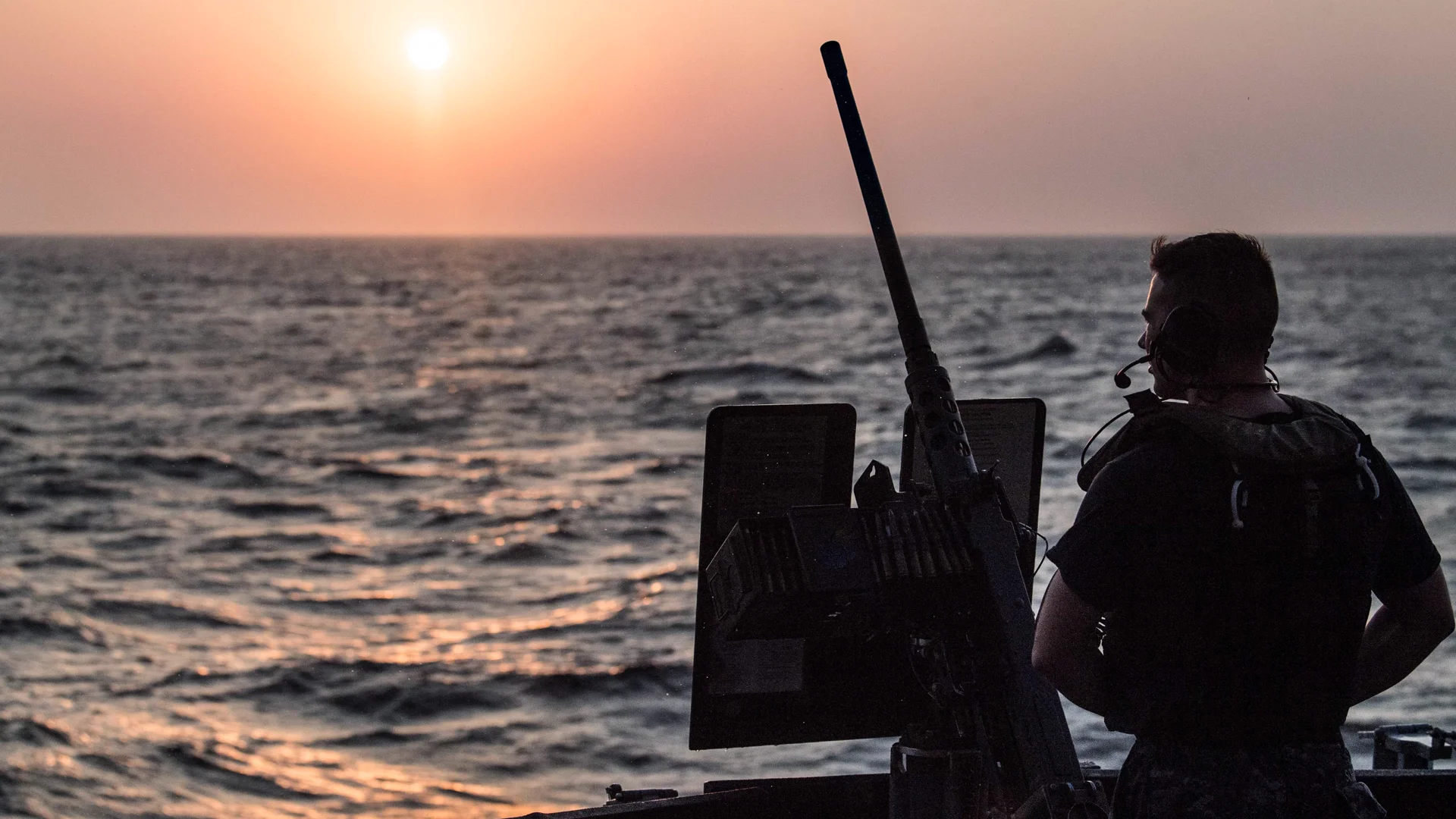
- Cover photo: A U.S. Navy destroyer on patrol in the Bab el-Mandeb Strait in October 2018 — Photo: U.S. Department of Defense / U.S. Navy / Wikimedia Commons (Public domain)