Washington Floats NATO Membership for Donbas, Zelensky Says, as Starshield Row Deepens
United States negotiators have floated the idea of Ukraine giving up its eastern Donbas region in exchange for NATO membership, President Volodymyr Zelensky has said, in the most striking disclosure yet from the American-mediated peace talks with Russia. Speaking to journalists on Friday evening after the latest round of talks in Abu Dhabi, Mr Zelensky said the question had been put to Kyiv for the first time. "The Americans raised a question: 'What if Ukraine joins NATO? Would Ukraine withdraw from Donbas?'" he said. "This was the first time this issue had been raised." The proposal, if it is on the table, would ask Kyiv to trade territory it still holds for the security guarantee it has sought since Russia's full-scale invasion in 2022 — a bargain Mr Zelensky said he could not accept on his own authority.
Mr Zelensky stressed that Ukraine was not ready to concede territory, but he set out the terms on which he would put such a proposal to the Ukrainian people. He said he would need a comprehensive package: security guarantees from NATO and the European Union, an army of adequate size with weapons and funding for a fixed period, and a recovery plan backed by money from clearly identified sources. "If the American side confirms precisely this to us, together with other NATO partners, then I will ask our Ukrainian society what it thinks," he said. "I have no right to make that decision on my own." Any deal, he added, would come "without any recognition of the occupied territories as Russian". He said he had asked for guarantees modelled on NATO's Article 5, the alliance's mutual-defence clause, "as an absolute minimum", and that American officials now spoke of something similar to Articles 4 and 5, along the lines of Washington's bilateral commitments to Israel. Asked whether American soldiers would deploy to Ukraine, he said the US side had answered "No."
The disclosure came at the end of a week of shuttle diplomacy that produced movement but no breakthrough. The US-brokered talks between Ukrainian and Russian delegations took place in Abu Dhabi on Tuesday and Wednesday, mediated by President Donald Trump's envoys — his son-in-law Jared Kushner and Middle East envoy Steve Witkoff — and marked the first talks involving both parties in months. The two envoys then met President Vladimir Putin in Moscow on Thursday. The one concrete outcome was an agreement on a prisoner exchange of 1,200 to 1,300 people on each side, which would be the largest of the war. Mr Zelensky also said the envoys had pledged to raise an energy ceasefire with Mr Putin, but there was no news of progress after their talks in Moscow.
Moscow, meanwhile, has shown no sign of softening its own demands. A Russian position paper obtained by The New York Times — an unsigned "non-paper" described by two sources involved in the talks as Russia's opening position — repeats Moscow's December 2021 ultimatums almost word for word: NATO forces out of every country that joined after 1997, no further enlargement, no Western weapons for Ukraine and no "military activity" in Ukraine, Eastern Europe, the South Caucasus or Central Asia. The Institute for the Study of War, a Washington think tank, said the American question about NATO membership amounts to an implicit rejection of Moscow's core demand. Mr Zelensky noted the contradiction himself: "That is why I believe NATO is back on the agenda. But you have also heard [Russian president Vladimir] Putin's signals, and this is an extremely difficult conversation." A US official told the BBC that "many ideas continue to be discussed but any final deal will have to be agreed to by both parties", and Mr Kushner later appeared to dampen expectations, urging confidentiality and describing the proposals as part of "private discussions" aimed at exploring new ideas.
Running alongside the diplomacy is a second, sharper dispute over the satellite system Ukraine's military depends on. Mr Zelensky escalated his criticism of SpaceX on Saturday, saying speed restrictions on its military-grade Starshield terminals had dangerous political implications and were undermining Ukraine's air defences. He said terminals operating in temporarily Russian-occupied territory had been limited to a maximum speed of 161 kilometres per hour for five days, hampering Ukraine's military capabilities, and that the Ukrainian defence ministry had raised the issue with SpaceX at the institutional level. "The restrictions have now been in place for five days. They say it is some kind of technical issue. We do not believe that is the case," he said. SpaceX has pushed back, denying that it introduced new restrictions or made any changes to its satellite operations. It is the second such disruption in recent weeks: in mid-October, Ukrainian officials said SpaceX limited the speed of Starlink and Starshield systems to about 160 kilometres per hour, before service was restored on 24 October.
In an update on Sunday morning, Mr Zelensky warned that many Russian strikes using Shahed-type drones were evading Ukraine's defences "because restrictions on the operating speed of Starshield terminals… are still there". "Our interceptor drones lose connection with their operators at a speed of 161 kilometres per hour (100 miles per hour) and simply cannot catch up with Russian jet-powered 'shaheds,'" he wrote. Online, the satellite dispute is already changing behaviour on the ground: a thread on r/worldnews reporting Ukrainian drone forces shifting to a Starlink alternative drew more than 6,700 upvotes, and an earlier thread on the October restrictions — when service was restored after high-level talks — drew more than 10,000. What happens next will be decided on two fronts at once: in the negotiating room, where the question of whether NATO membership is genuinely on offer — and what it would cost — remains unanswered, and on the battlefield, where Kyiv says the satellite limits are already costing it intercepts. For Ukraine, the test is whether a seat at the negotiating table protects it from a settlement drawn up over its head; for Washington, it is whether floating the most sensitive trade in the war — land for the alliance — moves the talks forward or simply hands Moscow a new reason to hold its ground.
- CNN — US floated idea of Ukraine swapping land for NATO membership, Zelensky says
- The Irish Times via EuropeSays — US suggested idea of Ukraine ceding Donbas for membership of Nato, says Zelenskiy
- Reuters via EuropeSays — Ukraine-Russia war peace talks: US envoys propose Donbas territory swap for NATO membership
- Transform Ukraine — Washington Floats NATO for Donbas as Moscow's Paper Revives 2021
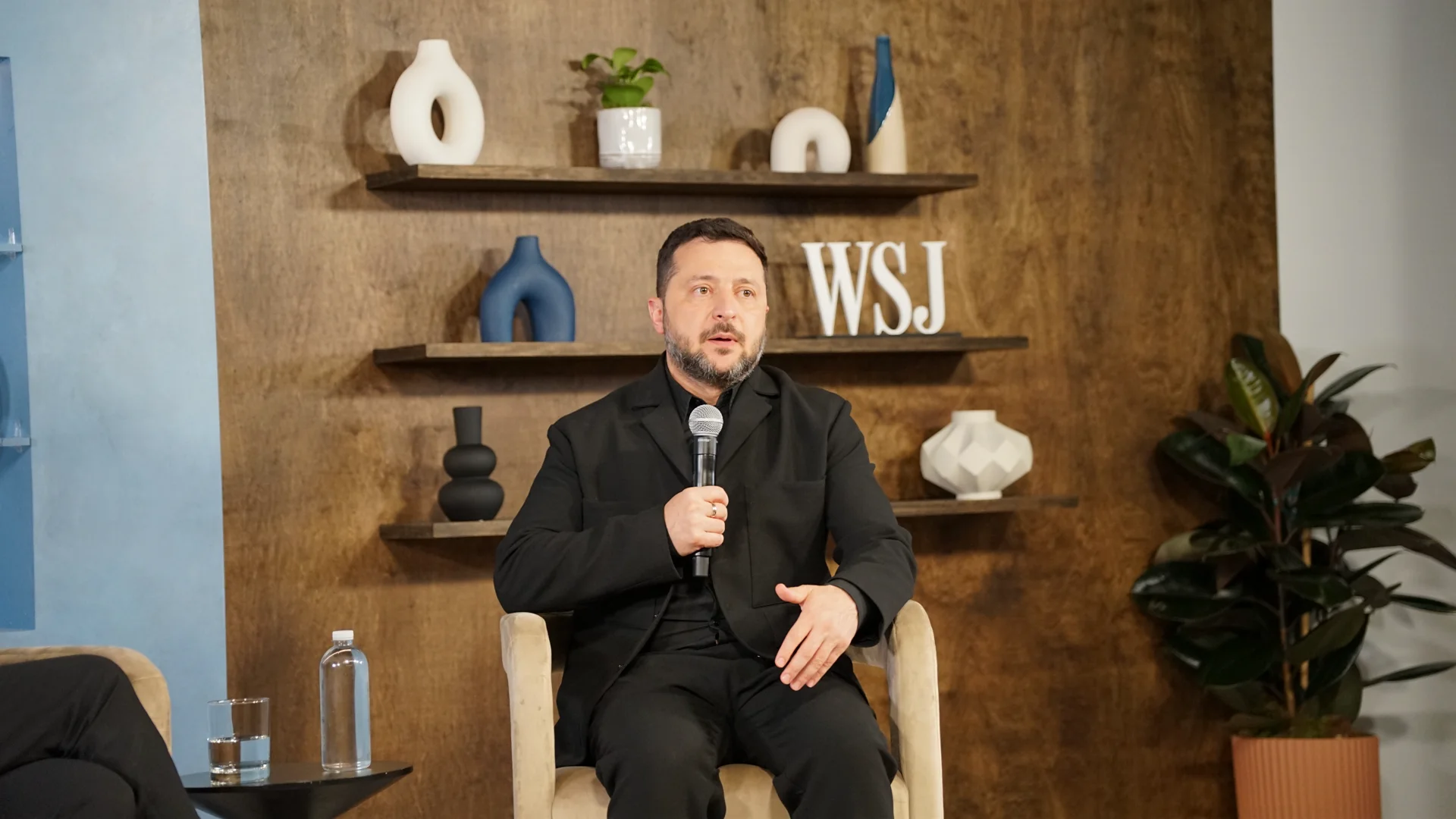
- Cover photo: Volodymyr Zelenskyy speaking during UNGA week in New York, September 2026 — Photo: Xuthoria / Wikimedia Commons (CC BY-SA 4.0)