Spain Counts 69 Dead as Investigators Ask How a Train Was Sent Towards Another
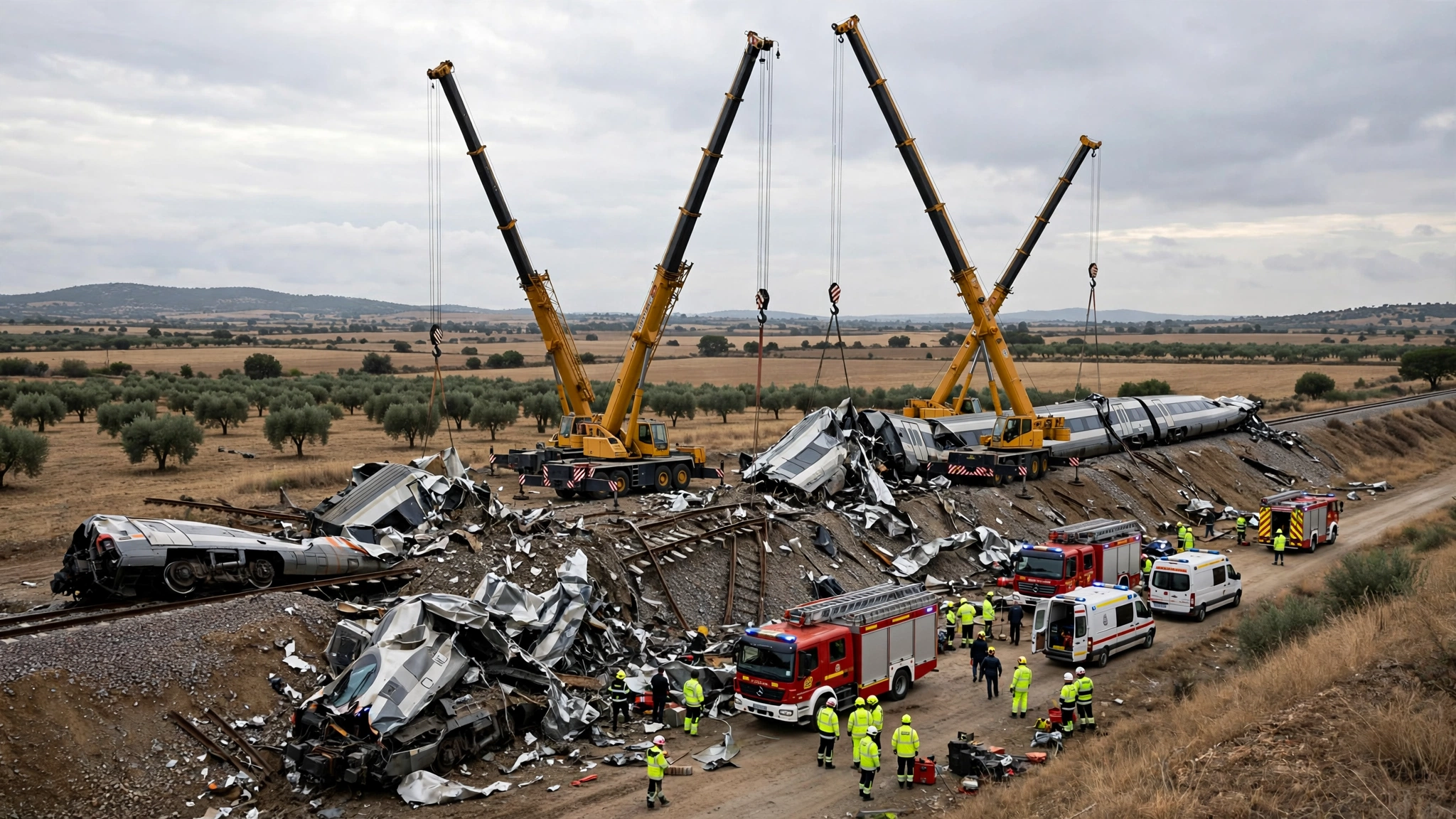
At least 69 people have died after two high-speed trains collided in Spain’s Toledo province, regional authorities said on Thursday, after one of the injured passengers died in hospital. The crash happened on Wednesday morning near Urda, on the Madrid–Seville line. It is Spain’s second major collision on the route this year. Authorities and investigators are still establishing the full account of the disaster.
Spain’s independent rail-accident investigation authority said its first technical report describes a possible chain of equipment failures, instructions and actions. It places the start of the incident at about 8:31 a.m. on Wednesday, when a communications fault took the LZB train-protection system offline across part of the line. Trains then had to operate under degraded signalling procedures. The authority stressed that the report is preliminary and does not establish the cause or responsibility.
According to the government’s account, the outage brought trains in the affected section to a halt. At 8:36 a.m., a controller authorised the Renfe train to resume under the backup system while the Iryo train remained stopped farther along the track. Transport Minister Óscar Puente has called the decision inexplicable. The preliminary report estimates the impact speed at 160 to 200 kilometres per hour, but says the precise figure depends on data from the train recorders.
Recordings reported by El País have added to questions about what the control centre knew and what instructions it gave. The newspaper says the Renfe driver was told to proceed at normal speed, while railway procedures in such conditions call for “proceeding on sight” at a speed that allows the train to stop if an obstruction appears—around 40 kilometres per hour. The recordings and the government’s account are now part of the questions investigators must assess; they are not, by themselves, a final finding.
The official death toll rose from 68 after an injured passenger died. More than 200 people were reported injured, although totals differ across updates and may change. The first technical report says investigators have not yet interviewed the drivers and control staff directly involved or analysed the onboard recorders. A judge and the independent technical authority are conducting separate inquiries, and the trains’ recorders and control-centre records are central to establishing the sequence of events.
The collision has renewed scrutiny of railway safety and staffing. Train workers held a previously planned strike on Thursday, with unions arguing that repeated safety-system failures and heavy controller workloads must be considered alongside individual decisions. In January, 46 people died in another major crash on the same Madrid–Seville corridor. Spain’s investigation now has to determine how the LZB failure was managed, why the two trains’ situations were not reconciled before movement resumed, and what safeguards are needed to prevent another collision.