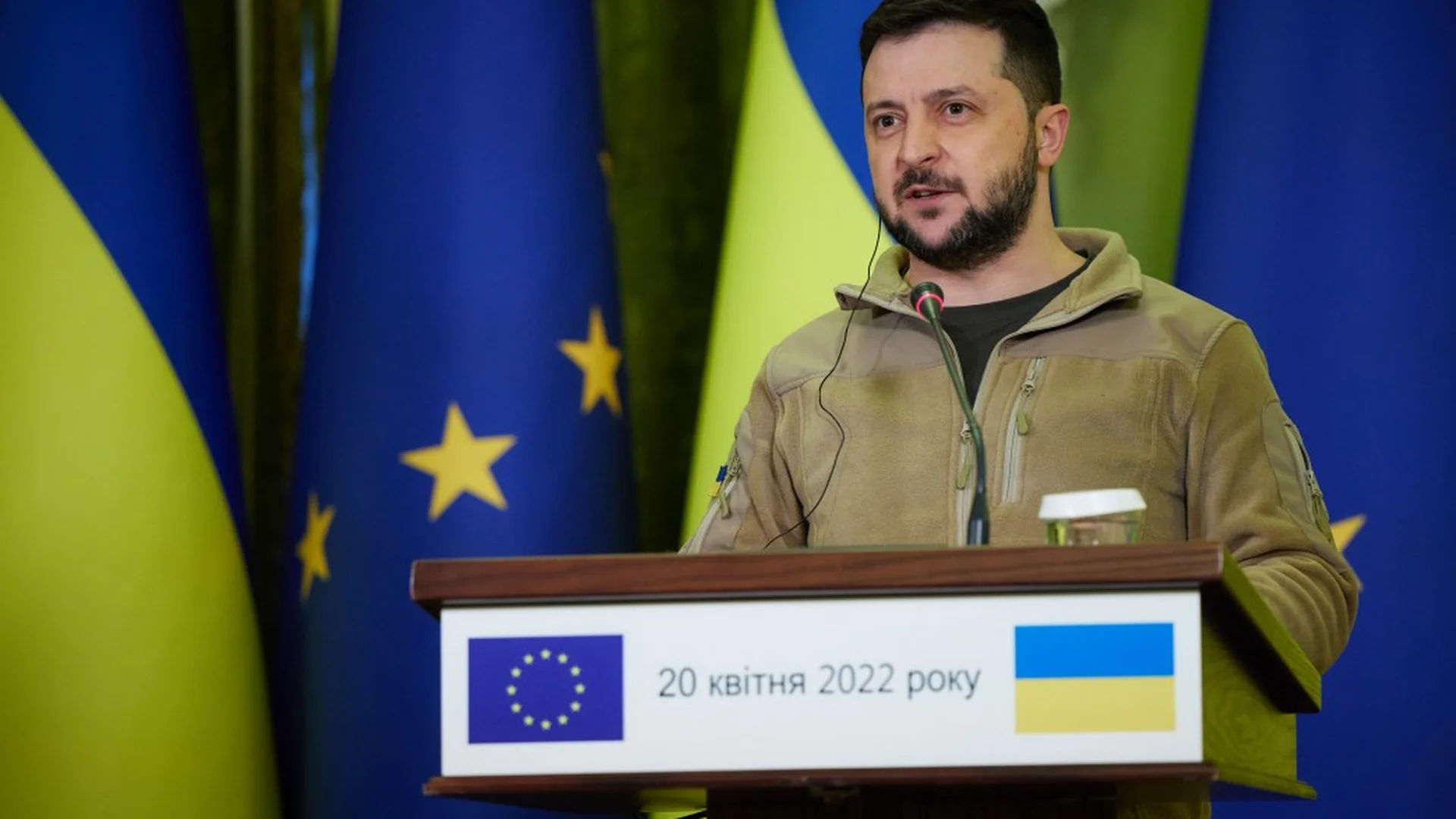
Zelenskyy Likens Trump's "Friend" Putin to Hitler as Ukraine Peace Talks Hit a Dead End
Ukraine's President Volodymyr Zelenskyy has likened Donald Trump's description of Vladimir Putin as a "friend" to calling Adolf Hitler a friend during the Second World War, in his sharpest public rebuke yet of the American president's relationship with the Russian leader, as the United States' own negotiators admit the peace talks are stuck.
In an interview with the BBC in Kyiv on Thursday, Mr Zelenskyy said it was up to Mr Trump what he said or posted, but called it "strange" to call Mr Putin a friend. "He's an aggressor … and a killer. He can't be a friend," he said, speaking in English. "It's the same that somebody say about Hitler during the Second World War that he's a good friend. No, he's not a friend." He added that Mr Putin had "brought fascism into the 21st century", acknowledged that his own experience of the war might shape his reaction, and questioned why the personal relationship needed to be discussed in public at all. "We also rely on our relationships and on our allies," he said. "But how can we look at a murderer when the United States says, 'He is a friend, a good friend'? No. He is not a friend."
Mr Zelenskyy's remarks were a response to the scenes at the trilateral summit in Shenzhen on 19 November, where Mr Trump greeted Mr Putin as "my friend" and embraced him before the two walked into a meeting with the Chinese president, Xi Jinping. Days later Mr Trump posted a photograph of himself shaking Mr Putin's hand on his Truth Social platform, captioned "My Friend", and added a split-screen post titled "The Great Powers 1945, 2026", comparing the Shenzhen summit with the 1945 Yalta Conference. In the same interview, Mr Zelenskyy urged Washington to take a more forceful position towards Moscow, arguing that the United States should use its influence to pressure Russia rather than present itself as an impartial mediator. "We need signals from a real, helpful ally who can put pressure on Russia," he said. "The United States cannot simply be a mediator — neutral — because when you try to be very neutral towards an aggressor, you are automatically not neutral." He also said Washington was too focused on the Middle East, that delays in delivering anti-ballistic missile systems were costing Ukrainian lives, and that the American-backed talks needed "more progress".
Mr Trump, for his part, used a meeting with the NATO Secretary General, Mark Rutte, at Mar-a-Lago on Thursday to press Mr Putin publicly to end the war. "I have spent a lot of time talking about the fact that I would like to see President Putin end any military aggression against territories in all of Europe," he wrote on Truth Social, calling the war a "complete bloodbath" in which thousands are killed each month and saying he believed a rapid deal between Russia and Ukraine was "very possible". Mr Trump and Mr Rutte released a joint statement warning Russia against "intentional or unintentional" actions that could widen the war to other countries, although Mr Trump later altered the text on Truth Social to add that Ukraine must also avoid any actions expanding the conflict, a change Politico reported was made without consulting Mr Rutte. Asked about the obstacles to peace, Mr Trump told reporters the core problem was personal: "The biggest problem for this agreement is the fact that you have two leaders who really hate each other."
Behind the public exchanges, the negotiations themselves are going nowhere. Mr Trump's son-in-law and chief negotiator, Jared Kushner, said after "many, many hours" of talks with Mr Putin that the territorial question was "stuck in a bit of a dead end", and suggested negotiating the post-war security architecture before addressing any Ukrainian territorial concessions. Mr Kushner rejected criticism that Washington was pressuring Kyiv, saying the United States had not pressured Mr Zelenskyy and remained Ukraine's largest financial backer while acting as mediator. Russia's chief negotiator, Vladimir Medinsky, doubled down after trilateral security talks in Abu Dhabi between Ukrainian, Russian and American representatives, affirming that Moscow would capture all the Ukrainian land it claims. Russian diplomats also raised the possibility of bilateral non-aggression treaties with selected NATO members, and Moscow has demanded that NATO roll its forces back to pre-1997 borders — a demand Mr Rutte has explicitly rejected. European leaders meeting in Berlin insisted they must be involved in any deal, and Mr Trump called in from Air Force One to tell them Moscow was serious about peace.
Mr Zelenskyy also used the interview to confirm that the strike that sank the Russian warship in the Libyan port of Benghazi on 22 November was not coordinated with Ukraine's partners, and to defend it — a disclosure that drew 2,338 upvotes on Reddit's r/worldnews, where commenters noted that a partner like the United States might have warned Moscow. A separate thread on the American envoys' trips to Moscow and Kyiv drew 1,786 upvotes on r/ukraine, with the top comments contrasting the red-carpet welcome for Mr Putin with the Oval Office dressing-down of Mr Zelenskyy. With the territorial question deadlocked, Russia demanding a NATO rollback, and Kyiv openly questioning whether Washington is a mediator or an ally, the peace process now faces its hardest test since the Shenzhen summit raised hopes of a deal. The question is whether Mr Trump's belief that a rapid agreement is "very possible" can survive a negotiation in which neither side will move on the land at its centre.
- Reuters via WTBX — Ukraine's Zelenskiy compares Trump's friendship with Putin to friendship with Hitler
- The Gaze — 'Like Calling Hitler a Friend': Zelenskyy Rebukes Trump Over His Relationship With Putin
- Political.org — Zelensky Compares Trump's 'Friend' Label for Putin to Calling Hitler a Friend in World War II
- World Today Journal — Trump Urges Putin to End Military Aggression After Mar-a-Lago Meeting With Rutte
- Nexus Europa — Russian negotiator doubles down on territorial demands despite Abu Dhabi talks
- Reddit r/ukraine — Trump envoys' trips to Russia and Ukraine
- Reddit r/worldnews — Zelenskyy confirms that attack on Russian ship in Libya was not coordinated with Ukraine's partners
- Cover photo: President Volodymyr Zelenskyy in Kyiv during the Russo-Ukrainian War, 20 April 2022 — Photo: The Presidential Office of Ukraine / Wikimedia Commons (CC BY 4.0)