America Disables a Ship Running Its Iran Blockade as Tehran Vows to Break the Embargo "From Air and Sea"
The United States military has disabled a commercial ship that tried to run its naval blockade of Iran, firing on the vessel in the Gulf of Oman, as Tehran vowed to break the American embargo by force and Kuwait summoned Iran's ambassador over a drone attack that killed two Italian technicians earlier in the week.
United States Central Command said on Friday that a military aircraft had launched precision munitions that struck the stern of the Palau-flagged bulk carrier M/V Pacific Archer on Thursday, after the ship left the Iranian port of Bandar Abbas and tried to evade the blockade despite repeated warnings from the United States Navy. The strike disabled the ship's propulsion, Central Command said, while its civilian crew was unharmed. The command said its forces had now redirected 158 commercial vessels and disabled six that refused to comply with the blockade, which Washington reimposed on Iranian ports in July and tightened this month with a new Task Force Iron Gate to restrict the movement of weapons and sanctioned materials across Iran's land borders and the Caspian Sea.
Tehran's response was defiant. Mohammad Mokhber, an adviser to Iran's Supreme Leader, Ayatollah Mojtaba Khamenei, said on Friday that Iran would neither reopen the Strait of Hormuz nor allow the blockade to stand. "Neither will the Strait of Hormuz be reopened, nor will we allow the blockade to remain in place," Iranian state media reported him as saying. The commander of the Revolutionary Guards' Aerospace Force, Majid Mousavi, warned that Iran's enemies should expect military action "from the air and sea", declaring that breaking the blockade was a firm mission and an unwavering determination. The Iranian navy commander, Shahram Irani, said operations to break the blockade were already under way, that the Supreme Leader had lifted geographical restrictions on Iranian military operations, and that American forces would be driven back to the Bay of Pigs in Cuba, "where they belong". Iran's deputy foreign minister had already declared the blockade an "act of war" last weekend.
The confrontation comes days after the drone attack in Kuwait that killed two Italian technicians working for the German defence group Rheinmetall at an air-defence surveillance station. Kuwait summoned Iran's ambassador on Friday and delivered a formal protest note over what it said were continued Iranian attacks, including the strike that killed the two Italians and wounded Kuwaiti and Pakistani nationals. The United Nations Secretary-General, António Guterres, condemned the attack and called on all parties to exercise restraint. Tehran has denied any role in the Kuwait attack, with Foreign Minister Abbas Araghchi calling it "suspicious" and a "precooked recipe for war", and offering a joint investigation with Kuwait and Italy. But analysts at the Institute for the Study of War noted that the attack was consistent with recent Iranian strikes on American and regional air-defence capabilities, and that Iran had repeatedly targeted air-defence systems in Bahrain and Kuwait in recent weeks, apparently to weaken the ability to detect and intercept Iranian projectiles.
The blockade is now the central front of a war that began in February, when the United States and Israel launched strikes on Iran and Tehran answered by closing the Strait of Hormuz, the waterway through which a large share of the world's oil is shipped. In his Thanksgiving calls to American troops on Thursday, President Donald Trump said the United States had "victory at hand" in the war and had launched 150 missiles to stop Iranian missiles and drones hitting commercial ships in the strait. Mr Trump also played down reports that Russia and China had been sharing intelligence with Iran to help it target American bases, saying the issue had been discussed at his recent trilateral meeting with the Chinese and Russian presidents. For now, neither side shows any sign of stepping back: Washington says it will strictly enforce the blockade, and Tehran says it will break it.
The markets, for what they are worth, expect the standoff to drag on. On Polymarket, traders put the chance of a final United States–Iran nuclear deal by 3 December at just 4.2 per cent. On Reddit, a thread putting the cost of the war with Iran at $48.3 billion drew nearly 5,000 upvotes, a measure of how closely the public is watching a conflict that has now run for nearly nine months. What happens next may depend on whether Iran's threats to act "from the air and sea" turn into another strike — and on whether the next ship that tests the blockade is met with the same response as the Pacific Archer.
- Reuters — US disables ship trying to leave Iran, as Tehran vows to confront blockade
- Breitbart — U.S. Disables Ship Attempting to Breach Iran Blockade — Tehran Threatens Military Action from 'Air and Sea'
- TBS News — US disables ship in Gulf of Oman under Iran blockade
- The News — US disables ship as Iran vows to confront blockade
- Critical Threats / ISW — Iran Update, November 27, 2026
- Polymarket — US-Iran Final Nuclear Deal by…?
- Reddit r/worldnews — Cost of US war with Iran reaches $48.3 billion
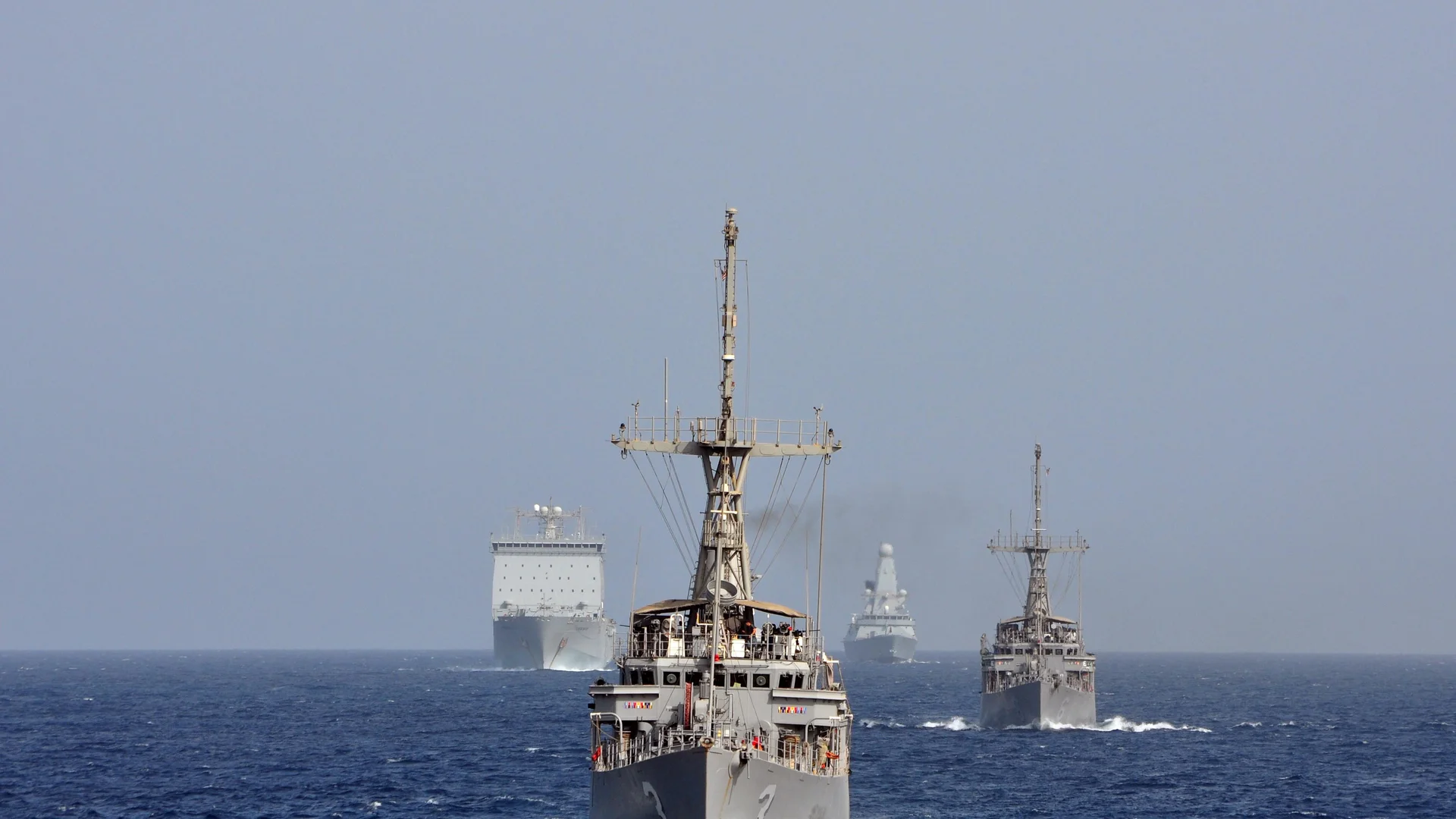
- Cover photo: The mine countermeasures ship USS Sentry (centre), with RFA Cardigan Bay and HMS Diamond, transits the Gulf of Oman, 20 September 2012 — Photo: U.S. Navy / Wikimedia Commons (Public domain)