Europe Picks Spain's Pablo Hernández de Cos to Steer the Central Bank Through Stormy Waters
European leaders have chosen Spain's Pablo Hernández de Cos to be the next president of the European Central Bank, handing a career technocrat the most powerful job in European monetary policy at a moment when the eurozone faces high government debt, flagging growth and inflation stoked by war in the Middle East.
The leaders of the 21 eurozone countries agreed on Thursday to recommend Mr Hernández de Cos, the European Council President, António Costa, announced on X, adding that the decision "will pave the way for the formal appointment of the new ECB leadership in December". The nomination must still be endorsed by the European Parliament and the ECB's governing council, with a final seal of approval by EU leaders expected at their December summit, but those steps are regarded as formalities. Mr Hernández de Cos, 55, will succeed Christine Lagarde when she steps down on 7 February, nine months before the end of her term, becoming the first Spaniard to lead one of the world's most influential central banks. He is expected to chair his first policy meeting on 18 March.
Mr Hernández de Cos is little known outside central banking circles, but his record is formidable. A career central banker who began as an economist at Spain's central bank and rose to become its governor from 2018 to 2024, he has served as general manager of the Bank for International Settlements, the Basel-based forum for the world's major central banks, since July 2025, and chaired the Basel Committee on Banking Supervision before that. He won out over the only other contender, the former Dutch central bank chief Klaas Knot, a noted hawk who favours higher rates to ward off inflation, after the Netherlands decided on Thursday to back him. French President Emmanuel Macron said a "consensus emerged" among eurozone member states and welcomed a "balanced trio" for the euro area, while Spain's Prime Minister, Pedro Sánchez, welcomed the selection of a Spaniard for the post.
The appointment was part of a three-way deal that fills the ECB's most influential seats. Laurence Boone of France is set to take charge of the bank's markets portfolio on 4 January, succeeding Isabel Schnabel of Germany, and the German economist Markus Brunnermeier will become chief economist on 1 June, replacing Philip Lane of Ireland. The three are all well-known economists with decades-long careers in central banking, and the package was carefully balanced between the bloc's biggest economies: Spain takes the presidency, France the markets role and Germany the chief economist's chair. Markets took the news calmly, with the euro staying modestly higher against the dollar, and analysts described the choice as signalling policy continuity at Europe's most powerful financial institution.
Yet Mr Hernández de Cos steps into the role at a difficult hour. The eurozone faces another potential crisis, with France's public debt and borrowing costs a standing worry, growth flagging, and inflation driven in part by the war in Iran. He will take over two months before France begins voting to choose a successor to Mr Macron, whose departure will reshape the politics around him. Le Monde noted that Mr Hernández de Cos, often described as a dove, is "not such a dove after all", and Reuters called him a crisis veteran, pointing to his years steering Spain's central bank through the pandemic and the post-2021 inflation surge.
Traders, meanwhile, have already made up their minds about the outcome: on Polymarket, the market asking who will be the next ECB president put Mr Hernández de Cos at 98 per cent, up 1.7 per cent on the day. The question now is not whether he gets the job, but whether a technocrat known for caution can hold the eurozone steady through the storms ahead.
- Reuters — Euro countries pick Spain's De Cos as ECB chief, Costa says
- Reuters — ECB turns to crisis veteran De Cos as new strains loom
- CNN — European Central Bank set to appoint its first Spanish leader
- Le Monde — ECB: the new trio tasked with protecting Europe from inflation
- Polymarket — Next ECB President?
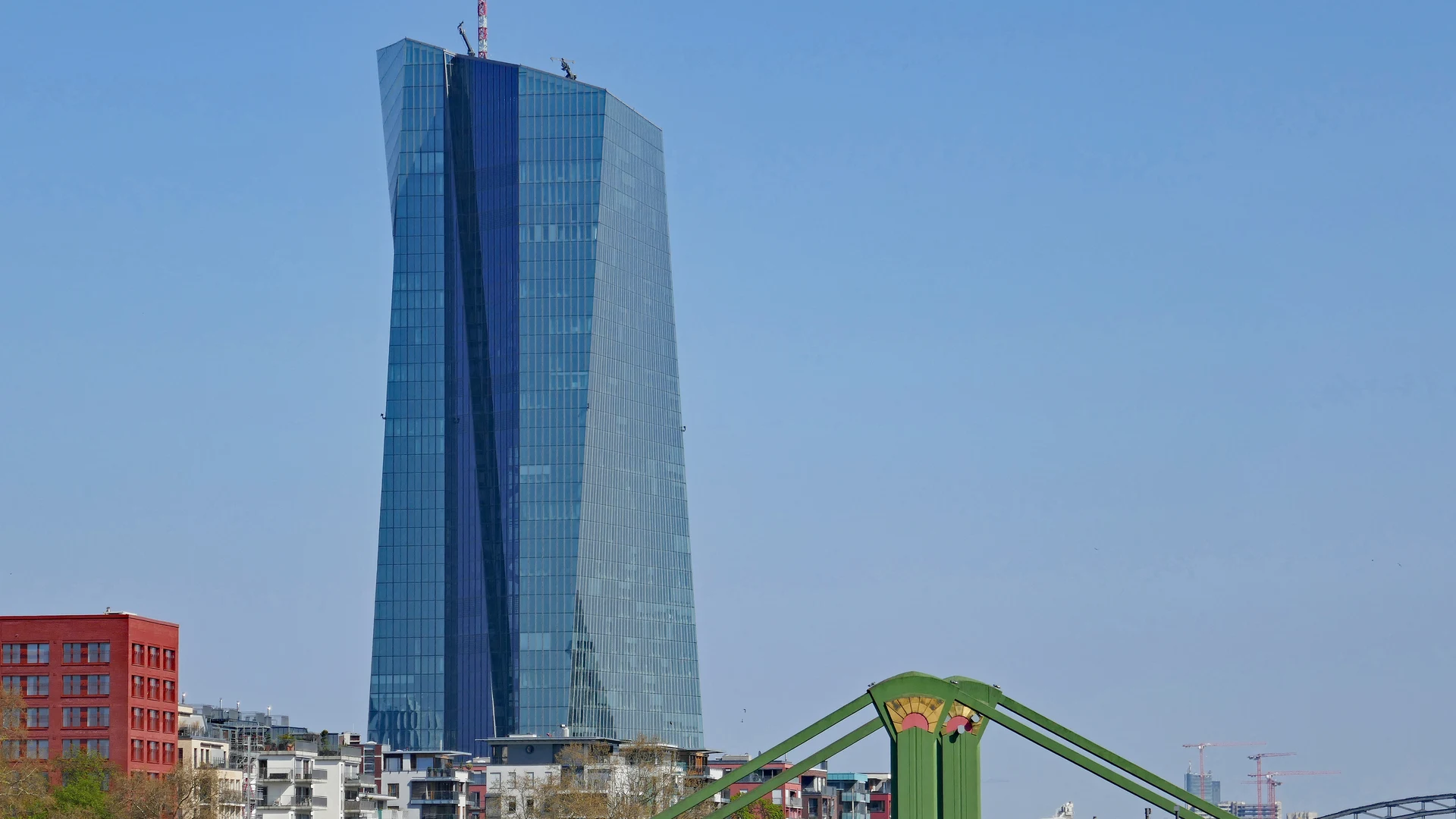
- Cover photo: The European Central Bank tower in Frankfurt, seen from the Flößerbrücke bridge — Photo: Hartmut Schmidt Heidelberg / Wikimedia Commons (CC BY-SA 4.0)