Wall Street's AI Sell-Off Deepens Before Thanksgiving as Nvidia Slides and Fear Spikes
Wall Street endured another bruising session on Wednesday as the sell-off in artificial intelligence stocks spread across the market in the last trading day before Thanksgiving. The tech-heavy Nasdaq Composite fell as much as 4.7 per cent in morning trading, the S&P 500 dropped more than 3 per cent and the Dow Jones Industrial Average lost 1,100 points, before dip-buyers stepped in and each index clawed back most of its losses. By the close the Nasdaq was down 0.6 per cent and the S&P 500 down 0.3 per cent, while the Dow finished 0.3 per cent higher. The Cboe Volatility Index, Wall Street's fear gauge, surged as high as 35 in the morning — a level that signals severe market stress — before settling around 28, still up 7 per cent on the day. It touched 40 during last Friday's sell-off. Markets will be closed on Thursday for Thanksgiving and will trade a shortened session on Friday.
Nvidia, the chipmaker at the centre of the global AI buildout, was again the focus of the selling. Its shares fell 4 per cent on the day after dropping as much as 8.7 per cent in morning trading, and have now fallen for two consecutive sessions after soaring more than 30 per cent on Monday, when its board reinstated Jensen Huang as chief executive. Advanced Micro Devices fell as much as 9.6 per cent during the session, and other chipmakers including Micron, Broadcom and Lam Research also fell sharply. The selling carried a new sting on Wednesday: S&P Global Ratings put Nvidia's senior unsecured debt on CreditWatch with negative implications, questioning the "effectiveness" of the company's management and governance, citing board independence and "key man" risk. Moody's took a similar step last week, lowering Nvidia's credit-rating outlook from positive to stable. Investors are also braced for more volatility next week, when Mr Huang is due to appear before congressional committees over his affair with a woman alleged to be a Chinese spy.
Beneath the daily swings lies a deeper doubt that has gripped Wall Street all month: whether the debt-fuelled boom in AI spending will ever produce adequate returns. Liz Ann Sonders, chief investment strategist at Schwab, told CNBC that the AI selloff "predated the news about Huang and Nvidia", pointing instead to worries about capital expenditure, the data-centre build-out and the gap between the cost of capital and the return on invested capital. Anthropic, the AI laboratory that last week completed the biggest initial public offering of all time, has become the symbol of that anxiety: its shares closed below their $83 IPO price on Tuesday, fell as low as $74 on Wednesday morning, and recovered to finish 1.1 per cent higher on the day — still below the price at which it listed. The Wall Street Journal has described the rout as a $4 trillion AI wipeout. On Reddit's r/wallstreetbets, a thread reporting that Nvidia chip sellers were seeking new buyers after Washington tightened rules curbing Chinese companies' remote access to advanced AI systems drew hundreds of upvotes and comments.
Other forces piled onto the selling. Hotter-than-expected inflation data and the fresh tariff threats from Washington — the administration's proposed duties on fourteen trading partners were unveiled the same morning — rattled traders already on edge. Third-quarter economic growth of 4.3 per cent, comfortably above the 3.4 per cent forecast, did little to calm nerves, since it reinforced expectations that the Federal Reserve will raise interest rates at its meeting on 9 December, taking its benchmark to 4.00–4.25 per cent. Not everything fell: defensive corners of the market rose, with HP jumping 11 per cent after strong quarterly results, IBM up 3 per cent to lead the Dow's advancers, and Dell up 0.7 per cent after beating expectations and raising its guidance. Meta rose more than 3 per cent, while gold futures climbed 0.3 per cent to $3,575, oil rose 2.5 per cent to $84.10 a barrel and Bitcoin traded at $60,300, up from an intraday low of $57,300 but still about 25 per cent below its highs for the month. The yield on the ten-year Treasury note eased to 4.87 per cent.
The damage to November is now severe. Through Tuesday's close the S&P 500 was down roughly 5 per cent for the month, the Nasdaq Composite had shed about 6.7 per cent and the Dow Jones Industrial Average around 3.4 per cent, leaving both the S&P 500 and the Nasdaq on pace for their worst November since 2008. That makes Monday's relief rally — the biggest one-day gains for the S&P 500 and the Nasdaq since April 2025 — look like a brief interruption rather than a turning point. The pattern of the month has been violent two-way trading: a brutal sell-off, a sharp bounce on the Huang news, and then a resumption of selling that has now erased the bounce. Thin holiday trading may have exaggerated Wednesday's morning plunge, but the direction of travel is unmistakable, and the market's fear gauge has now spent a week at levels rarely seen outside genuine crises.
What happens next will be decided in a holiday-shortened week and then at the Federal Reserve. American markets reopen on Friday for an early close at 1 p.m. Eastern time, and traders will be watching whether the dip-buyers who rescued Wednesday's session return, or whether the AI trade — the engine of the market's record run in recent years — continues to unwind. The Federal Reserve's decision on 9 December is now seen as a near-certainty for a quarter-point rate rise, which would raise borrowing costs further for the companies funding the AI buildout with debt. And Mr Huang's appearance before Congress next week will put Nvidia's governance, already questioned by two ratings agencies, under a harsher spotlight still. For now, Wall Street heads into Thanksgiving nursing its worst month in eighteen years — and no longer sure that the technology that powered its rise can pay for itself.
- Investopedia
- TradingView / Benzinga
- Motley Fool
- CBOE
- Fox Business
- Reddit — r/wallstreetbets, Nvidia sellers seek new buyers
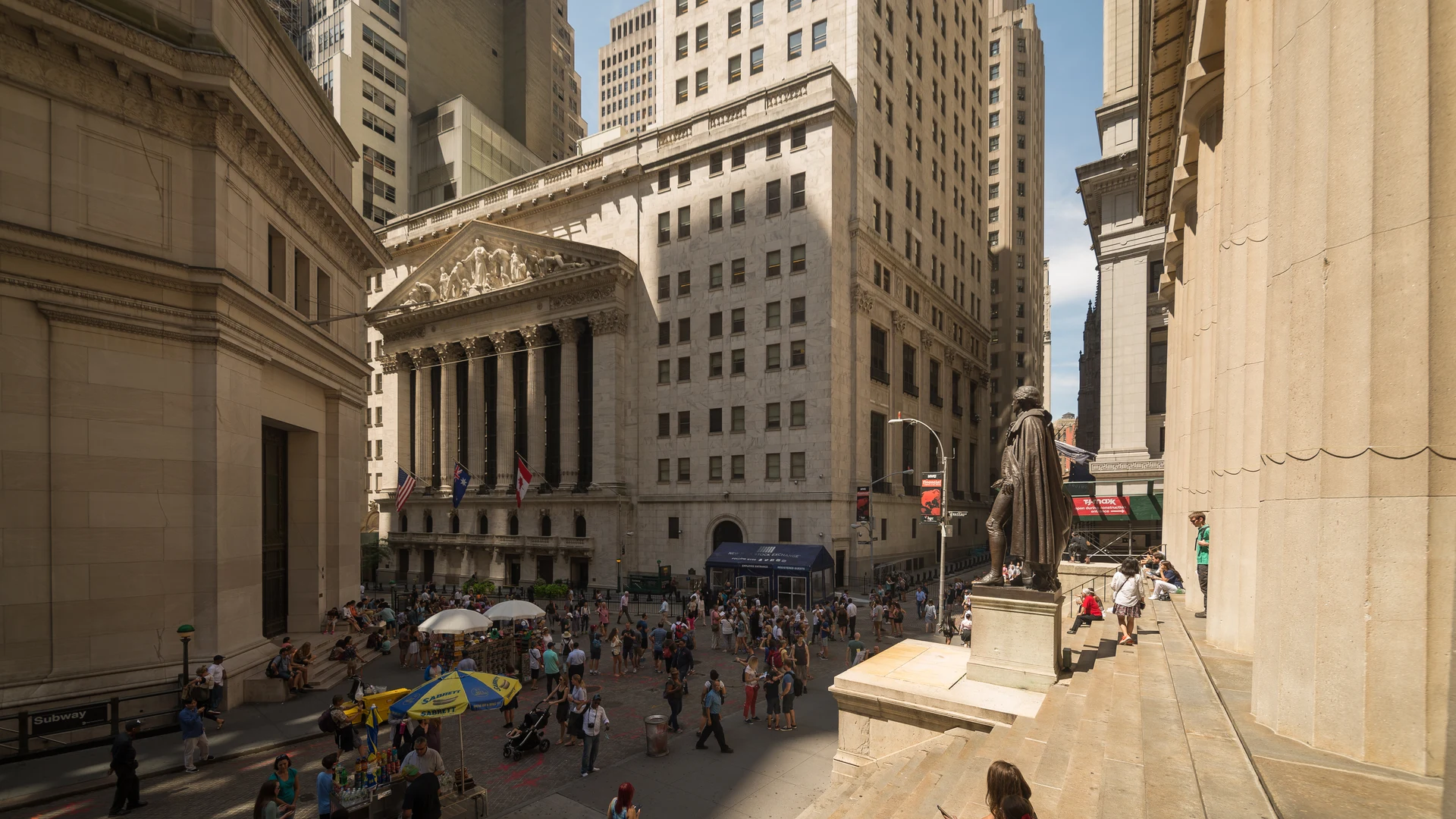
- Cover photo: Intersection of Broad Street and Wall Street with the New York Stock Exchange and Federal Hall, photographed 16 August 2017 — Photo: Arild Vågen / Wikimedia Commons (CC BY-SA 4.0)