Israeli Judges Urge Prosecutors to Drop the Bribery Case Against Netanyahu — and Rethink a Second
Israeli judges on Wednesday recommended that prosecutors drop the most serious of the three corruption cases against Prime Minister Benjamin Netanyahu, in a significant turn for a trial that has shadowed Israeli politics for six years. The three judges of the Jerusalem District Court — Rivka Friedman-Feldman, Moshe Bar-Am and Oded Shaham — told Attorney General Gali Baharav-Miara at an unusual hearing that a conviction in the case known as Case 4000 was unlikely and the charge should be dropped. They also recommended that prosecutors reconsider a second case, Case 2000, because of doubts that Mr Netanyahu's actions constituted a criminal offence, and seek a negotiated deal in the third, Case 1000, concerning gifts. The court stressed that its recommendations were not a ruling, and Ms Baharav-Miara said she would review them with the prosecution team. Mr Netanyahu, who did not attend the hearing, called the court's intervention "a ray of light for truth and justice" in a televised address.
In Case 4000, prosecutors allege that Mr Netanyahu granted regulatory favours worth around 1.8 billion shekels, about $500 million, to Bezeq Telecom Israel, and in return sought favourable coverage for himself and his wife, Sara, on the Walla news website, which was then controlled by Bezeq's chairman, Shaul Elovitch. Mr Elovitch has denied wrongdoing. Judge Friedman-Feldman, who presides over the case, was blunt about the prosecution's prospects. "The bribery charge presents considerable difficulties," she said. "There is serious doubt as to whether the evidentiary foundation supports this allegation." The judge said the alleged quid pro quo rested mainly on a single meeting at which instructions were supposedly given, that it was difficult to make findings based on the testimony of the former communications ministry director-general Shlomo Filber, and that it was unclear on what basis the treatment Bezeq received could be called unusually favourable. "The chances of conviction are low enough to warrant reconsideration," she concluded, adding that doubts about the conflict of interest also weakened the related breach-of-trust charge.
The judges were similarly sceptical about Case 2000, in which prosecutors allege that Mr Netanyahu negotiated a deal with Arnon Mozes, owner of the Yedioth Ahronoth newspaper, under which he would receive better coverage in return for legislation slowing the growth of a rival paper. "We doubt whether the charge entails an offense," Judge Friedman-Feldman said. "There is a real question as to whether the legal conclusions asserted are supported by the evidence." On Case 1000, the gifts case, the judges took a different view, saying a decision must be reached and indicating that they saw grounds for a conviction on some offence, even if not breach of trust as originally charged. "Here we can work toward a resolution. We are open to every possibility," they said. Ms Baharav-Miara replied that the prosecution was willing to consider what the court said, adding: "There are two ways to conclude the case: a verdict or an appropriate deal that reflects the nature of the conduct and the evidence." Mr Netanyahu's defence lawyer, Amit Hadad, said the defence was ready for mediation "here in court, not with the president".
Mr Netanyahu was indicted in 2019 on charges of bribery, fraud and breach of trust, and has pleaded not guilty. His trial began in 2020, and he has now finished giving testimony, which Judge Friedman-Feldman cited as the reason the court felt the moment had come to consider how the proceedings should end. "The public interest requires a rethink," she said. It is not the first time the judges have urged the prosecution to abandon the bribery count: they made the same recommendation in June 2023 and again in June 2026, and in September, after hearing Mr Netanyahu's testimony, said their position remained unchanged. Coalition ministers seized on Wednesday's development to demand an end to the trial, with Aryeh Deri, leader of the ultra-Orthodox Shas party, saying the recommendation "proves once again what everyone already knows: there is no bribery". Traders on the prediction market Polymarket, for their part, put the chance of a conviction in the corruption trial at only 14 per cent, down 18 points over the past month.
The judges' intervention lands in the middle of a political vacuum. Israel's election on 27 October stripped Mr Netanyahu's bloc of its parliamentary majority — it won 53 of the Knesset's 120 seats — but left no rival with a clear path to power, and Mr Netanyahu remains in office as caretaker prime minister. President Isaac Herzog gave the mandate to form a government to Gadi Eisenkot, leader of the Yashar party, on 8 November, and Mr Eisenkot has until 6 December, with a possible fourteen-day extension, to assemble a coalition. The new Knesset was sworn in on 10 November, and on 17 November it elected Mr Eisenkot's ally Matan Kahana as speaker by 66 votes to 52, after a six-hour filibuster by Mr Netanyahu's bloc. On Tuesday, Mr Eisenkot's party said it had clinched its first coalition agreement, with a right-wing opposition party. Mr Netanyahu has challenged some of the election results, but the Central Elections Committee has affirmed the integrity of the vote, finding no evidence of irregularities.
What happens next will be decided in two rooms at once. Ms Baharav-Miara and her team must now weigh whether to follow the judges' advice and drop the bribery charge, fight on, or pursue the plea deal the court has effectively invited in the gifts case — a deal the attorney general called "the quickest route" to ending the proceedings. Any agreement would still need to satisfy a public that has watched the trial drag on for six years, and Mr Netanyahu himself struck a defiant note on Wednesday, telling viewers that "ten years of suffering" had been inflicted on dozens of his associates "just so they would give false testimony against me". Meanwhile, the coalition clock keeps ticking: if Mr Eisenkot cannot form a government by his deadline, Mr Netanyahu will get his own chance to try, and if that too fails, Israelis could be back at the polls in 2027. The trial and the coalition talks, each unresolved for years in its own way, are now running towards their conclusions together.
- Reuters
- Globes
- CNN via LA Post
- JFeed — ministers react
- The Hindu BusinessLine — Eisenkot coalition
- Global Guardian — election context
- Polymarket — Netanyahu convicted in corruption trial?
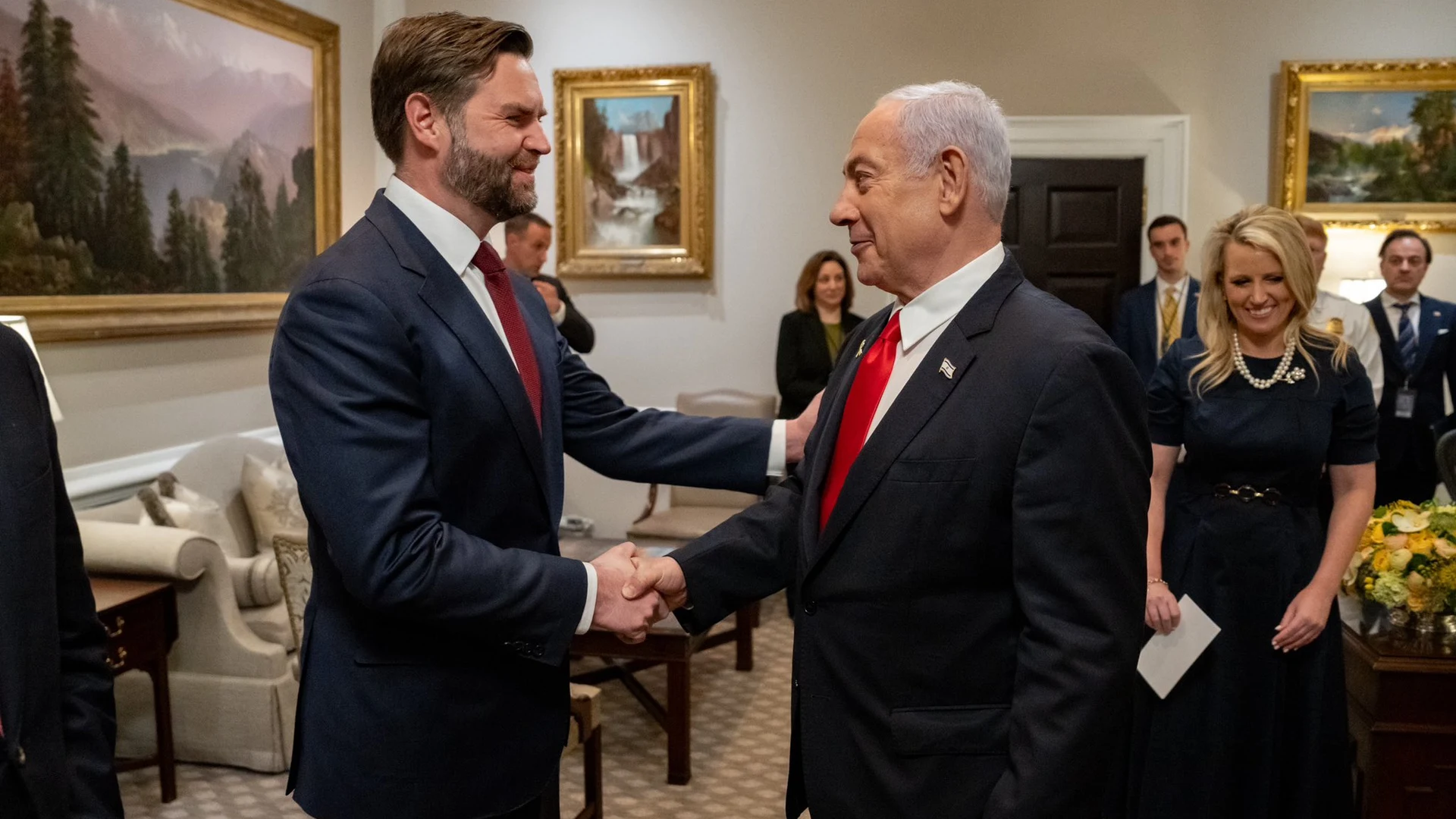
- Cover photo: Vice President JD Vance shakes hands with Prime Minister Benjamin Netanyahu, 7 April 2025 — Photo: Office of the Vice President of the United States / Wikimedia Commons (Public domain)