Trump Unveils New Tariffs on Fourteen Trading Partners, Rebuilding His Trade Wall on Firmer Legal Ground
President Donald Trump fired a new tariff salvo on Wednesday, proposing import duties on fourteen major trading partners after an eight-month investigation into what his administration calls structural excess capacity in global manufacturing. The United States Trade Representative, Jamieson Greer, unveiled headline rates of between 20 and 40 per cent, but said the duties would be capped at lower levels already agreed in trade deals or still under negotiation. China would face the highest capped rate, 20 per cent, on top of roughly 25 per cent in duties imposed during Mr Trump's first term, while Vietnam would face 35 per cent if it fails to reach an agreement with Washington and 20 per cent if it does. India, which has yet to conclude a trade deal, would face 25 per cent, or 17 per cent if talks succeed. The proposals will not take effect until after a public hearing on 25 January, with written comments due by 5 January.
The fourteen economies named in the findings are China, the European Union, Japan, India, Vietnam, South Korea, Taiwan, Indonesia, Malaysia, Cambodia, Thailand, Bangladesh, Singapore and Switzerland. The European Union, Japan, South Korea, Taiwan and Switzerland would face a capped rate of 15 per cent including existing most-favoured-nation duties, while Cambodia, Indonesia, Malaysia, Thailand and Bangladesh would face 18 per cent and Singapore 10 per cent. Mexico and Norway were left out of this round because investigations into their trade practices are still under way. The duties would not stack on top of earlier tariffs of 10 or 12.5 per cent imposed under a separate inquiry into forced labour, nor on sectoral national-security duties on steel, aluminium and cars. Mr Greer said about $30 billion of Chinese imports would also be spared under a bilateral mechanism known as the Board of Trade. In a separate action, the administration proposed a new 10 per cent tariff on finished Embraer commercial aircraft from Brazil and higher duties on Brazilian sugar above quota, after Mr Greer said months of talks with Brasilia had made "no meaningful progress".
The announcement is the centrepiece of the administration's effort to rebuild Mr Trump's tariff programme on sturdier legal ground. In February the Supreme Court struck down his broad global duties, which had been imposed under a national emergencies law, and the new measures rest instead on Section 301 of the Trade Act of 1974, a court-tested trade law that allows duties against foreign practices deemed unreasonable or discriminatory. Mr Greer said the tariffs were intended to counteract "industrial strategies built on targeting manufacturing, wage and labour suppression, financial and other support, non-market economy inputs, and other market-distorting practices" that undermine the American manufacturing base. Washington has long accused China of subsidising industry and flooding world markets with cheap steel, electric vehicles and solar panels. "It is another reminder that while the legal justification for tariffs keeps changing, US protectionism is becoming increasingly difficult to unwind," analysts at ING wrote. Nathaniel Halvorson, a former trade official now at the law firm Baker McKenzie, noted that there is bipartisan support in Congress for countering excess capacity centred on China, and warned that undoing the tariffs could cause trade deals to collapse.
The reaction from the targeted countries was swift and sharply worded. A spokesperson for China's embassy in Washington rejected the allegation that China is a source of excess capacity, saying: "The so-called issue of 'industrial overcapacity' does not really exist and should not be used as a pretext for political manipulation," while urging both sides to deliver on the agreements reached between Mr Trump and President Xi Jinping. India said it "does not have structural excess capacity in any sector", adding that it remained committed to an early conclusion of a bilateral trade agreement and that trade concerns should be settled through those negotiations. The European Commission's deputy chief spokesperson, Olof Gill, said Brussels would examine the findings but "strongly rejects the premise that Europe is a source of structural overcapacity". The scale of public attention was visible online, where a thread on Reddit's r/stocks sharing news of the announcement drew more than 900 upvotes and 440 comments within hours.
The timing is political as well as economic. Tariffs and their effect on the cost of living were a major issue in the midterm elections, in which Democrats swept to a sweeping victory only weeks ago, and a Reuters/Ipsos opinion poll conducted afterwards found that 62 per cent of respondents would support efforts to repeal the duties. Senator Ron Wyden, the Oregon Democrat expected to chair the Senate Finance Committee when the new Congress begins in January, said: "Not even a month after voters rejected his disastrous trade agenda, Trump has decided to yet again increase prices for Americans. As Finance Committee Chair, I will use every tool at my disposal to end Trump's disastrous tariffs." But that will not be easy. Mr Halvorson pointed out that Democrats "would have to consider whether they want to undo a settlement that might be working for US interests to some extent", and the Section 301 route, unlike the emergency-powers duties, has survived court challenges before.
What happens next is a two-month negotiation window rather than an immediate change at the border. Trading partners and American businesses have until 5 January to submit written comments, and the public hearings that begin on 25 January will shape the final rates, exemptions and implementation dates, with the earliest duties expected in January. India and the United States are already deep in talks over a bilateral agreement, and New Delhi's commerce secretary said last week that negotiations were nearly complete, after the two sides announced a framework for an interim deal in February. Court challenges are also expected, and the prospect of new trade barriers weighed on stock markets on Wednesday, with the Nasdaq falling more than 3 per cent in early trading. For now the message from Washington is unchanged from the one this newspaper reported yesterday, when the announcement was still imminent: the tariff wall is being rebuilt, this time on a legal foundation designed to last.
- Reuters via TBS News
- Reuters — India responds
- Forbes India
- Invezz
- Europeans24 — EU reaction
- Diplomacy and Law — analysis
- Reddit — r/stocks, tariff announcement thread
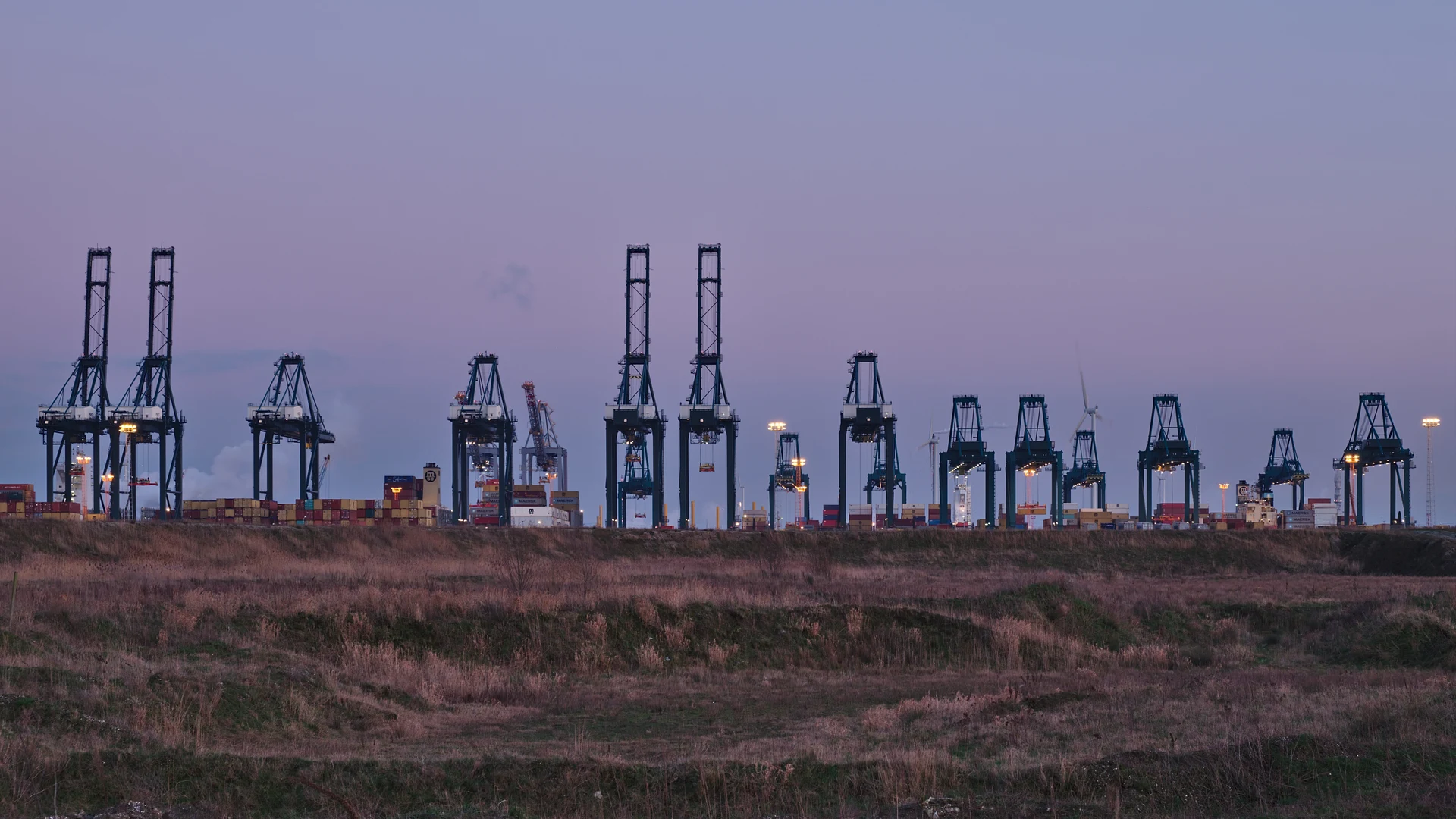
- Cover photo: Container cranes at the MPET–MSC PSA European Terminal, Port of Antwerp (Kieldrecht, Belgium), photographed 4 February 2018 — Photo: Trougnouf / Wikimedia Commons (CC BY 4.0)