Nvidia's Comeback Rally Fades as Lawmakers Demand Answers on Trump's Role — and the Attorney General Dodges
Nvidia shares fell about 7 percent on Tuesday, giving back part of the extraordinary gains that followed Jensen Huang's shock reinstatement as chief executive a day earlier, as lawmakers from both parties demanded answers about President Donald Trump's role in bringing him back. The stock closed down nearly 6 percent at $155.38, still well above where it ended last week, but the slide — which dragged the Nasdaq and the S&P 500 lower with it — turned a corporate comeback into a political fight over national security, China and the limits of presidential power. Nvidia's shares are down almost 30 percent over the past six months, and the whiplash of the last two days has left investors, Congress and the White House arguing over who really runs the world's most valuable chipmaker.
Huang was handed his job back on Monday, eleven days after he resigned on 12 November, following revelations of extramarital affairs — including one with Alice Huang, a former executive at the Singapore-based company Megaspeed who American officials suspect of having ties to Chinese intelligence — and a second affair with a fellow Nvidia executive, according to the New York Times. Trump said he had spoken to the company's directors and convinced them to bring Huang back, calling the 63-year-old a "national treasure" and telling CNBC he was "totally involved" in the decision. The board, chaired by Harvey Jones, voted unanimously to reinstate him, saying it was now "satisfied with respect to Mr Huang's candour", though it said its own independent investigation "will proceed to conclusion". On Monday the stock rocketed more than 31 percent, adding roughly $1 trillion to the company's market value in a single session.
On Tuesday Huang faced his own employees for the first time since his return. At an hour-long all-hands meeting, he apologised to staff for what he called "terrible mistakes", said he was now in therapy for 90 minutes a day, denied being "above the law", and insisted that claims of political pressure behind his reinstatement were "completely untrue", according to the New York Times. The apology did little to calm Washington, where the questions are no longer about Huang's private life but about what the president did to save his job — and what assurances, if any, the administration received in return.
Those questions landed on Tuesday at the feet of Attorney General Todd Blanche, who dodged them repeatedly at a news conference. Asked several times whether the Justice Department or the FBI had investigated Huang, Blanche replied: "I don't know what you're talking about." He said he had no information about Huang's security clearance status, and he praised the company, telling reporters: "I have no reason to stand up here and say Nvidia is anything but a good corporate citizen." According to the Wall Street Journal, Blanche had told Trump over the weekend that Huang was not the target or subject of any Justice Department investigation and that the department had no evidence he had broken laws or posed a national security risk — a claim Trump then repeated publicly, adding that he would consider pardoning Huang for any potential criminal activity, though he did not think it would come to that. In a statement after Blanche's remarks, Democratic congressman Jamie Raskin questioned whether the Justice Department had adequately examined the matter, saying Congress was "stepping in to get all the facts and to use our legislative powers".
The anger crosses party lines, and it is aimed as much at the future of American chip policy as at Huang himself. Senator Tom Cotton of Arkansas, the Republican chairman of the Senate Intelligence Committee, warned that "the controversy with Nvidia and Megaspeed is just the tip of the iceberg, and it's not resolved because Jensen Huang has his job back". Senator Elizabeth Warren called the reinstatement "reckless" and said Huang, the board and Nvidia executives "owe Congress answers about the company's compliance with US export controls". Republican congressman Don Bacon said: "We are sending high-end computer chips to China, and yet we're saying we want to win the AI war. It's a contradiction, and it's a failure of leadership in the White House." Senate Minority Leader Chuck Schumer questioned whether Chinese President Xi Jinping had influenced Trump's involvement. On Monday the Commerce Department added Megaspeed and several other firms to a trade blacklist; the Commerce and Justice departments said in a joint statement last week that they had been investigating Megaspeed since 2024 for potential export-control violations. Three bills moving through Congress — the AI Overwatch Act, the Chip Security Act and the Match Act — would tighten China's access to advanced chips further, and with Democrats set to control large majorities in both chambers after 3 January, they could pass with Republican China hawks in majorities large enough to override a presidential veto. Huang is due to be interviewed in Congress next week, with a hearing scheduled for 1 December.
For the markets, the episode has become a stress test for the artificial intelligence boom itself. Japan's Nikkei fell 2.76 percent on Tuesday and the S&P 500 slipped 0.5 percent as investors questioned again whether the AI rally will pay off, and the Times called the affair "the biggest signal yet that the AI balloon is aloft on not a lot". Online, the mood is combative: the top-voted discussion on Hacker News argued that Trump's intervention "has all but guaranteed an inquisition from Congress", while threads on Reddit's r/stocks tracked the estimated $12.2 billion hit short sellers took from Monday's rally. Experts doubt Huang's return will soften American policy — if anything, they expect the opposite. "I think it's going to lead to a tightening," said Aaron Friedberg, a professor of politics and international affairs at Princeton University. "There's going to be a lot of pressure from the Congress to tighten the existing restrictions." What began as a boardroom scandal is now a fight over who controls America's most strategic industry — and it will be fought in Congress, in the courts and in the market, all at once.
- Reuters
- USA Today
- The Times
- The Wall Street Journal
- StocksTracker
- Hacker News, Trump's intervention "has all but guaranteed an inquisition from Congress"
- Reddit — r/stocks, Nvidia bears face $12.2 billion hit
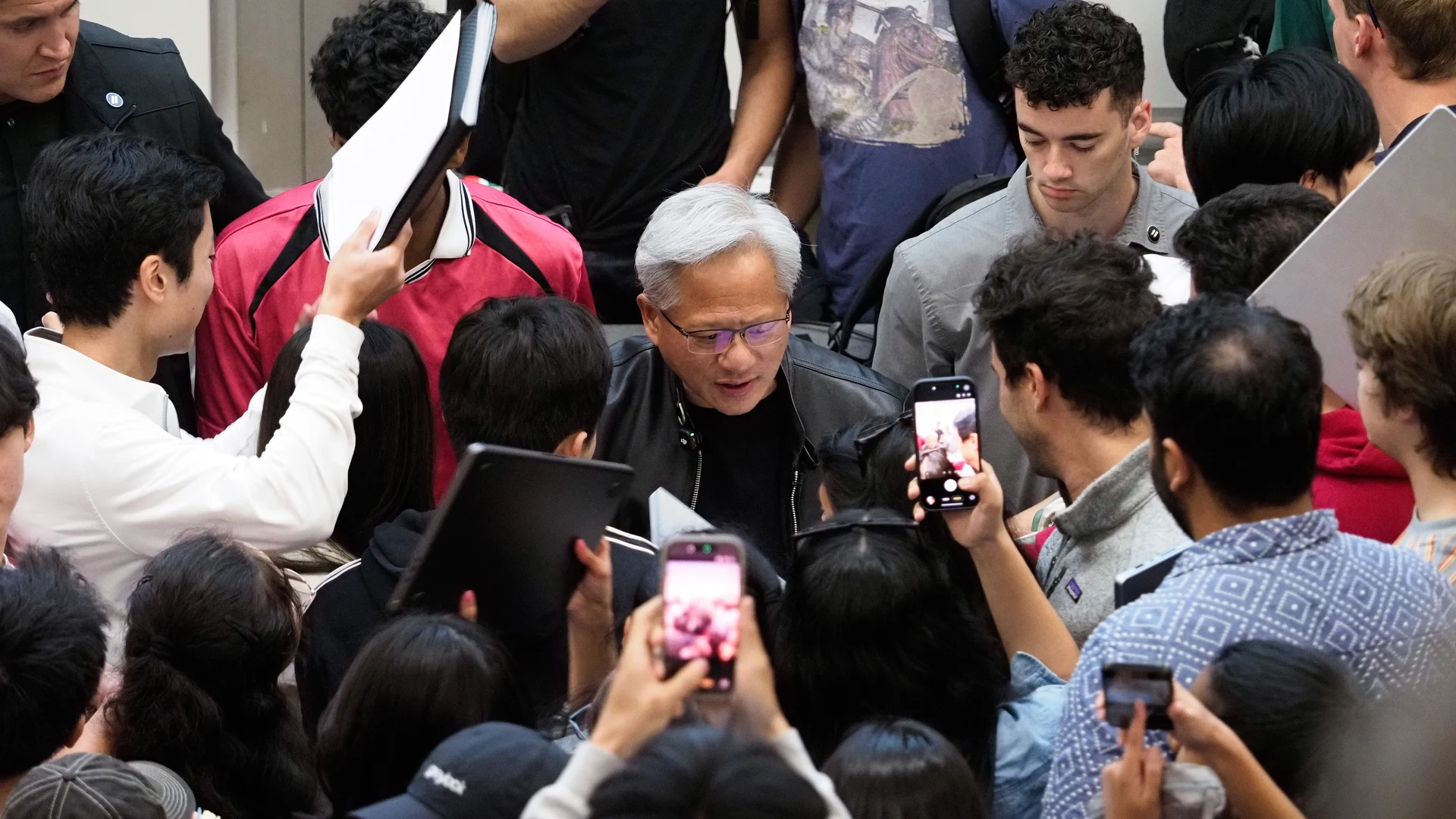
- Cover photo: Jensen Huang, co-founder and CEO of Nvidia, surrounded by students after his talk in Stanford University's CS 153 course, April 30, 2026 — Photo: Anders Eidesvik / Wikimedia Commons (CC BY 4.0)