Xi's Purge Claims Its Biggest Name Yet: Shanghai Boss Chen Jining Under Investigation
China has opened an investigation into Chen Jining, the Communist Party chief of Shanghai and a member of the country's elite Politburo, in the most striking escalation yet of President Xi Jinping's anti-corruption purge. The announcement, carried by the state-run Xinhua news agency on Tuesday evening, said Chen, 62, was under investigation by the Central Commission for Discipline Inspection for "suspected serious violations of discipline and laws" — the standard official wording used to signal corruption allegations. Chen becomes the fourth member of the 24-person Politburo formed in 2022 to face such a probe, in what the Wall Street Journal called the largest purge at this level since 1976. For an official of Chen's rank, a public announcement of that kind is widely understood to mark the beginning of a process that usually ends a political career.
Chen's fall is remarkable because of who he was. An environmental scientist by training, he earned a doctorate in environmental systems analysis from Imperial College London, rose through China's most prestigious university, Tsinghua, to become its president in 2012, and entered government as environment minister in 2015 — at the time the youngest person ever appointed to a national ministerial post in China. He became mayor of Beijing in 2018, steering the capital through the Covid-19 pandemic and the 2022 Winter Olympics, and in October 2022 he was elevated to the Politburo and given Shanghai, China's largest city and financial centre. The Shanghai post has traditionally been a stepping stone to the Politburo Standing Committee, the pinnacle of Chinese power, and Chen was widely regarded as a contender for elevation — even a possible successor — at the party's twice-a-decade congress in the autumn of 2027. His last public appearance appears to have been on Thursday, 19 November, when he inspected the headquarters of a Chinese shipping conglomerate.
The three Politburo members purged before him were General He Weidong and General Zhang Youxia, both senior members of the Central Military Commission that oversees the armed forces, and Ma Xingrui, the former party chief of Xinjiang. The military's top decision-making body, usually seven strong, is now down to only two members, one of them Xi himself. The campaign reaches far beyond the Politburo: according to official data cited by CNN, more than 500 ministerial-level officials were convicted, removed or expelled from the party for corruption between 2012 and 2022, and more than 410 officials have been purged in the last three years alone. In just the past two months, Beijing's deputy mayor and a retired former mayor of Chongqing have also fallen.
Analysts said the Chen investigation showed that no senior figure is safe. "The takedown again shows that Xi Jinping's anti-corruption campaign has no limits," Mingda Qiu, a senior analyst at Eurasia Group, said in an emailed statement. "This is the fourth Politburo member to fall, and the fourth sitting member brought down in the current cycle. The pattern is unprecedented." Joseph Torigian, a professor at American University in Washington, noted that the recent purges showed how much Chinese politics depended on shifting circumstances, "with even officials with qualities that Xi apparently valued being vulnerable to removal." At a meeting on Tuesday evening, Shanghai party leaders endorsed the probe against Chen and pledged loyalty to Xi.
Shanghai itself is part of the story. Under Chen, the city positioned itself as a leading player in cutting-edge sectors including artificial intelligence, robotics and biomedicine, hosting industry events, funding research and supporting startups, and it remains China's financial centre and a semiconductor hub, with a chip-making ecosystem spanning research, design and manufacturing. Chen is the first Shanghai party secretary to be placed under investigation since 2006, when his predecessor was dismissed for alleged misconduct. Whoever succeeds him will inherit not only the country's richest city but also a political machine now publicly reminded that proximity to the top offers no protection.
What follows is likely to proceed out of public view, as such cases do: the investigation, then a formal decision, and in most cases prosecution and imprisonment. Beijing is even expanding Qincheng prison, its maximum-security facility for disgraced senior officials. The more consequential question is political. Xi, who is all but certain to seek a precedent-breaking fourth term as party chief at the 2027 congress, has used the anti-corruption drive he launched on taking power in late 2012 to secure his standing as China's most dominant leader in decades — and the fall of a man once tipped to join him at the very top clears the way for a reshuffle of the ruling elite on Xi's terms. The 2027 congress will now take place with one of its most closely watched names sidelined.
- The Wall Street Journal
- CNN
- Reuters
- Associated Press
- The Guardian
- The Telegraph
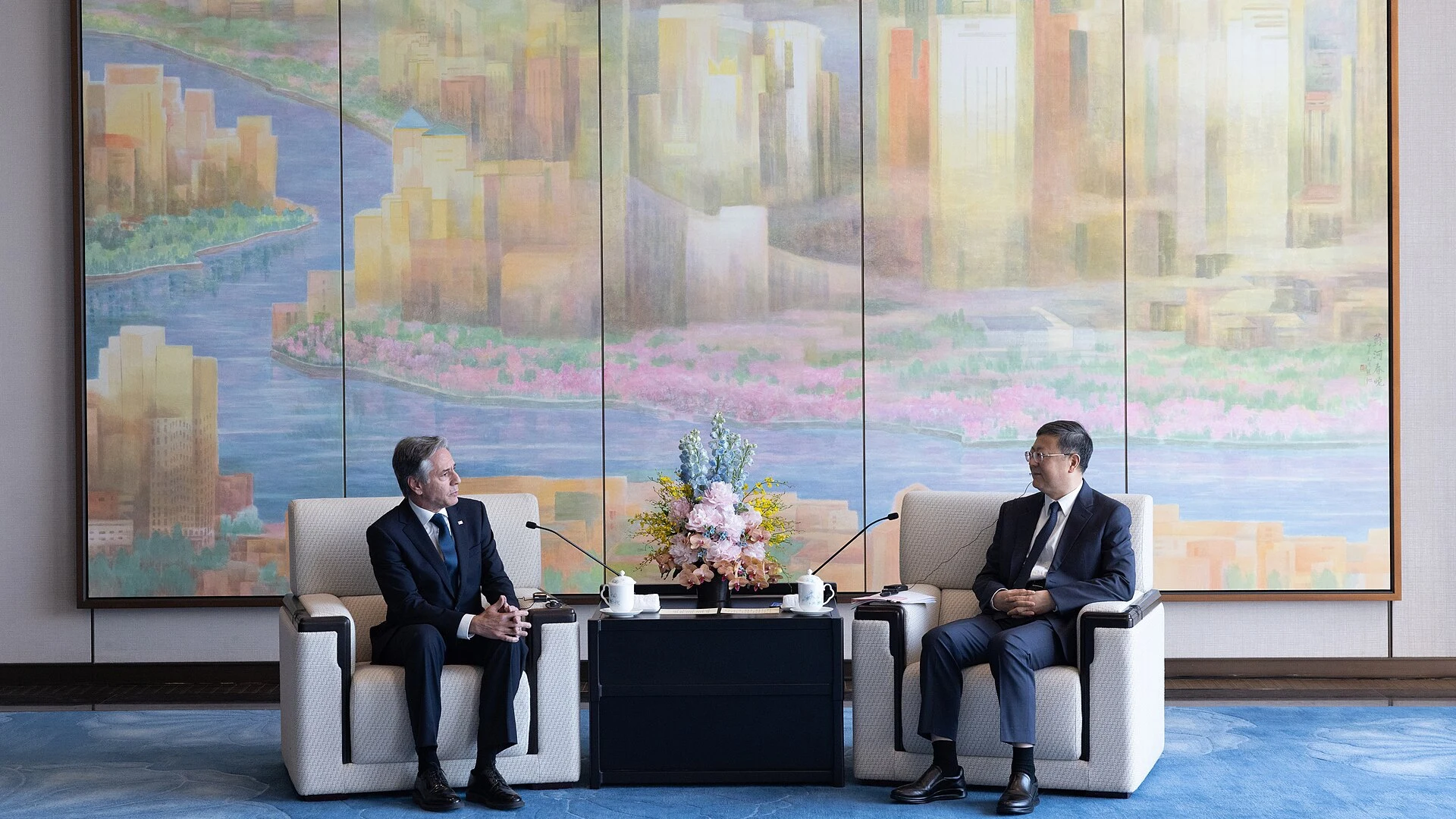
- Cover photo: Secretary Antony J. Blinken meets with Chinese Communist Party Secretary of Shanghai Chen Jining in Shanghai, China, April 25, 2024 — Photo: Chuck Kennedy / U.S. Department of State / Wikimedia Commons (Public domain)