Three Tankers Burn in the Strait of Hormuz as Iran Steps Up Gulf Strikes — and Qatar Races to Revive Talks
Three oil tankers caught fire early on Tuesday after striking naval mines in the Strait of Hormuz, according to Iran's Islamic Revolutionary Guard Corps, in the latest blow to shipping through the world's most important oil chokepoint. Iran's Fars news agency, citing the Guards, reported that the tankers suffered severe explosions and fires while sailing what Tehran called an "unauthorised route" in the eastern part of the strait. Britain's maritime agency, United Kingdom Maritime Trade Operations, said it had received reports of incidents involving two tankers in the region. The Iranian claims could not be independently verified, and the tankers, their flag states and their operators have not been identified.
The incident caps a sharp escalation in the Gulf over the past week. On Saturday, Iran struck a civilian industrial facility on Sitra Island in Bahrain, causing a fire and material damage and injuring two people, a Pakistani resident in critical condition and a Bahraini citizen in stable condition. The Revolutionary Guards claimed they had also launched a combined missile-and-drone attack on American military positions at the Al-Riffa and Awali bases in Bahrain, saying they struck two Patriot air defence radars, while Bahrain's Defence Force said its air defences had intercepted several Iranian aerial attacks. Iran also claimed it had shot down an American drone over Qeshm Island and damaged an F-16 fighter jet, a claim United States Central Command denied, saying all its fighter jets in the Middle East were safe and accounted for. Al Jazeera reported that at least 25 tankers have been hit in and around the strait in the past seven days, and traffic through the waterway has fallen to about 65 percent below pre-war levels, with war-risk insurance rates climbing from 0.10 to 0.25 percent before the conflict to between 3.5 and 7.5 percent.
The attacks are Tehran's answer to an economic campaign that is squeezing it hard. On Monday, the United States Treasury imposed sanctions on more than two dozen Iranian entities in what it called a crackdown on Tehran's "shadow banking" network, and Treasury Secretary Scott Bessent said the Iranian leadership was "panicking". The American naval blockade of Iranian ports passed its 130th consecutive day on Saturday, which Washington says is preventing the Revolutionary Guards from exporting billions of dollars in crude oil. An Iranian judiciary official said the country's courts had ordered the United States to pay $290 billion in damages. Tehran's demands for reopening the strait include ending the war, unfreezing Iranian assets, lifting oil sanctions and ending the American counter-blockade of Iranian ports.
Diplomacy, meanwhile, is moving in parallel. Qatar's Prime Minister, Sheikh Mohammed bin Abdulrahman bin Jassim Al Thani, met Secretary of State Marco Rubio in Washington on Monday and told Al Jazeera that Doha was working with both sides to restart negotiations, warning that the Middle East could not withstand another escalation. President Donald Trump, who met the Qatari prime minister at the White House on Monday, said he saw "positive momentum" towards ending the conflict and that new attacks on Iran were unnecessary. In Paris, where foreign ministers from the Group of 7 were meeting, Rubio said Washington was "open to diplomacy" and that the economic campaign was "so devastating that right now there is no need for major combat operations".
Tehran's public line, however, remains defiant. Iran's security chief, Mohsen Rezaei, told Lebanon's Al Mayadeen television on Tuesday that claims about continuing negotiations were "a pure lie" and that the Strait of Hormuz would stay shut until Washington met Iran's seven conditions for peace talks. Foreign Minister Abbas Araghchi has said the strait could be reopened within two days if the demands are met, and that the conflict "will not be resolved through military means, nor by intensifying sanctions", insisting the only solution is diplomacy conducted "in a language of respect". The war, which began in late February, is now in its ninth month, and it has roiled global markets and pushed up oil and gas prices around the world.
What happens next turns on whether the Qatari channel can produce a meeting that both sides can accept, and whether the attacks on shipping stop long enough for one to happen. Bahrain has called on the United Nations Security Council to act over the attacks on its territory and demanded compensation, and the United Arab Emirates, Qatar and Saudi Arabia have all condemned the strikes. With roughly a fifth of the world's oil and gas passing through the strait, every new incident keeps prices high for consumers everywhere, and every day the waterway stays dangerous makes a negotiated end to the war more urgent and, so far, more elusive.
- Al Jazeera
- TRENDS MENA
- World Today Journal
- Live From Europe
- Faultline
- Hatha Alyoum
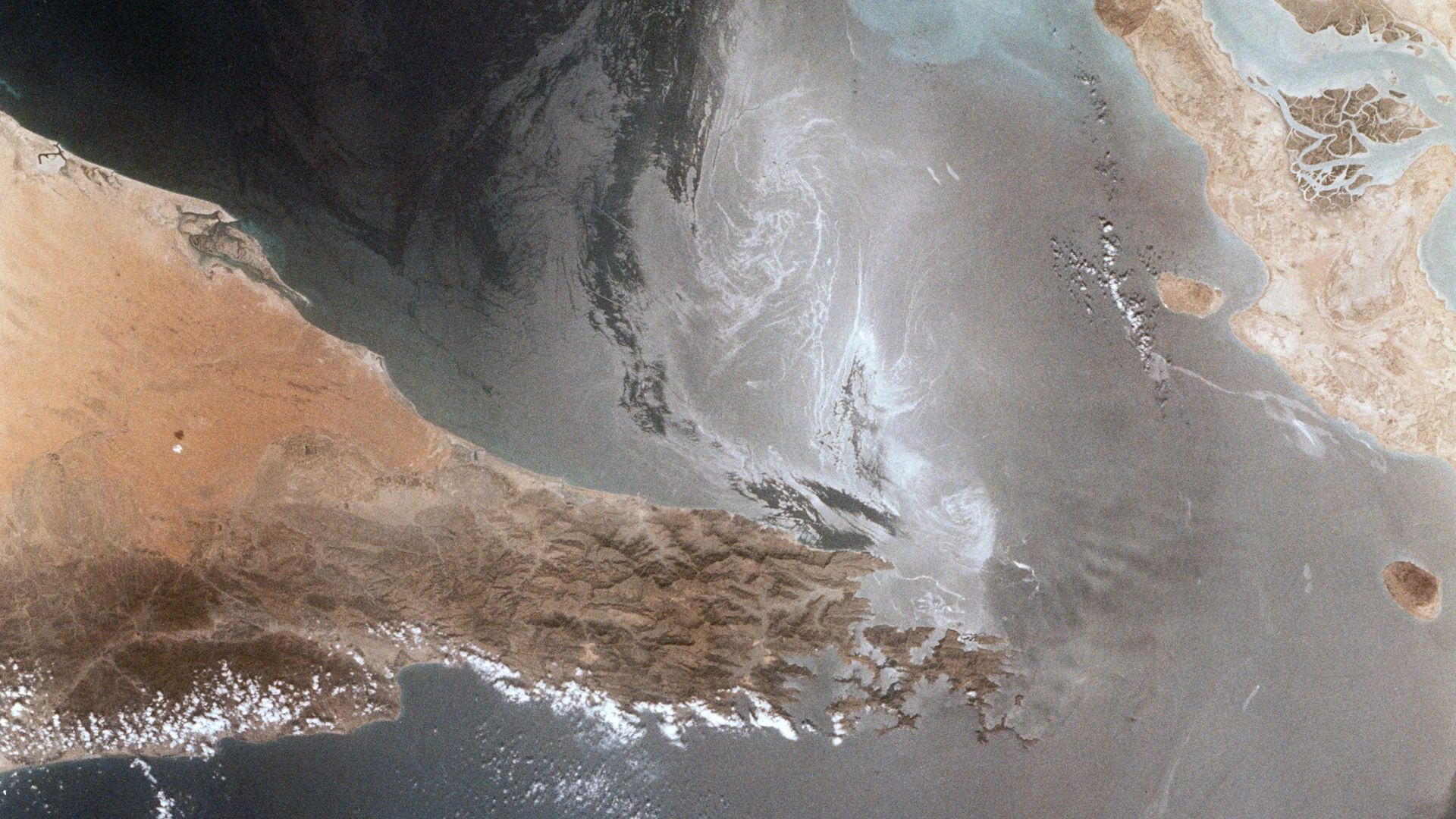
- Cover photo: Portions of Oman, The United Arab Emirates and Iran are seen at the Strait of Hormuz (26.0N, 56.0E) in this view. A number of ship wakes can be seen in the area of the strait — NASA space shuttle photograph, June–July 1982 — Photo: NASA / Wikimedia Commons (Public domain)