AI to Read Half of Britain's Breast Scans in the World's Largest Trial of Its Kind
Nearly 700,000 women across the United Kingdom are to take part in the world's largest trial of artificial intelligence in breast cancer screening, in a study that will test whether software can safely take the place of one of the two specialists who currently read every mammogram. The trial, known as EDITH — Early Detection using Information Technology in Health — opened its first site at Cambridge University Hospitals, with recruitment under way and 30 screening centres across the country due to join over the next three years. It is the most ambitious attempt yet by a national health service to answer the question that has followed AI into medicine for a decade: can a machine spot cancer as reliably as a human, and can it do so without missing the cancers that matter or flagging the ones that do not?
The design of the trial is deliberately simple, and deliberately cautious. At present, two NHS experts independently examine each breast X-ray, known as a mammogram, before a result is given. Under EDITH, one of those human readers will be replaced by an AI system, while the other specialist continues to review the images. Four different AI systems are being tested, and the trial will examine more than one way of working: in one arm the software grades the images before they reach the specialists, and in another it checks them afterwards. The study is led by the University of Warwick, the University of Cambridge and Cambridge University Hospitals NHS Foundation Trust, working with NHS England, and is backed by £11 million of government funding through the National Institute for Health and Care Research. Professor Sian Taylor-Phillips of Warwick, who co-leads the trial, said her team had rigorously tested all four systems for accuracy — and stressed that every clinical decision would remain with NHS staff.
The stakes are set by the scale of the programme itself. Women aged 50 to 71 are invited for routine NHS breast screening every three years, and more than two million attend each year. Breast cancer is the most common cancer in the UK, and the earlier it is found the better the chances of successful treatment — yet the screening service is under strain, with waiting lists and a shortage of the radiologists and specialist readers the double-reading system depends on. If AI can do the work of one reader safely, the same number of specialists could screen far more women, and the freed-up clinicians could spend more time supporting patients who need further investigation. The trial will also test whether the software can identify cancers too small to see or feel, the cases where earlier detection makes the greatest difference.
That promise comes with a warning the trial's leaders have been careful to state in public. The aim, Professor Taylor-Phillips said, is to improve early detection while avoiding overdiagnosis — the detection of mild, slow-growing disease that would never have caused harm — and avoiding unnecessary recalls, the call-backs for further tests that cause anxiety and consume clinic time. It is the central tension in all cancer screening: find more disease, but only the disease that matters. The trial's three-year span, its 30 sites and its 700,000 participants are designed to produce evidence robust enough to settle that question, rather than the small, single-hospital studies that have dominated the field so far. The NHS has also built a research platform called AIR-SP, with nearly £6 million of government money, to make it easier for hospitals to join AI screening studies in future.
The launch was announced on the same day the government opened a call for evidence on a new National Cancer Plan, and the trial's backers presented it as part of a wider modernisation of cancer care. Professor Lucy Chappell, the Department of Health and Social Care's chief scientific adviser and chief executive of the NIHR, called EDITH a "landmark trial" that could lead to a significant step forward in early detection, offering women faster and more accurate diagnoses when it matters most. "It is another example of how NIHR research, shaped and funded by the public, is crucial for rigorously testing world-leading new technologies, such as AI, that can potentially save lives while reducing the burden on the NHS," she said. The language matters: this is a trial, not a rollout, and its leaders have been at pains to say that no woman's screening will depend on software alone.
What happens next will be measured in years, not weeks. Recruitment will expand from Cambridge to the other 29 sites in the coming months, and the women invited will be told about the study in their screening letters, with the option to opt out. Results will not be instant — the trial is expected to run for around three years — and the decision that follows will be one of the most consequential the NHS has taken about AI: whether one specialist plus software can match two specialists, at a scale of hundreds of thousands of scans. If the answer is yes, breast screening in Britain will change permanently, and the model will be watched by health services around the world. If the answer is no, or not yet, the trial will still have done something valuable — it will have tested the technology where it matters, on real patients, before it was trusted with their lives.
- BBC — Can AI spot breast cancer earlier? NHS launches world's largest trial to find out
- Sky News — Major trial to examine if AI can help detect breast cancer earlier
- University of Warwick — Warwick Professor to lead cutting-edge trial using AI to catch breast cancer early
- Computer Weekly — NHS launches breast cancer AI trial
- UKAuthority — DHSC announces trial of AI screenings for breast cancer
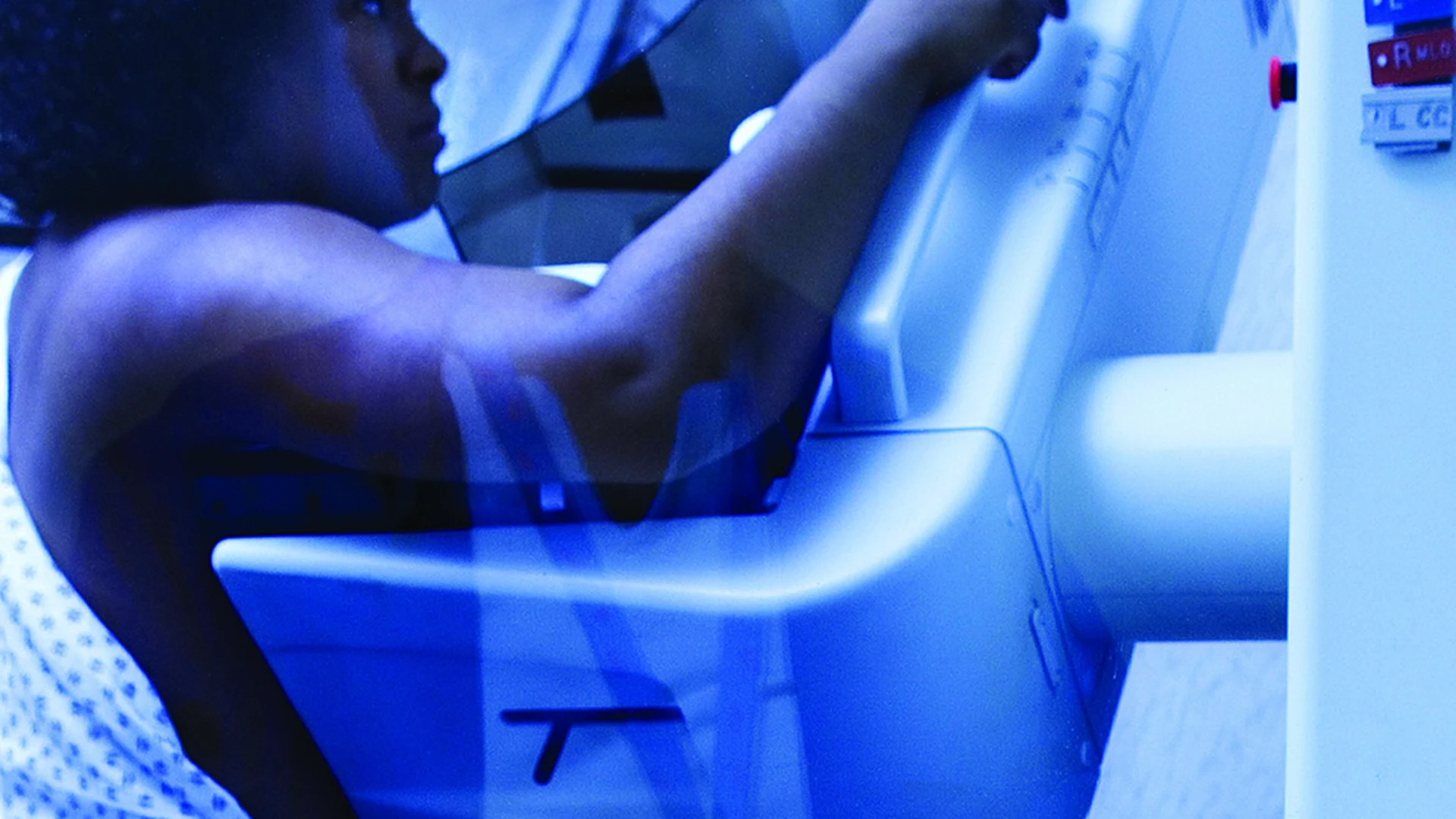
- Cover photo: A mammogram being conducted — a woman in a hospital gown at a mammography machine, photographed 23 August 2012 — Photo: CDC (Centers for Disease Control and Prevention) / Wikimedia Commons (Public domain)