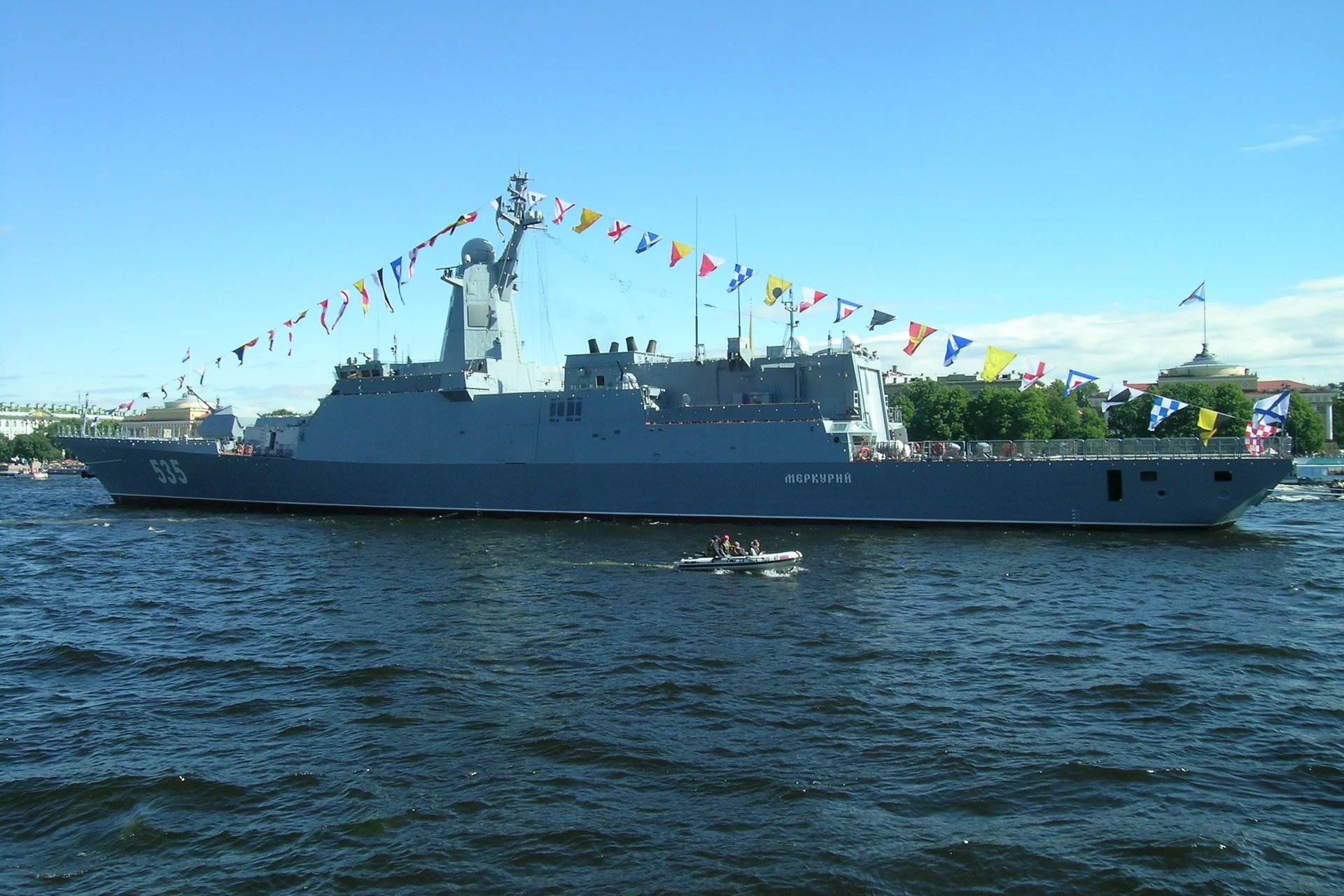
Suspected Ukrainian Sea Drones Hit Russian Corvette Merkury at Benghazi Naval Base
Suspected Ukrainian sea drones struck the Russian Navy corvette Merkury at the Benghazi naval base in eastern Libya before dawn on Sunday, severely damaging the warship and setting it ablaze — the second Russian-linked vessel hit in two days, after the military-linked cargo ship Sparta II was struck in the Gulf of Finland on Saturday. The attack shows the war's maritime reach now stretching from the Baltic to the Mediterranean.
Several sea drones were launched at the ship, two Libyan military officials told the Associated Press: at least four were intercepted and destroyed, while two hit the warship. Satellite imagery reviewed by BBC Verify showed a vessel burning at 05:47 GMT, and a later image appeared to show the same vessel partially submerged. Ten people — Russians and Libyans — were slightly injured and were being treated in Benghazi, medical sources told Reuters; no deaths were reported. The fire was later extinguished, and the port and naval base facilities were safe.
The eastern-based Government of National Stability said in Statement No. 19 of 2026 that a preliminary investigation indicated the explosion occurred aboard a Russian ship docked at the port, pointing to an attack "using unmanned vehicles". The vessel had stopped at Benghazi to refuel and resupply on its way back to Russia, under maritime cooperation agreements between the two countries. The AP's officials said the drones were launched from a base run by Ukrainian forces in western Libya. Axios, citing a military source, reported the long-range strike was carried out by Ukraine's SBU security service. No group claimed responsibility, and neither Russia nor Ukraine commented.
In separate developments, a commercial vessel flying the Maltese flag was targeted by a drone boat off the coast of Benghazi on Sunday, two Libyan military sources told Reuters; Libyan naval forces rescued the crew. Libyan naval and air forces intercepted more than 20 drone boats off the coast of Benghazi during Sunday evening, the sources said.
The eastern government condemned the suspected attack as a violation of Libya's sovereignty and a threat to maritime safety, saying it would take legal and diplomatic measures, and ordered a joint investigation with Russia. "The Libyan government will not allow Libyan ports, territory or territorial waters to be turned into an arena for settling scores or exporting international conflicts," it said, calling the strike "a serious aggression against national sovereignty" and warning that "touching Libya's security and sovereignty is a red line". The Tripoli-based Government of National Unity warned against hosting foreign forces and letting them use Libyan facilities, saying it raised "serious fears" about the risks of involving ports and civilian facilities in external conflicts.
The strike fits a pattern Ukraine has built in western Libya, where its forces — mostly drone experts — operate mainly at the Misrata air base and at facilities in Tripoli and Zawiya under a covert deal. In March, they struck the Russian tanker Arctic Metagaz, carrying 61,000 tonnes of liquefied natural gas, in a suspected sea drone attack near Maltese waters; all 30 crew were rescued. The Merkury is a Steregushchiy-class corvette (Project 20380), commissioned in May 2023 and assigned to the Black Sea Fleet; it had been stationed in Benghazi for several days after escorting a convoy of cargo vessels carrying military supplies, according to Naval News. Naval analyst H I Sutton assessed the ship as "almost certainly destroyed" from satellite images. Hours after the blast, a Russian Emergencies Ministry Il-76 flew directly from Moscow to Benghazi. It is the second Steregushchiy-class ship knocked out this year, after the Boikiy was struck by Ukrainian drones in dry dock near St. Petersburg in June.
What remains unresolved is how far the damage goes and who launched the drones. The ship's permanent destruction has not been conclusively established, and no independently authenticated evidence publicly identifies Ukraine as the attacker. One unverified report suggested the drones were launched from Albania rather than Libya — a claim no major outlet has corroborated. What is clear is the pattern: within 48 hours, suspected Ukrainian drone strikes have hit Russian-linked shipping in the Baltic and the Mediterranean, and both of Libya's rival governments now warn that their ports are being dragged into a war that is not theirs.
- Reuters — Libya's eastern government suspects drone attack caused explosion on Russian ship at Benghazi port
- Associated Press — Suspected Ukrainian sea drones hit Russian warship at Benghazi naval base, Libyan officials say
- Defence Blog — Libya says Russian corvette in Benghazi hit by drones
- New York Post — Putin's warship hit in suspected Ukrainian drone strike that set off huge explosion
- Wikipedia — Russian corvette Merkury
- The Times of India — Libya's eastern government orders joint inquiry with Russia into ship explosion
- Cover photo: The Russian Navy corvette Merkury (hull 535) at the naval parade in St. Petersburg, July 2022 — Photo: 13243546A / Wikimedia Commons (CC BY-SA 4.0)