COP31 Puts Its Final Deal to the Vote — Without a Single Mention of Fossil Fuels
After two days in overtime, the United Nations climate summit in Antalya, Türkiye, put its final deal before the world's governments in the early hours of Sunday morning — a ten-page package that its presidents say every country can accept, and that does not contain the words fossil fuels, oil, coal or phase out anywhere in its text. COP31, co-hosted by Türkiye and Australia and attended by delegations from nearly 200 countries, was scheduled to end on Friday. Instead, negotiators worked through Saturday and into the small hours of Sunday, and the conference was due to reconvene on Sunday morning to approve a text that its president, Murat Kurum, presented as a consensus deal. "We believe that we have put forward a text which all the parties can agree upon," Mr Kurum told a late-night plenary session. Delegations were given until 03:00 GMT to lodge objections, with the approval session due to begin at 06:00 GMT.
The package is the product of a fortnight of deadlock over the one question that has dominated the summit: whether the final agreement should name the cause of global warming at all. An earlier draft, published on Thursday, stripped out every reference to moving away from fossil fuels after objections from Saudi Arabia and other major oil and gas producers, and dropped a proposed target of $120 billion a year in adaptation finance for developing countries. The new text refines that draft rather than reversing it. It recalls the 2023 Dubai agreement — the "UAE Consensus", under which countries agreed to transition away from fossil fuels — in its very first line, but the words themselves never appear again. Mr Kurum said he believed concerns around fossil fuels had been addressed, as had those around helping developing countries finance their adaptations to climate change. Whether the countries that demanded explicit language agree will be decided in the plenary hall.
What the text does offer is a single, headline energy goal: raising electricity's share of total final energy consumption from about 21 per cent today to 35 per cent by 2035, a target backed by some 90 countries and championed by Türkiye as its signature contribution to the summit. But the target carries no requirement that the additional electricity come from renewable sources, so power generated by burning coal and gas could count towards it. "Electrification that runs on coal and gas does not limit warming," said Bill Hare, the chief executive of Climate Analytics. "Continued reliance on coal and gas risks shifting where fossil fuels are burned and locking in further emissions." Türkiye and the head of the International Energy Agency have argued that, because about 80 per cent of new electricity is fuelled by renewables, the goal will cut emissions just the same. The text also sets a specific goal for carbon capture and storage — one billion metric tons — a technology backed by the oil industry and criticised by several delegations as expensive and unproven at scale.
The finance section, which matters most to the countries already living with rising seas and failing harvests, is where the compromise looks thinnest. The commitment to triple adaptation finance by 2035 is reaffirmed, but — as in earlier drafts — with no explicit baseline against which the tripling would be measured and no details on how it would be calculated. Many developing countries had wanted those details spelled out; they did not get them. The text would also be the first COP outcome to acknowledge that the world will overshoot the 1.5°C limit set by the Paris Agreement, calling for any overshoot to be kept "as small and short as possible". The science makes the admission hard to avoid: October 2026 was 1.8°C warmer than the mid-1800s, according to Berkeley Earth. The United States, the world's largest historical emitter, is absent for a second consecutive year, after President Trump ended cooperation with the process and called global warming a hoax.
The reaction to the package, before most delegations had even read it, was shaped by the threats made during the week. Panama's environment minister, Juan Carlos Navarro, had vowed to formally object to any agreement that failed to cap oil production, accusing the talks of being held hostage to a "petroleum mafia". The European Union's climate commissioner, Wopke Hoekstra, said on Saturday that the summit should produce a good deal or no deal at all. Alden Meyer of the think tank E3G, who has followed these negotiations for decades, noted that fossil fuels went unmentioned in final COP decisions for more than 25 years before Dubai — and warned that coming out of Antalya "with no signal that we were serious about what we agreed to do three years ago" would be a real setback. There is also a practical worry: as negotiators depart, organisers fear the conference may struggle to muster the two-thirds quorum of delegates needed to pass the draft at all.
What happens next will be decided in the plenary session on Sunday morning, where near-unanimous consensus is required and a single formal objection can stop a deal. If the text is adopted, COP31 will be remembered as the summit that admitted defeat on 1.5°C and built its energy future on electrification without naming the fuels it must replace — and the next summit, in Addis Ababa, Ethiopia, will inherit a process whose credibility is in tatters. If it is blocked, Antalya will join the short list of summits that ended with no agreement at all, the first since 2000. Online, the mood in the climate community was bleak before the package even landed: on Reddit's r/climate, a thread arguing that "climate science says 1.5C is dead" drew 565 upvotes and 55 comments, while a thread on António Guterres's farewell speech — "You cannot build peace on a burning planet" — drew 947 upvotes. For a world that has just lived through its hottest October on record, the stakes could hardly be higher.
- Reuters — COP31 climate talks close to final deal, says summit president
- AP — Turkey's final draft at UN climate talks doesn't mention the fossil fuels that cause global warming
- Europe Says — Head of COP31 UN Climate Change Conference says gap narrowing on final text
- The True Post — COP31 Nears Final Deal After Overtime Talks in Antalya as Fossil Fuel Fight Eases
- Stories of Record — COP31 climate talks in Antalya run past their deadline as countries split over fossil fuels
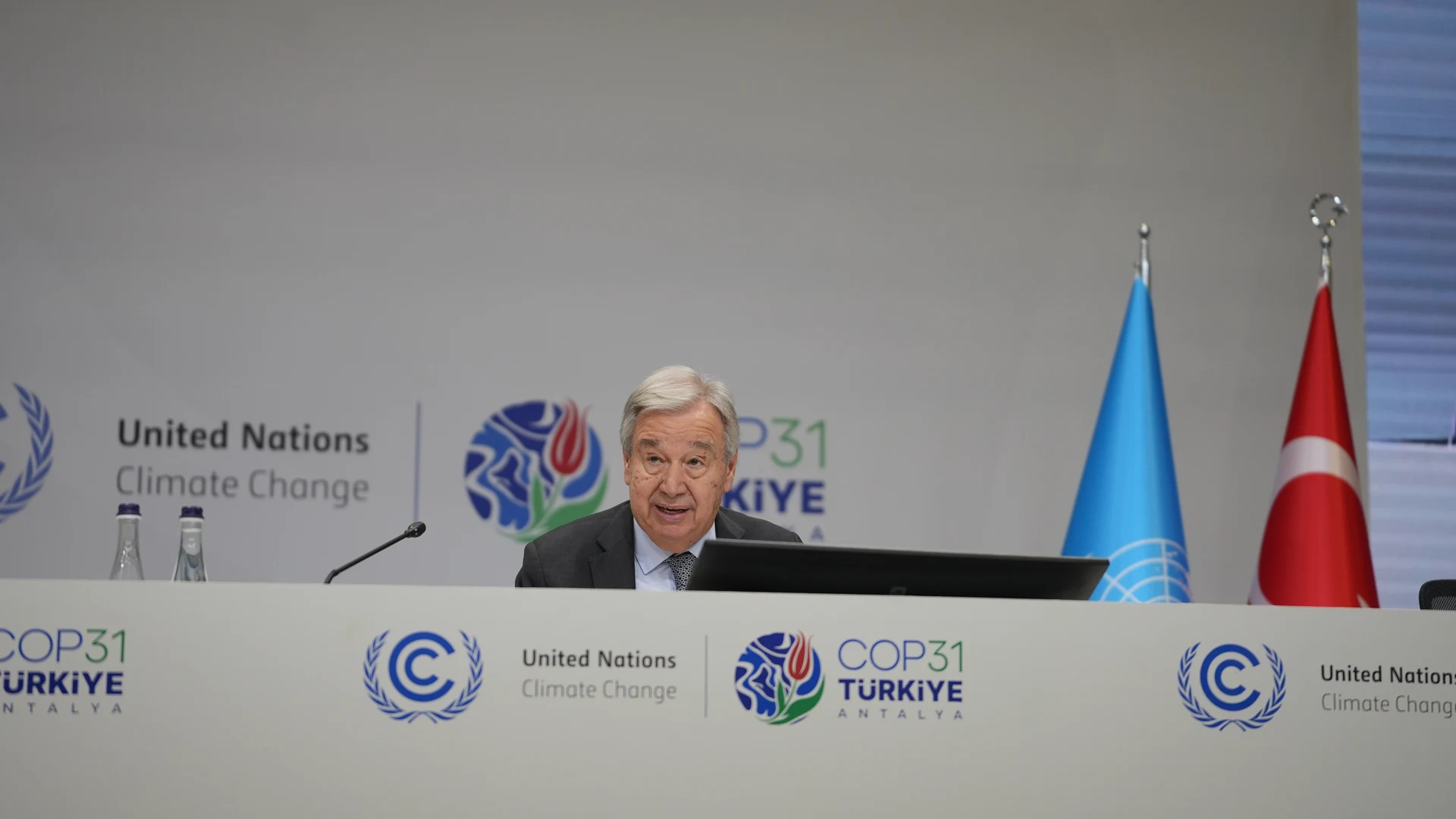
- Cover photo: UN Secretary-General António Guterres speaking at COP31 in Antalya, Türkiye, in front of the COP31 Türkiye / United Nations Climate Change backdrop, 13 November 2026 — Photo: Xuthoria / Wikimedia Commons (CC BY-SA 4.0)