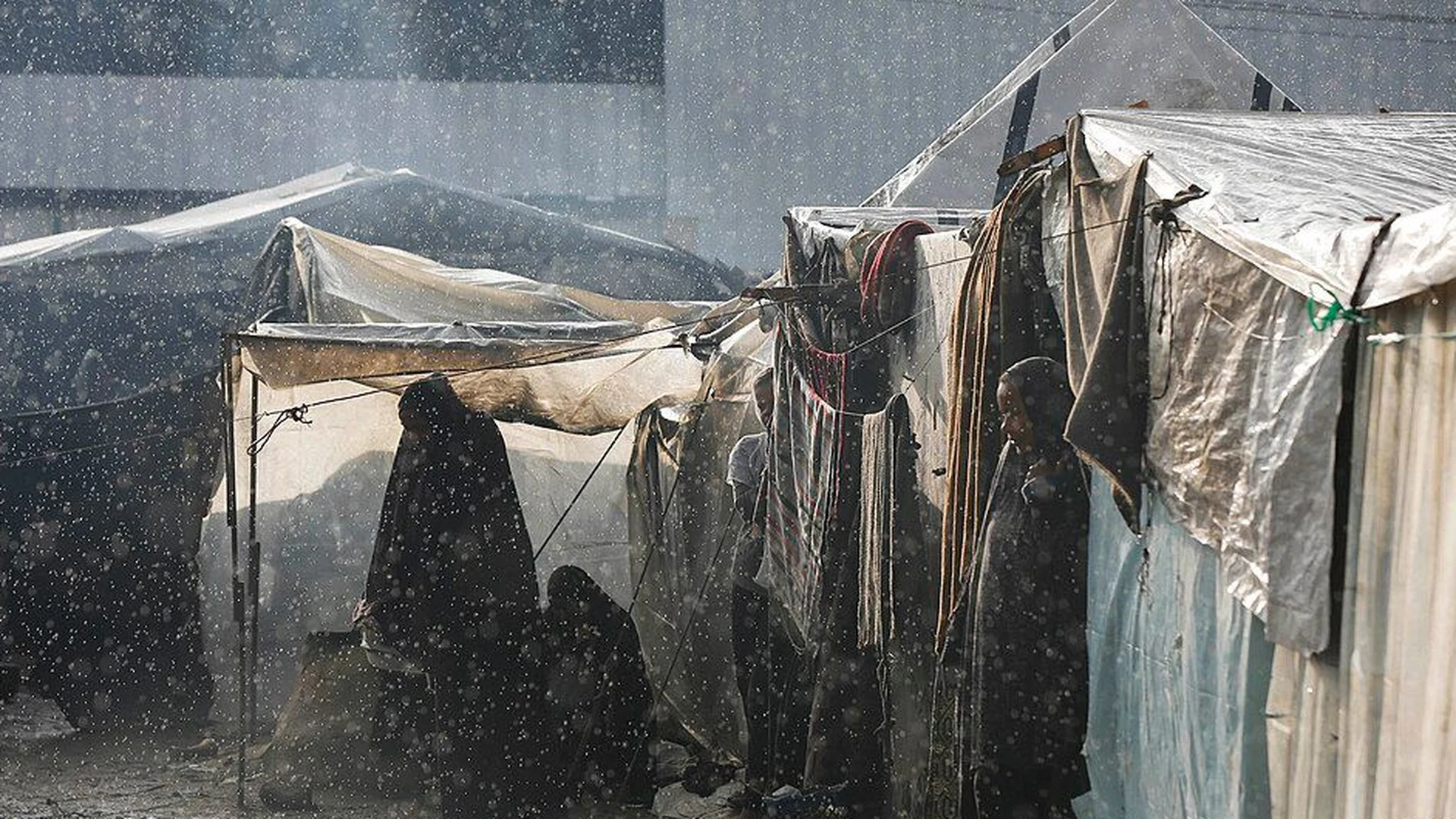
The Tents Are Drowning: Gaza's Floods Leave Families in Water While 150,000 Tents Wait at the Border
The first winter storm of the season turned Gaza's displacement camps into lakes in early November, and the water has not gone away. Heavy rain that began on 6 November flooded an estimated 70,000 tents, soaked the mattresses, blankets and clothes of tens of thousands of displaced families, and killed at least six people — among them three small children and a baby. In some places the floodwater rose to 1.5 metres, and Gaza's civil defence service received 2,166 emergency calls in a single day. It was, by every account from the ground, only the first storm of the winter. And while families bailed out their tents with buckets, some 150,000 tents procured by humanitarian agencies sat outside Gaza, held at the border and prevented from entering.
The deadliest single moment came on Sunday 8 November, when a rain-soaked sand embankment collapsed onto tents sheltering displaced families near Birkat al-Baraka, west of Deir al-Balah in central Gaza, killing five people — three children aged four, five and eight, and two women, one of them the children's mother — and injuring another person. An infant drowned at a separate displacement site. The United Nations Office for the Coordination of Humanitarian Affairs reported that more than 26,000 households had their shelters or belongings damaged, with the true figure believed to be higher; more than 6,000 family shelters were destroyed outright and some 17,400 more damaged, and around 3,900 households were left with nothing over their heads at all. Flooding hit 261 displacement sites across the territory, from Gaza City in the north to Rafah in the south, and 222 of them sustained severe damage. Latrines were destroyed, sewage mixed with floodwater, and roads were cut off as drainage systems failed for want of fuel and spare parts.
The flooding struck a population with almost nothing left to fall back on. About 65 per cent of Gaza's people — roughly 1.4 million men, women and children — are living in tents or makeshift shelters, and some 1.7 million displaced people are in tents, makeshift shelters or damaged buildings altogether. The UN says 950,000 displaced people live in flood-prone areas, including 400,000 — almost half of them children — in locations at extremely high risk. Before the storm, aid agencies estimated that families still needed about 121,000 tents, 561,000 tarpaulins, 57,000 emergency shelter kits and 1.7 million mattresses. Inside Gaza they had about 2,800 tents in stock and no emergency shelter kits at all. A further $186.5 million in funding for winter preparations remained unmet. "The ceasefire has not brought shelter to the almost 2 million people still displaced in Gaza," said Bob Kitchen, vice-president for emergencies at the International Rescue Committee. "Families in Gaza lost the little they had in a single weekend of rain, and there is little left to replace it."
The scale of the suffering has now drawn an unusually direct diplomatic response. On Sunday, the foreign ministers of Australia, Canada, Italy and the United Kingdom issued a joint statement calling the humanitarian situation "dire" and warning that the floods "have brought further suffering — and this was only the first storm of the winter". They urged the Government of Israel "to stop the delays now and allow immediate, rapid and unimpeded humanitarian access throughout Gaza", saying the crossings must be opened, the tents allowed in, and dual-use items necessary for humanitarian operations granted entry "before it is too late". The appeal followed a rare public rebuke from the Board of Peace, the body created by President Donald Trump to oversee Gaza's post-war transition, which on 9 November declared the flooding an "immediate humanitarian emergency" and called Israel's aid response "insufficient". The European Union had issued its own statement the previous day, expressing grave concern and urging Israel to reopen all Gaza border crossings. Fifty-three nations and organisations had already called for urgent aid access earlier in the month.
Israel's government rejects the charge that it is blocking relief. Its military aid-coordination body, COGAT, says it has facilitated the entry of more than 91,000 tents and over 8,200 trucks carrying winter supplies, alongside some 4,200 aid trucks a week, and that about half of the more than 820 approved requests from aid organisations for winter equipment have not yet resulted in deliveries because of the organisations' own logistical and budgetary problems. The prime minister's office says large-scale reconstruction cannot begin until Hamas disarms, and accuses Hamas of diverting building materials and intimidating engineers. Aid agencies dispute that account: the UN says Israeli restrictions on the entry of supplies and equipment, alongside funding shortfalls, constrained winter preparations, and Medical Aid for Palestinians says the refusal to allow in heavy machinery such as bulldozers has left flooded camps impossible to clear. The two accounts cannot both be right about why 150,000 tents are still outside the border, and the families in the camps are the ones paying for the disagreement.
What happens next will be decided by the weather as much as by diplomacy. Gaza's winter runs from December to March, with temperatures falling to around 8 degrees Celsius in January, and more storms are expected in the coming weeks; the flooding of early November, aid workers warn, is a preview rather than an exception. UNICEF, which has reached at least 10,000 children with winter clothing and thermal blankets in the past week, is appealing for $97.5 million for its winter response, and is clearing blocked sewers and installing sandbags at displacement sites. Online, the mood is one of bleak familiarity: on Reddit's r/Palestine, a thread on the 53-nation appeal for urgent aid drew more than 2,000 upvotes, while a widely shared post noted that for families in Gaza, losing a tent means spending thousands of dollars they can barely afford to replace it. For now, the tents that could keep them dry are on the wrong side of the border, and winter has only just begun.
- UN — Joint statement on Gaza by the Foreign Ministers of Australia, Canada, Italy and the United Kingdom
- CARE via ReliefWeb — Gaza floods November 2026: How CARE is responding
- UNICEF UK — Three children killed as heavy rains batter displaced families in Gaza
- British Red Cross — Gaza floods: thousands affected by storms and heavy flooding
- The Independent via Finwire — 'Children are sleeping in flood water': Inside Gaza's escalating floods crisis
- Cover photo: Flooded tents of displaced Palestinians due to heavy rain in Deir el-Balah, Gaza Strip. Photographed 23 January 2025 — Photo: Ashraf Amra (UNRWA) / Wikimedia Commons (CC BY-SA 3.0 IGO)