The AI Party Ends in a Rout: Nasdaq Wipes Out Its 2026 Gains as Nvidia Crashes
The artificial intelligence boom that carried American stocks to record after record came to a crashing halt on Friday, as the Nasdaq Composite plunged 5.28 per cent — 1,261.47 points — in a single session, wiping out every gain the index had made in 2026 and leaving it in the red for the year. The fall took the Nasdaq to around 15 per cent below its record high of 27,599.79, set on 6 October, putting it within sight of bear-market territory, and capped a week in which the index lost roughly 10 per cent. The S&P 500 fell 3.7 per cent on Friday, its seventh straight losing day, and is now in correction territory, 10 per cent below its own 6 October record of about 7,819; it closed the week at 6,910, down 8.6 per cent — its worst week since April 2025. The Dow Jones Industrial Average is in correction too. The Financial Times reported that about $4 trillion of Nasdaq market value was destroyed in the week, making it the worst week for technology stocks since the Covid crash.
At the centre of the rout stood Nvidia, the company that has become the symbol of the AI trade — and, in the space of a few weeks, of its unraveling. Nvidia's shares fell 14 per cent on Friday to $125.53, its worst day since the DeepSeek scare of January 2025, after Reuters reported that the Securities and Exchange Commission is probing the company's accounting. It was the stock's seventh straight weekly decline, its longest losing run since 2008, and it is now down about 48 per cent from its October record, with a 52-week high of $243.37 far behind it. Around $500 billion of market value was erased in a single session, and roughly $2.8 trillion has been lost since the October peak. The fall came a day after California's attorney general, Rob Bonta, served an investigative subpoena on the company, probing whether China obtained advanced chips or confidential information and whether Nvidia misled investors, after reports that its chief executive, Jensen Huang, had an affair with a woman alleged to be a Chinese spy.
The crisis at Nvidia is no longer only about the market. Mr Huang resigned as chief executive, president and board member on 12 November after reports of extramarital affairs, including one with a Chinese executive at the Singapore-based firm Megaspeed who is suspected of having intelligence ties. The company's chief financial officer, Colette Kress, is serving as interim chief executive, and the board has rejected Mr Huang's return; he now faces questioning by Congress. The company's third-quarter results, reported on 17 November, were by any normal measure superb — revenue up 103 per cent year on year to $115.8 billion and net income up 105 per cent to $65.3 billion — but they did not matter to a market that had stopped listening to earnings. Even the company's regulatory filing for the quarter has been delayed, with Nvidia saying it will arrive in "coming weeks".
Nothing captured the mood better than the fate of Anthropic, the maker of the Claude chatbot, whose record-breaking initial public offering on Wednesday — $81.3 billion raised at a fully diluted valuation of $1.3 trillion, the largest IPO ever — was supposed to revive the trade. Instead, Anthropic's shares fell 8.5 per cent on Friday, giving back much of the 17 per cent jump on their debut. The listing, the biggest the market has ever seen, could not hold back a sell-off driven by doubts that have been building for weeks: whether the scale of spending on AI infrastructure can ever be justified by the returns, whether the Democrats' sweep of the midterm elections — including in states that voted against data centres — will change the industry's regulatory landscape, and whether President Trump's threatened "tremendous" tax on data centres built outside the United States will reshape where the industry can build.
The selling was not confined to technology. Oil rose above $100 a barrel, inflation came in hot, and the yield on the 10-year US Treasury note reached 5.3 per cent — a combination that has historically been poison for growth stocks, whose valuations depend on the promise of distant profits. What began as a wobble in October, when the market first began to question the economics of the AI build-out, has become a rout. The Nasdaq has now given back its entire year, and the question traders are asking is no longer whether the AI trade is overvalued, but how much further it has to fall before buyers return.
What happens next will be decided by earnings, politics and the bond market. The market will look for any sign that the SEC probe into Nvidia is narrow rather than systemic, and for the delayed quarterly filing that might restore some confidence in the company's books. Congress's questioning of Mr Huang will keep the China question in the headlines. And the broader test is whether the companies pouring hundreds of billions of dollars into data centres can show that the spending is producing revenue to match — the doubt that has driven the sell-off from the start. Online, the mood was grim but not panicked: on Hacker News, the top thread on the sell-off drew 496 comments, with many readers arguing a correction was overdue — "a market correction is a healthy thing so long as it doesn't turn into a collapse", as one user put it — while a busy r/stocks thread tracked Anthropic's slide. For now, the AI party is over, and the hangover is being measured in trillions.
- TheStreet — Nasdaq Approaches Concerning Milestone Ahead of Thanksgiving Holiday
- Motley Fool — Here Is Why Nvidia Stock Crashed on Friday
- Pioneer Advice — Market Recap: Has Nvidia Been Propping Up the Market?
- Kitco / Reuters — Global AI Stocks Sink, Nvidia CEO's Exit Deepens Sector Concerns
- The Guardian — Global stock markets slump as Anthropic IPO fails to halt AI sell-off
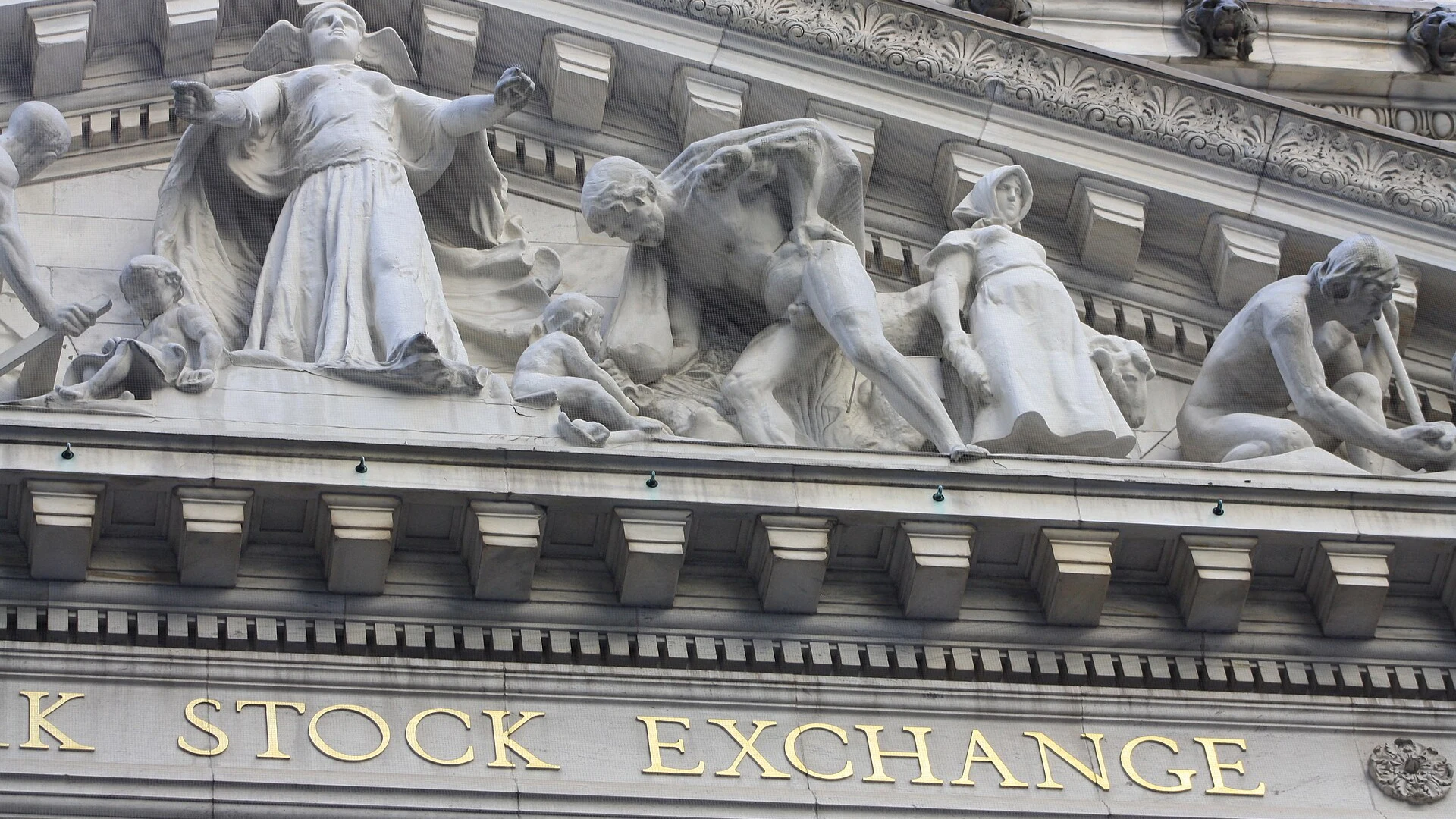
- Cover photo: New York Stock Exchange facade, pediment with gold 'STOCK EXCHANGE' lettering. Photographed 14 June 2024 — Photo: Ryan Schwark / Wikimedia Commons (CC0)