The Ground Shook Across Half of Peru — and Almost Nothing Broke
A powerful earthquake shook Peru on Friday night, sending residents of Lima rushing into the streets, evacuating the country's Congress and rattling buildings across a vast swathe of the Andean nation — yet by Saturday morning the toll was, remarkably, no deaths and only minor damage. The earthquake, measured at magnitude 6.7 by both the United States Geological Survey and Peru's Geophysical Institute, struck at 7:09pm local time (00:09 GMT on Saturday), with its epicentre in the central Junín region — 30 kilometres north-west of the city of Junín, according to the Peruvian institute, or 9 kilometres north-east of Carhuamayo, according to the USGS. An initial wire report put the magnitude at 6.8. The quake was felt across Lima, some 320 kilometres from the epicentre, and in Callao, Huánuco, Pasco, Áncash, Ica and Ucayali — across roughly half the country.
The first reports from the capital described a long, rolling shake. People poured out of apartment blocks and houses onto the streets of Lima; lawmakers were evacuated from Congress as the building swayed. The tremor was strong enough to be felt clearly in the coastal districts of the capital and in the highland towns of the interior alike. Yet within hours it was clear that the shaking had done far less damage than a quake of this size usually does. The USGS issued a green alert under its PAGER system, indicating a low likelihood of casualties or significant damage, and the Peruvian Navy ruled out any tsunami. The country's civil defence agency, INDECI, and its emergency operations centre, COEN, later tallied about 34 damaged houses, rockfalls blocking stretches of the Carretera Central highway and the Costa Verde coastal road, and power outages in Pichanaqui, Satipo, Junín and Cerro de Pasco. A university campus in La Merced suffered structural cracks, and at least one person was reported injured in Lima.
The reason the earthquake was felt so widely yet damaged so little lies in its depth. The quake struck 129 kilometres below the surface, according to Peru's Geophysical Institute — 108 kilometres by the USGS measurement — far deeper than the shallow quakes that typically devastate cities. At that depth, the energy spread over an enormous area, which is why the shaking was felt from the coast to the Amazonian foothills, but it arrived at the surface weakened, sparing the buildings above. "The ground shaking was intense," said Hernando Tavera, president of the Geophysical Institute, "there have been landslides and rockfalls on the hillsides." The depth, in other words, turned what could have been a catastrophe into a fright.
The contrast with Peru's recent history makes the point. In July, a magnitude 5.1 earthquake in the same Junín region — a far smaller quake — killed six people, injured 32 and destroyed 52 homes, because it struck close to the surface. Friday's quake was more than thirty times more powerful in energy terms, yet its toll was a fraction of that. Peru sits on the Pacific Ring of Fire, the arc of seismic activity that runs around the Pacific Ocean, and is no stranger to devastating earthquakes; the country has lived with the knowledge that a major quake could strike at any time. That history made the restraint of Friday night's damage all the more striking — and a reminder of how much depends on where, and how deep, the ground breaks.
The authorities moved quickly to manage the aftermath and the anxiety. Defence Minister Rafael Belaunde said "minor damage was reported to homes... interruptions of electricity service" and "no harm to people". Emergency crews worked through the night to clear the rockfalls from the highways and restore power to the affected towns, and engineers were sent to assess the cracked buildings. The Geophysical Institute, meanwhile, cautioned against false information circulating on social media, reminding Peruvians that earthquakes cannot be predicted — a warning aimed at the rumours that inevitably follow a night like this one.
For the millions who felt the ground move beneath them, the quake was a reminder of the country's vulnerability — and of its luck. The shaking will be assessed in the coming days as damage reports come in from the more remote parts of Junín, and the power outages and blocked roads will take time to clear. But the early picture is one of a country that was shaken, frightened and largely spared. In a nation that has buried thousands in earthquakes past, that counts as good news.
- Reuters via Q106 — Magnitude 6.8 quake strikes Peru, sending Lima residents from homes
- USGS via GSM Global News — Peru earthquake
- Particle News — 6.7 magnitude quake shakes Junín and is felt across much of Peru
- Devdiscourse — Magnitude 6.8 quake in Peru's Andean region sends Lima residents onto streets
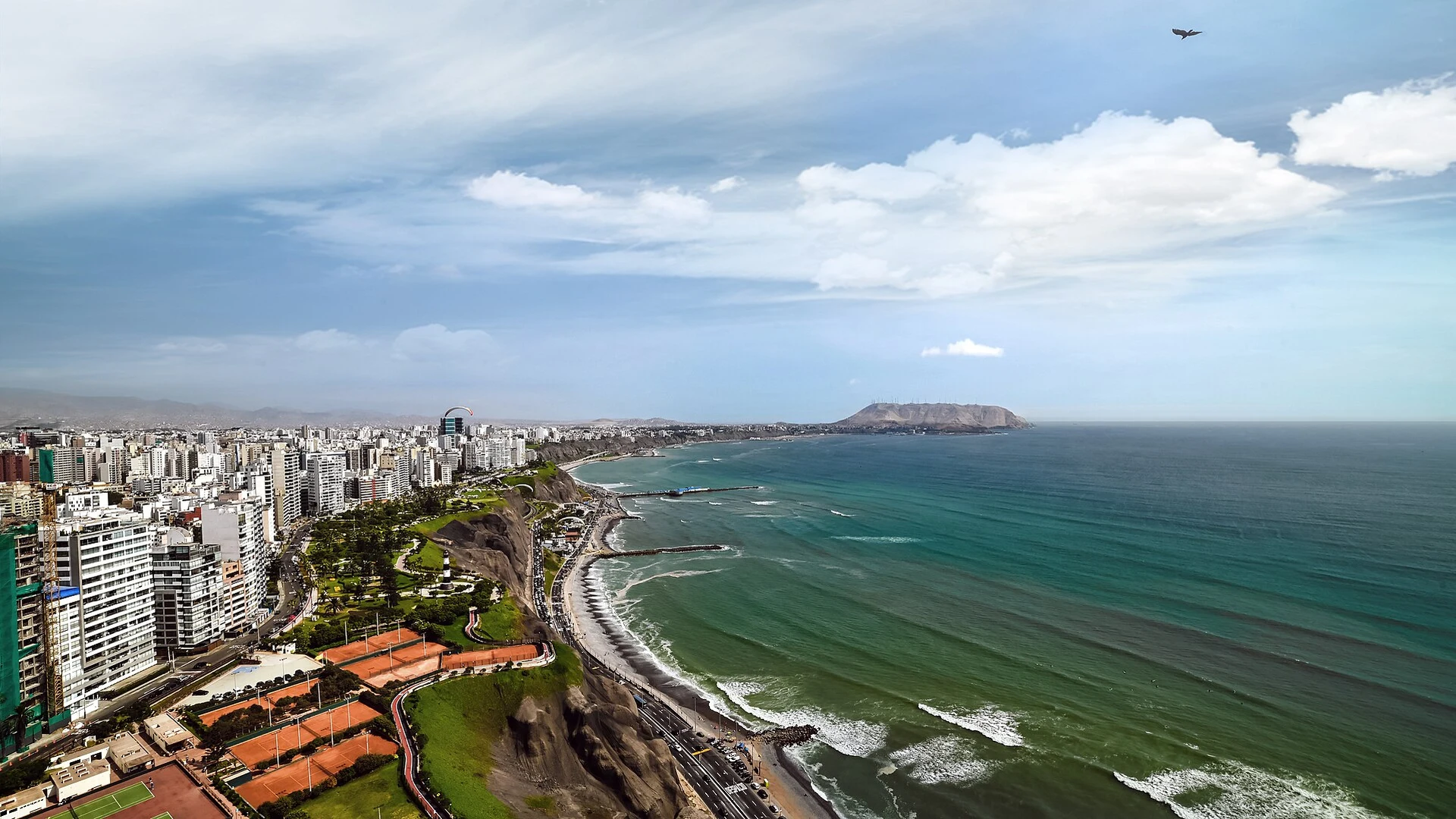
- Cover photo: Malecón de Miraflores coastline, aerial view, Lima, Peru. Photographed 19 July 2018 — Photo: Alec Gamoff / Wikimedia Commons (CC BY)