The Climate Summit That Forgot Fossil Fuels: COP31 Stumbles Into Overtime
The United Nations climate summit in Antalya, Türkiye, slipped into overtime on Friday night with no final deal in sight, after a draft agreement stripped out every reference to moving away from fossil fuels — the central promise of the Paris Agreement's last great breakthrough — and prompted warnings that the meeting could go down as the worst climate summit in history. COP31, co-hosted by Türkiye and Australia and attended by delegations from around 200 countries, was scheduled to end on Friday. Instead, negotiators worked through the night, with a third draft of the final deal due on Saturday morning, and the summit's president, Murat Kurum, telling delegates: "We are close to the finish line but not there yet."
The second draft of the agreement, published on Thursday, was the document that set off the alarm. It removed all mention of transitioning away from fossil fuels after objections from Saudi Arabia and other major oil and gas producers, and it dropped a proposed target of $120 billion a year in adaptation finance. At least 23 countries registered their dismay. If adopted in anything like its current form, it would be the first COP outcome to acknowledge that the world will overshoot the 1.5°C limit set by the Paris Agreement — the draft says any overshoot should be kept "as small and short as possible" — a concession that, only a few years ago, would have been unthinkable. The science makes the admission hard to avoid: October 2026 was 1.8°C warmer than the mid-1800s, according to Berkeley Earth. But acknowledging the overshoot while abandoning the language that was supposed to prevent it struck many delegations as a surrender dressed up as realism.
The draft did retain one headline target: "35 by 35", the goal of raising electricity's share of total energy use from about 21 per cent today to 35 per cent by 2035, backed by some 90 countries. But it contains no requirement that the additional electricity come from renewable sources, so power generated by burning fossil fuels could count towards it. The adaptation finance section was similarly hollowed out: the commitment to triple adaptation finance by 2035 was reaffirmed, but with no details on how it would be calculated, and the text of the finance work programme was stripped of substance. The just-transition mechanism and the global goal on adaptation are both stuck, their draft texts wholly enclosed in brackets — the negotiators' mark for text that has not been agreed at all. The United States, the world's largest historical emitter, is absent for a second consecutive year, after President Trump ended cooperation with the process and called global warming a hoax.
The reaction from those who have spent their lives in these negotiations was bleak. Mohamed Adow, the founder of Power Shift Africa, warned of the "worst COP ever". Ghiwa Nakat of Greenpeace Middle East and North Africa said weakening fossil-fuel commitments "risks undermining progress". Panama's environment minister, Juan Carlos Navarro, wrote an open letter vowing to block any outcome that failed his eight demands, including a cap on oil production, and accused the talks of being held hostage to a "petroleum mafia". Alden Meyer of the think tank E3G said: "Unless things change by tomorrow, we are heading for a very disappointing outcome." Civil society groups dubbed the summit the "worst COP in history". During a late-night session, delegates passed a protest banner reading "failure", and a demonstrator interrupted Mr Kurum, shouting "you are killing the future".
Not everyone has given up. Australia's climate minister, Chris Bowen, who is leading the negotiations, insisted he was determined that COP31 would "not be remembered for that" — the admission that 1.5°C will be overshot — and told delegates: "We won't be leaving the rooms of Antalya until we have that consensus." And outside the main negotiating halls, a coalition of the willing has been building its own momentum: Vanuatu, Denmark, Spain, Portugal, Luxembourg, Ireland and Tuvalu have released or announced roadmaps for phasing out fossil fuels, bringing the total number of countries with such plans to 25. Their argument is that the summit's failure, if it comes, will be a failure of the consensus process, not of the countries that want to act.
What happens next will be decided in the small hours of Saturday, when the third draft lands and the delegations that have threatened to block a weak deal must decide whether to do so. If the fossil-fuel language is restored, or a credible finance package appears, the summit may yet be salvaged. If it is not, COP31 will be remembered as the summit that admitted defeat on 1.5°C and dropped the language that was meant to prevent it — and the next summit, in Addis Ababa, Ethiopia, will inherit a process whose credibility is in tatters. On Reddit's r/climate, a thread on the scrubbed draft drew 238 upvotes and anger — "The status quo has a death-grip choke hold on our children and grandchildren, and COP31 is allowing that — as they all have done since the start", one user wrote — while a separate thread with 565 upvotes debated whether the 1.5°C goal is effectively dead. For a world that has just lived through its hottest October on record, the stakes could hardly be higher.
- Reuters — COP31 climate talks spill into overtime as nations quarrel over fossil fuels
- UN News — COP31 talks continue as draft deal divides nations
- Carbon Brief — Debriefed 20 November 2026: deal distant, fossil-fuel fractions, coalitions seek progress
- AP via LA Post — Nations still seeking deeper fossil-fuel cuts as annual UN climate change summit enters final day
- Fast Company — 'Worst COP ever': climate talks in Turkey near finish line amid activists' uproar
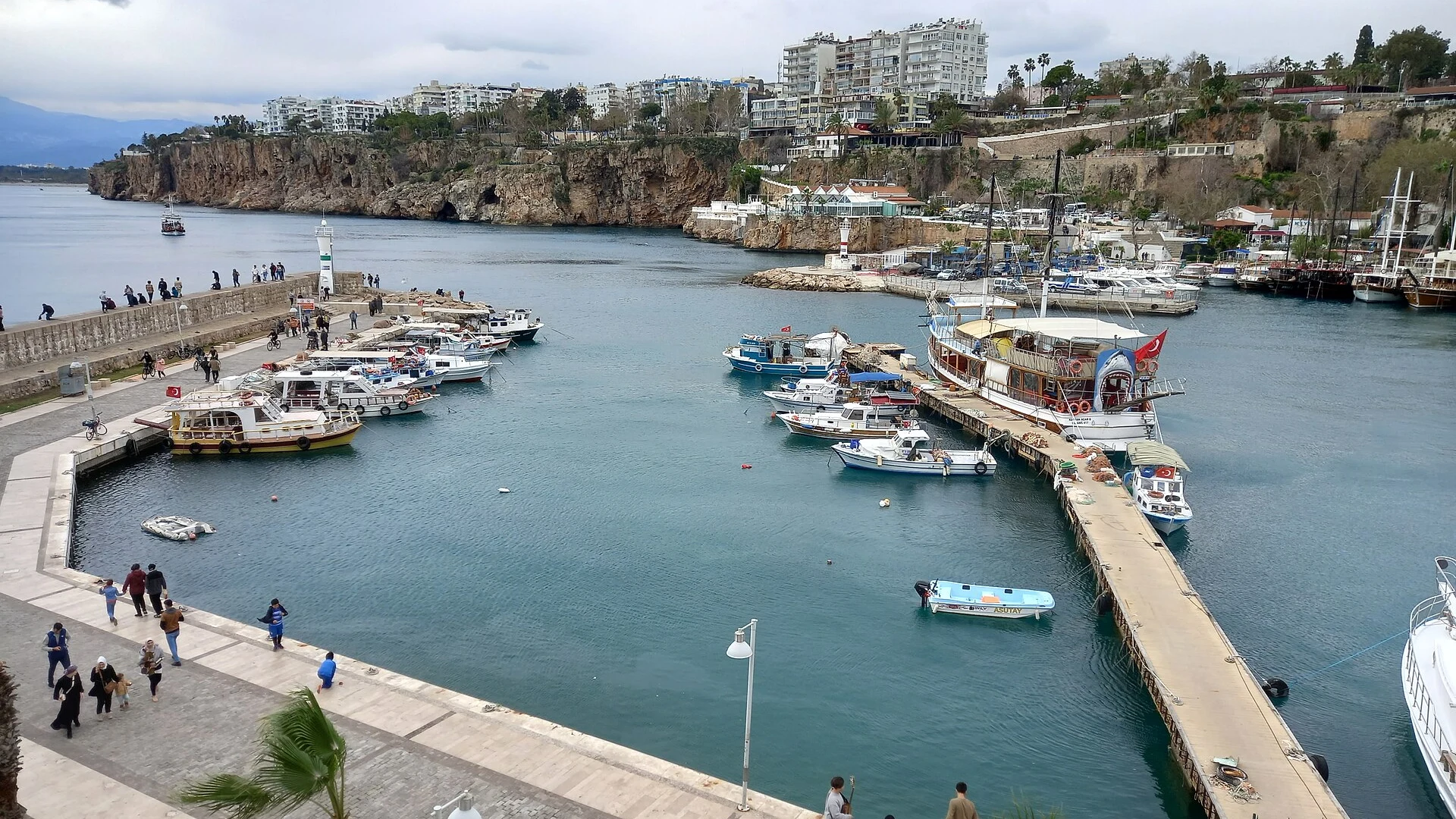
- Cover photo: Kaleiçi marina / harbour, Antalya, Türkiye. Photographed 19 March 2023 — Photo: Mike Finn / Wikimedia Commons (CC BY)