Trump Readies a New Tariff Blitz on Sixteen Trading Partners as the Old Duties Face the Courts
The Trump administration is poised to unveil a new round of tariffs on sixteen of America's largest trading partners, according to three people familiar with the matter cited by Reuters, in a move that would rebuild the president's global tariff regime after the Supreme Court struck down its first version in February. The findings of an investigation into excess industrial capacity, conducted by the United States Trade Representative under Section 301 of the Trade Act of 1974, are expected as soon as Tuesday or Wednesday, and the Trade Representative's office is expected to propose new import duties that would stack on top of tariffs already imposed during Trump's second term. The White House and the Trade Representative's office did not respond to requests for comment.
The probe, launched in March, covers most of America's biggest trading partners: China, the European Union, India, Japan, South Korea, Mexico, Vietnam, Taiwan, Thailand, Malaysia, Indonesia, Switzerland, Norway, Singapore, Bangladesh and Cambodia. The administration has singled out China as the biggest source of excess industrial capacity, which it says is flooding global markets with steel, aluminium, electric vehicles, appliances, solar products and other goods. Officials have floated a two-step approach: set steep tariffs to match the subsidies they say foreign governments provide, then suspend them down to levels agreed in trade deals. Ryan Majerus, a former senior Commerce Department trade official now at the law firm King & Spalding, said he expected a lengthy report with differentiated remedies for each of the sixteen partners, and that the administration could propose rates of 15 to 25 percent on imports from countries deemed to have excess capacity in various sectors.
The duties would not be a blanket rate. The White House is expected to honour the caps written into trade deals already negotiated during Trump's presidency: 20 percent on second-term tariffs on Chinese goods, so long as a trade truce due to expire on 10 January is extended, 15 percent on goods from the European Union, Japan and South Korea, and 19 percent for Malaysia. Thanks to those caps and duties already on the books, the European Union, Japan and South Korea could see modest increases of just 2.5 to 5 percent, while Vietnam, Cambodia and Malaysia could be hit harder. Goods from Mexico and Norway are unlikely to face any immediate levies, one of the people said. Oil, gas, fertiliser and other goods America does not make are expected to be exempt, and steel, aluminium and automobiles are already covered by separate national-security tariffs.
The timing is political as well as economic. The new duties are designed in part to replace the global "Liberation Day" import taxes the Supreme Court struck down in February, and they come just weeks after voters handed Republicans a drubbing in the midterm elections, amid anger over rising prices tied to tariffs. A Reuters/Ipsos opinion poll after the midterms found that 62 percent of respondents would support efforts to repeal the tariffs, which have in part contributed to higher prices on consumer goods in the United States. The household cost is also the subject of heated online debate: a thread on Reddit's r/Economics arguing that repealing the tariffs could save more than $1,100 per household drew more than 3,400 upvotes in recent days, while another highly upvoted thread there cited ProPublica reporting that corporations were spending tariff refunds on bonuses rather than reimbursing consumers. The administration has also vowed to hit Mexico with harder tariffs over claims it is allowing migrants to reach the southern border, and the expected announcement comes in the middle of tense talks over renewing the United States-Mexico-Canada Agreement. Global trade will also be on the agenda at the G20 summit in Miami, hosted at the president's golf resort in Doral.
The Trade Representative launched the excess-capacity probe in March alongside a separate investigation into weak or lax enforcement of anti-forced-labour laws in 59 countries and the European Union, and the new duties would pile on top of the 10 to 12.5 percent tariffs Trump imposed in July over forced labour in foreign supply chains. Like Trump's other post-Supreme Court levies, any final duties are expected to land in court. The Wall Street Journal reported earlier that the probe's results could be unveiled as soon as this week, and the New York Post reported that Trade Representative Jamieson Greer was set to announce the measures later on Tuesday, ahead of the Thanksgiving holiday.
What to watch now is the detail: the rates proposed for each country, the exemptions, and the market reaction when trading opens. If the caps hold, the immediate impact on Europe, Japan and South Korea may be modest; for China, everything depends on whether the truce expiring on 10 January is extended. For American consumers, the question is whether a new round of duties pushes prices higher still — the issue that cost Republicans at the ballot box this month. And for the sixteen governments in the probe's sights, the announcement will set off a fresh round of lobbying, retaliation threats and hurried diplomacy before the duties take effect.
- Reuters
- BusinessWorld
- New York Post
- TradingView / Bloomberg
- Reddit — r/Economics, repealing tariffs could save $1,100 per household
- Reddit — r/Economics, tariff refunds spent on bonuses
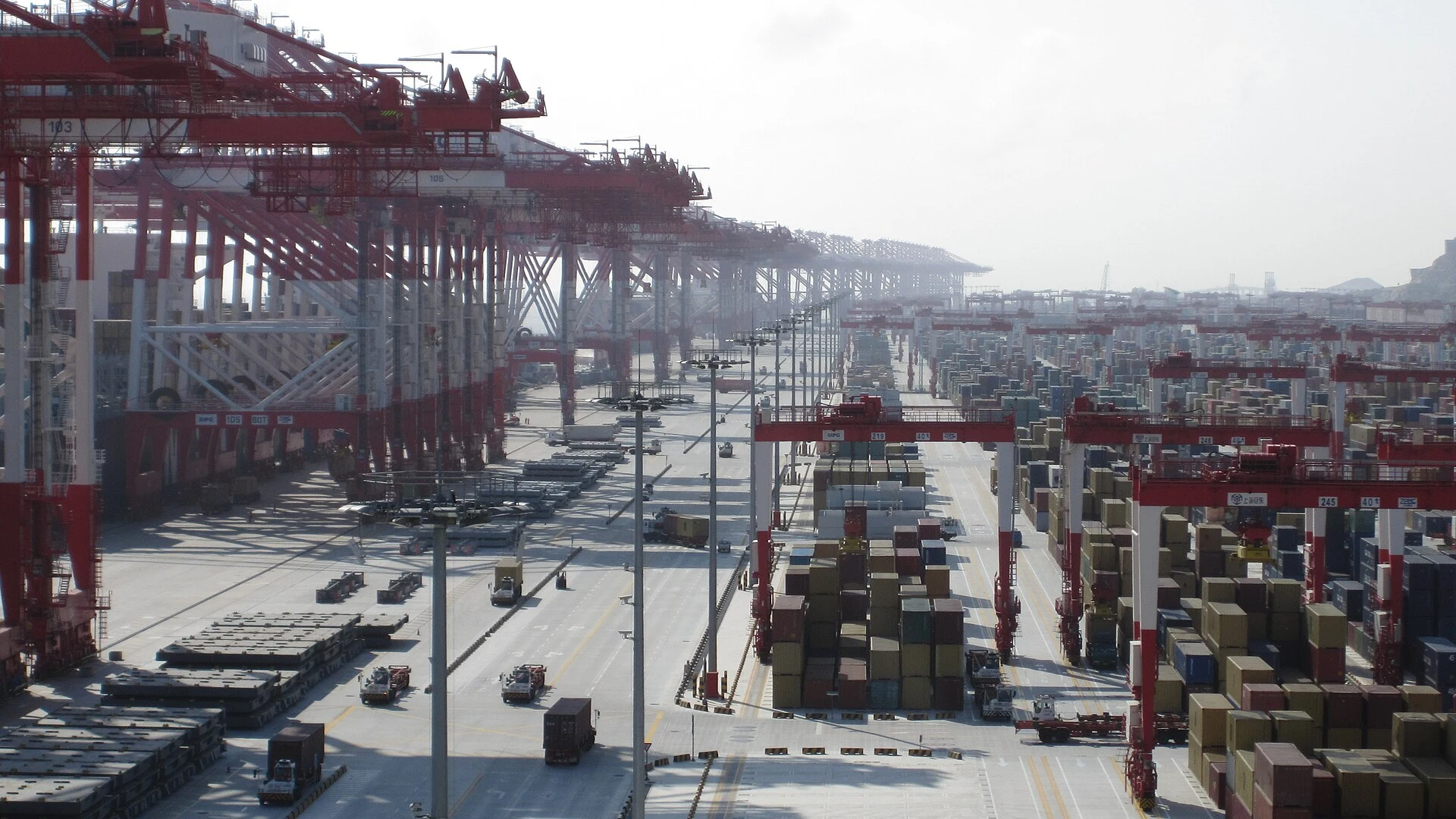
- Cover photo: Containers and cranes at Yangshan Port, Shanghai, photographed 17 June 2009 — Photo: Reb42 / Wikimedia Commons (CC BY)