Two More Tankers Burn in the Strait of Hormuz as Iran Vows to Tighten Its Grip — and Qatar Races to Keep Talks Alive
Two oil tankers struck naval mines, exploded and caught fire in the Strait of Hormuz early on Wednesday, Iran's Revolutionary Guards Navy said in a statement carried by state media, in the latest attack on shipping through the world's most important oil waterway. The Guards said the vessels had been attempting to transit an unauthorised route through the strait. The United Kingdom Maritime Trade Operations agency separately reported three more vessels struck by projectiles while travelling eastbound through the strait, and Iran's Fars news agency said a fourth tanker had hit a mine on Tuesday. The Iranian claims have not been independently verified: the multinational Joint Maritime Information Centre, which monitors shipping in the region, said the mine-strike claims were unconfirmed, though it recorded 114 passages through the strait with American assistance between 19 and 21 November.
The attacks continue a campaign that has escalated sharply in recent weeks. The United States and Iran have been at war since the end of February, and the number of attacks on shipping soared in October to the highest level since the war began, continuing at nearly daily occurrences so far in November, according to data compiled by Bloomberg. At least 22 attacks in and around the strait have been confirmed this month, and the flow of ships has collapsed: ship-tracking data counted 125 crossings in the week to Monday, down almost 45 percent from 226 in the first week of November, leaving around 18 vessels a day against a pre-war rate of 125 to 140. Oil flows through the strait are running at only about 49 percent of normal levels. Only on Tuesday, this site reported three tankers catching fire after hitting mines; Wednesday's incidents show the assault on shipping is intensifying rather than easing.
Iran is making clear that the pressure will only grow until its demands are met. Major General Amir Hatami, the commander-in-chief of Iran's army, told senior commanders that until Iran's seven conditions were satisfied, the strait "must be closed further day by day, conditions for the enemy must become more difficult, and stronger control will be exercised over it", warning that any new American military action would draw blows "more severe, more crushing and without geographical limitation". The Iranian navy has told tanker owners they are "required to coordinate with the armed forces to ensure safe passage", and Foreign Minister Abbas Araghchi said discussion of reopening the strait was "pointless" while Iran's demands went unmet. Tehran wants the American naval blockade of its ports lifted, sanctions eased and frozen assets released, and an end to the war on all fronts; through Qatari mediators it has offered to reopen the waterway within 48 hours of Washington meeting its conditions.
Diplomacy is still running, but the two sides remain far apart. Qatar's prime minister, Sheikh Mohammed bin Abdulrahman Al Thani, met Vice President JD Vance and Secretary of State Marco Rubio in Washington on Monday to try to restart talks, saying afterwards that "the situation in the Middle East cannot afford a new escalation between the US and Iran". President Donald Trump has said diplomacy will continue but that he may resume attacks after the New Year if no agreement is reached, and NBC reported that administration officials are deciding whether the military should target Iran's top leaders. Trump said of Iranian tankers attempting to run the naval blockade: "I hope they do, they'll all be at the bottom of the sea like the rest of the navy." On Monday the Treasury imposed fresh sanctions on 22 entities and eight people in what it calls Iran's shadow banking network, stretching across Iran, Dubai, Hong Kong and Turkey. Renewed hostilities between Saudi Arabia and Yemen's Houthis are meanwhile threatening a second important maritime corridor.
Oil markets, for now, are refusing to panic. Brent crude traded at around $90 to $91 a barrel on Wednesday, with American benchmark West Texas Intermediate at about $81, both lower on the day as signs of rising supply outweighed the renewed attacks. Brent has tumbled by more than a fifth this month, after Trump held off on renewed strikes following the Democrats' sweep of the midterm elections and as Gulf producers managed to export more crude. Analysts at ING wrote that the prospect of negotiations had eased some immediate concerns over Middle East supply, "however, significant differences between the US and Iran remain, leaving oil vulnerable to any setback in talks". Online, the attacks are being followed closely: threads on Reddit's r/oil and r/energy tracking the burning tankers have drawn thousands of upvotes and more than a thousand comments in recent days.
What happens next turns on a deadline Trump has effectively extended into the new year. Qatar's mediation continues, but with Tehran demanding the blockade lifted before it fully reopens the strait and Washington unwilling to concede, a breakthrough looks distant. If the talks fail, the administration is openly weighing renewed strikes — and, according to NBC, action against Iran's leadership itself. For the shipping industry and the economies that depend on Gulf oil, the calculation is stark: the strait through which roughly a fifth of the world's petroleum liquids normally pass is now a mined, contested waterway, and every day without a deal makes the next tanker transit a gamble.
- Reuters
- OilPrice
- PrimeXBT
- EmiratesWire
- FullAvante News
- Flagship Energy
- Reddit — r/energy, towering inferno in the Strait of Hormuz
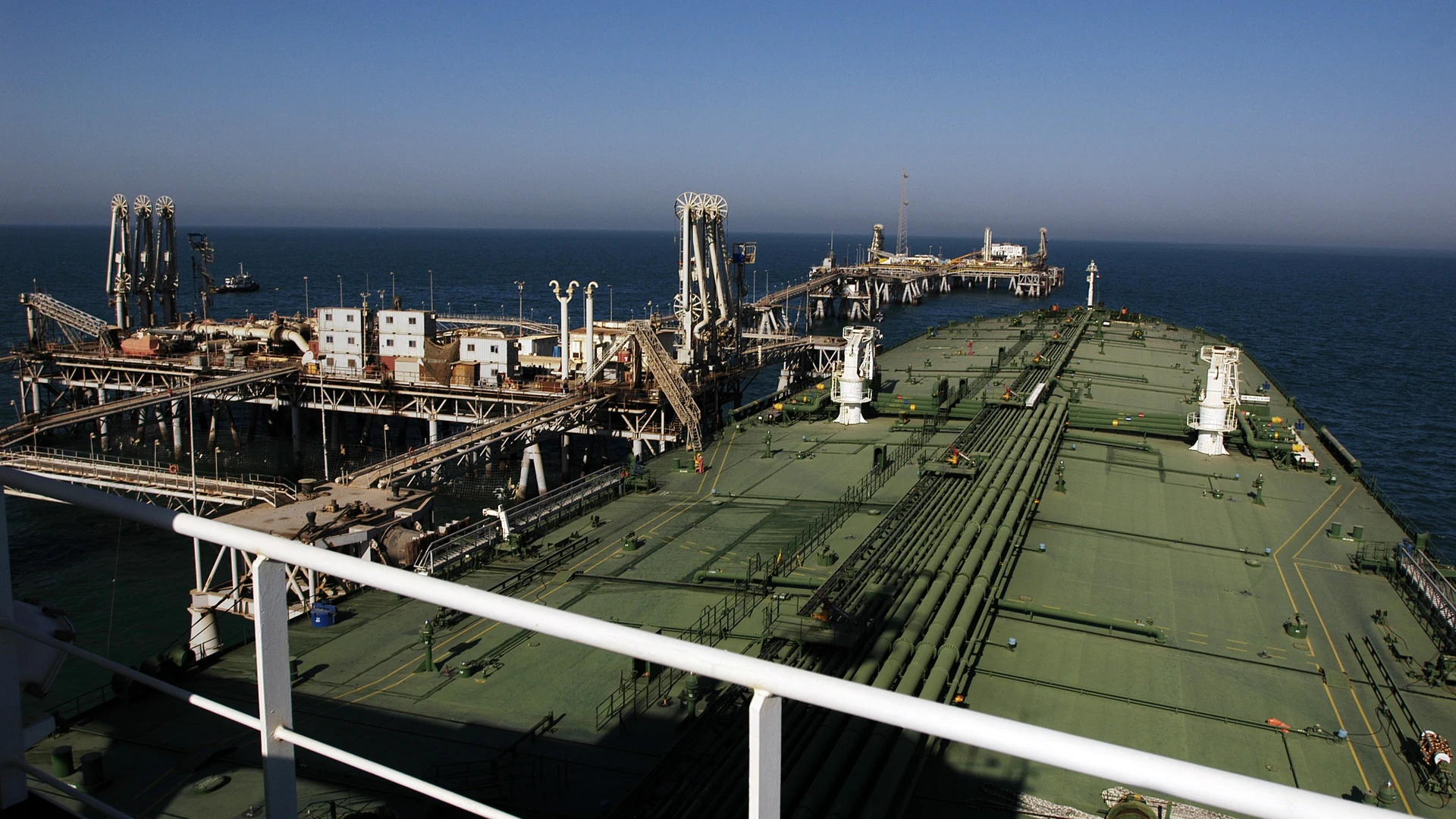
- Cover photo: An oil tanker docked to the Al Basrah Oil Terminal takes on crude oil in the Persian Gulf, photographed 11 November 2005 — Photo: U.S. Navy / Wikimedia Commons (Public domain)