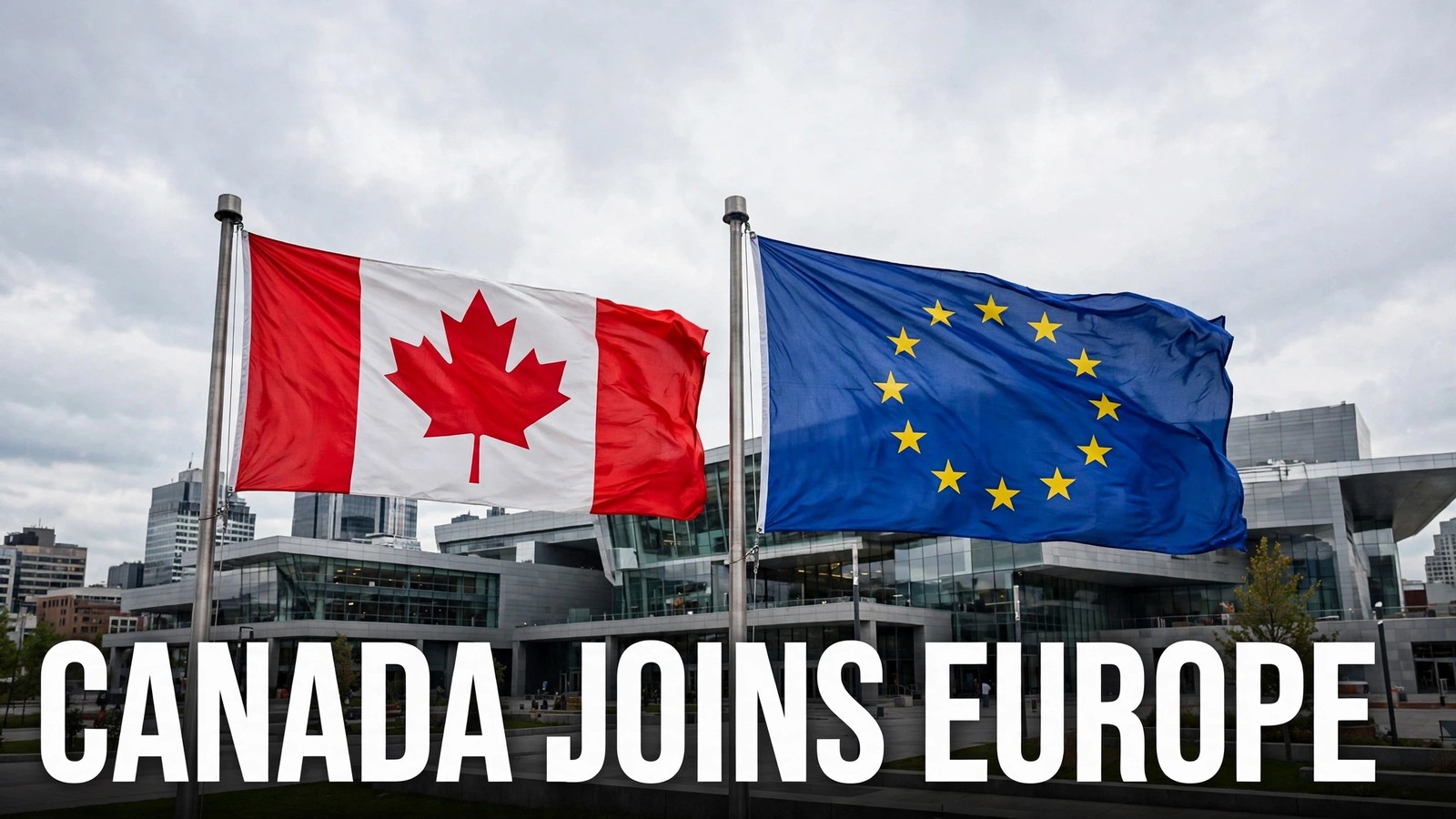
Canada and Europe Just Redrew the Map of the West — Without Washington
In Montreal on Friday, 30 October, Canada and the European Union launched an “Alliance for the Future” after two days of talks, setting out a closer partnership on trade, security and strategic industries. Prime Minister Mark Carney hosted European Commission President Ursula von der Leyen and European Council President António Costa. Carney described a world of growing danger and division, warning of eroding democratic norms and “the weaponization of trade.”
The alliance is intended to produce practical cooperation. The leaders announced the conclusion of negotiations on a digital trade agreement and signed a framework allowing the European Investment Bank to consider financing Canadian projects, with critical raw materials expected to be an early focus. They also committed to advance cooperation on artificial-intelligence security and safety. Carney said the summit had produced more than twenty measures aimed at affordability, opportunity and sovereignty. The joint declaration describes a goal of creating a “common prosperity and economic security space.”
Ukraine was another immediate focus. Canada announced its intention to join the European Union’s €90 billion Ukraine Support Loan, and Carney said Ottawa would contribute an initial €500 million. The commitment would add a non-European partner to a major European financing effort for Kyiv as it continues to defend itself against Russia’s invasion. The joint statement records Canada’s intention to join the loan; the detailed contribution and implementation arrangements are to follow.
The summit’s most politically charged idea concerned Canada’s future relationship with the EU. Carney said the two sides were working toward the closest possible partnership and described Canada as a potential first “associate member.” Von der Leyen said geography ruled out full membership but that the EU wanted to bring Canada as close as possible. The final joint declaration does not use the term “associate membership”; instead, it commits the partners to define an “ever-closer association” by their 2027 summit, with Carney saying he hoped to conclude negotiations in June.
That distinction reflects real disagreement inside Europe. Germany and other governments had raised concerns about the associate-member label, whose legal meaning has not been settled. For now, the agreed text establishes a process for closer cooperation rather than a new membership category. Digital trade rules still require formal signature and approval procedures, while EIB financing will depend on standard project review and approval.
The Montreal initiative also reflects efforts in Ottawa and European capitals to reduce economic vulnerabilities as trade tensions with Washington intensify. Carney has framed Canada’s heavy reliance on the U.S. market as a strategic exposure; the EU and Canada say their new framework is open to like-minded partners. Whether the alliance becomes a lasting shift will depend on turning agreements on minerals, digital commerce and technology into projects—and on resolving what “ever-closer association” will mean in practice. The partnership has been announced; its shape is still being negotiated.