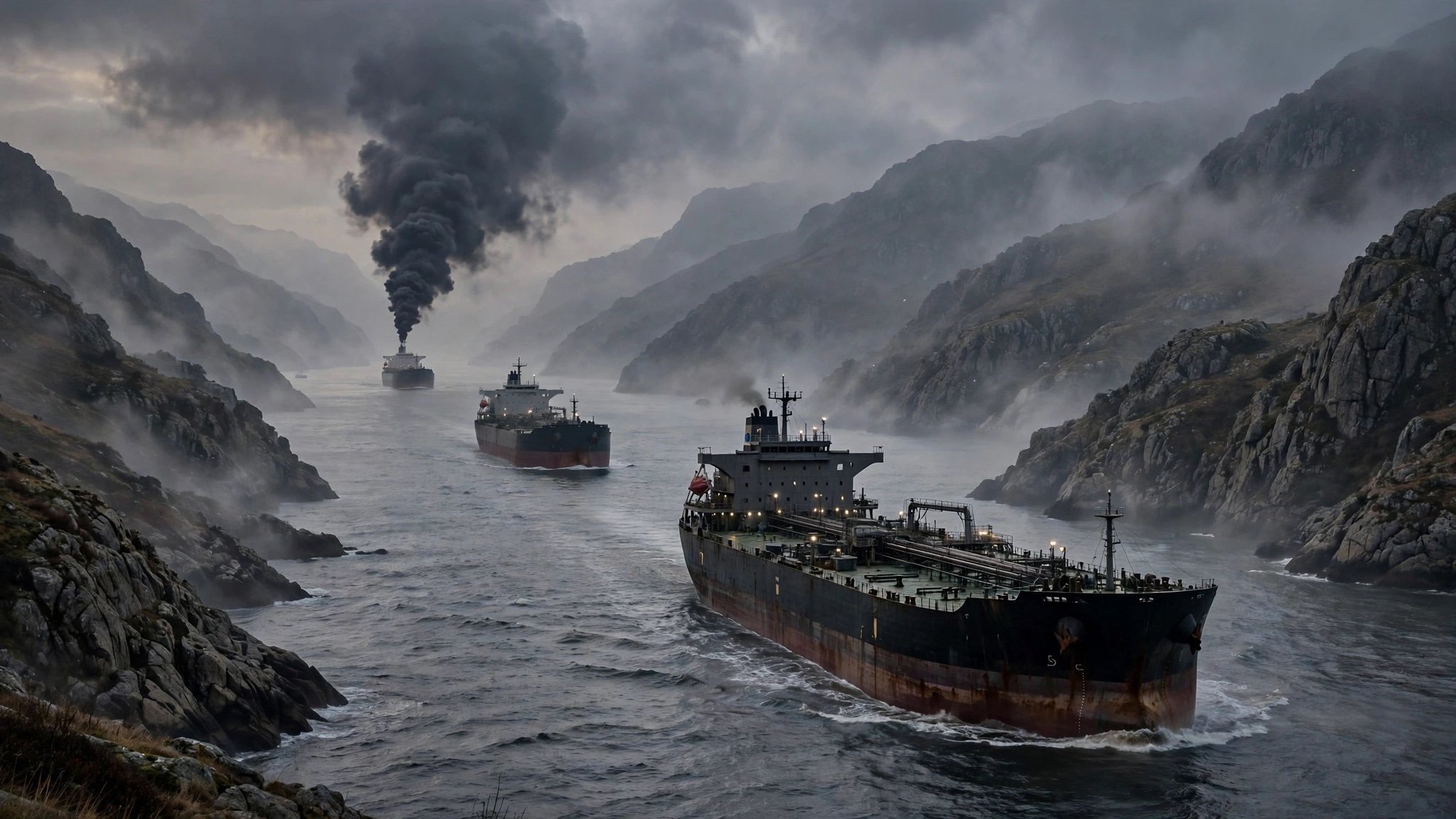
Two Days to Reopen the Strait — If Washington Meets Tehran's Seven Conditions
Iran and Qatari mediators have drafted a conditional framework under which the Strait of Hormuz could reopen within two days, provided the United States meets Tehran's conditions, Iranian Foreign Minister Abbas Araghchi said on Saturday. Speaking to Al Jazeera, Araghchi said discussions with the Qatari side had shortened the proposed implementation period for reopening the strategic waterway from five days to two. "The Qatari side proposed shortening the implementation period of the Iranian proposal to five days. We have reached a proposal at this stage that reduces the implementation period to two days," he said. The conditions he outlined included lifting sanctions imposed after the Islamabad memorandum, reducing United States military forces in the region, restoring oil waivers and releasing frozen Iranian funds, including funds held in Qatar. Iran is also seeking recognition of shipping routes through the strait that it has discussed with Oman, along with the closure of other routes, and Araghchi said reopening the strait in line with those conditions would pave the way for renewed negotiations with Washington on outstanding issues.
The fuller and harder version of Tehran's position came from Mohsen Rezaei, secretary of Iran's Supreme National Security Council, who said on Iranian state television on Saturday that the strait would remain closed until the United States met seven conditions and provided guarantees of Iranian interests. Rezaei said each of the seven conditions contained two or three further conditions, with the guarantees sought ranging across financial and other issues, and he indicated that Tehran was awaiting a final American response that could arrive as early as Sunday. He described how implementation would work on the water: if the American reply arrived, work could begin in a corridor through the centre of the strait, waters he described as shared with Oman and under Iranian administration, with ships following a route agreed by Tehran and Muscat. Washington has previously rejected joint Iranian-Omani management of the waterway and insists on free passage under international law. Rezaei is also the official to whom Vice President JD Vance addressed a letter delivered through Qatari mediators; he said on Saturday that he had read the letter but had not yet replied, while describing Washington's tone as having "completely changed", which he called a very good sign. Araghchi, for his part, said there were currently no plans for meetings with American officials and described reports of an imminent meeting as media speculation, while calling the Vance letter a positive step.
While the diplomacy moved through Doha, the language from Washington pointed in the other direction. President Donald Trump told reporters at his Mar-a-Lago club in Florida on Saturday evening that the United States had knocked out much of Iran's military and nuclear programme but still had "one or two sites" to take care of, adding, "We can do that in 10 minutes." He named a suspected underground nuclear complex, saying, "You probably could look at Pickaxe Mountain, and you have to take care of that." In the same remarks he said negotiations were "going fine" but that Tehran was "not very reliable", and he declined to say whether he would order renewed strikes. EA WorldView reported that Trump and Israeli Prime Minister Benjamin Netanyahu had spoken by telephone on Saturday morning about American plans to resume strikes on Iran. Separately, three senior Gulf Arab officials familiar with the discussions told reporters that the Trump camp was warning of possible strikes as early as 4 November, the day after the United States midterm elections on 3 November, expected to be brief but intense, while Gulf states pressed for de-escalation and one official said some Gulf countries might oppose the use of American bases on their territory. A White House official declined to comment on military plans that might or might not exist, saying only that Trump kept all options on the table to ensure Iran could never have a nuclear weapon.
The waterway at the centre of the dispute remained dangerous over the weekend. Qatar Gas Transport Company confirmed on Sunday that one of its liquefied natural gas tankers, the Al Mayeda, had been hit by "unidentified objects" in the Gulf on Friday night, with no crew members hurt, no environmental impact, and the vessel in a safe and operational condition while the impact was assessed. The incident followed a week in which Iran claimed tankers had struck mines and caught fire in the strait, claims the United States military rejected, saying the recognised transit routes had been cleared. US Central Command said on Wednesday, through spokesperson Captain Tim Hawkins, that traffic through the strait "continues to flow", that American forces had since early May assisted commercial vessels moving more than 900 million barrels of crude oil through the strait, and that more than 100 ships trying to violate the blockade on Iranian maritime trade had been redirected. The market reaction continued: Brent crude returned to $117.72 a barrel, almost 3 per cent higher on the day and its highest level since April, according to EA WorldView's update on 31 October, as traders priced in both the tanker attacks and the prospect of renewed American strikes.
The wider diplomatic setting offered little reassurance. Foreign ministers of the Group of 20 ended two days of meetings in Atlanta on Saturday without a joint statement and without the traditional group photograph, after European ministers objected to appearing alongside Russian Foreign Minister Sergei Lavrov. Secretary of State Marco Rubio acknowledged that the ministers recognised the importance of freedom of navigation through the Strait of Hormuz and the Black Sea, as well as food and energy security and mineral supply chains, but said, "I won't pretend that we are close to finding universally accepted solutions to these problems." The Atlanta meeting had served as preparation for the G20 leaders' summit due in Miami in December, and its failure to agree on the wars in Ukraine and Iran, on tariffs and on other issues underlined how far apart the major powers remain on the very questions the Hormuz mediation is trying to settle bilaterally. The context is an eight-month war begun by American and Israeli strikes on Iran on 28 February, with the Pentagon telling legislators that the cost of the American war on Iran had reached $47.1 billion by 16 October, and with the head of the International Atomic Energy Agency, Rafael Grossi, telling the UN Security Council that since June 2025 no activity to repair or reconstruct damaged nuclear facilities had been identified, and that Iran had not provided the information and access needed to verify previously declared nuclear material, including 440 kilograms of highly enriched uranium.
What happens next turns first on whether Washington's reply arrives on Sunday, and on what it contains. Tehran has sequenced the negotiation firmly: the strait and sanctions first, the nuclear programme only afterwards, a position reported this week by Lebanon's Al-Akhbar and repeated by Iranian officials. Washington, in the Vance letter as reported, wants the nuclear issue on the table from the outset and negotiators empowered to resolve it. Between those two sequences sits the Qatari framework, a possible meeting in Doha or Istanbul within a week, and a calendar that gives both sides a reason to wait: the midterm elections on Tuesday, and the warnings, from Gulf officials and from Trump himself, that the days immediately after them could bring either a deal or a short, intense campaign. The strait may reopen in two days, as Araghchi proposed, or it may remain the place where diplomacy and military preparation run in parallel until one of them gives way.