Nvidia Ordered to Explain $12bn of Chips Bound for China as Huang Weighs a Comeback
Nvidia has been ordered to explain to the US administration whether it benefited from illicit sales after it was accused of aiding the supply of close to $12 billion of its most advanced artificial intelligence chips to companies in China, The Times reported. The demand, delivered by Treasury Secretary Scott Bessent on Sunday, turns the crisis at the world's leading AI chipmaker into a direct confrontation with Washington — and it comes just four days after the company's founder and chief executive, Jensen Huang, resigned amid a scandal that has already wiped hundreds of billions of dollars from Nvidia's market value.
Mr Bessent, speaking on Fox News' "Sunday Morning Futures", said Nvidia's board and its outside lawyers should answer within ten days whether the company built a corporate culture of complying with US export controls. "I want to keep coming back to what was the culture at Nvidia and were they pressing these seemingly illicit sales to goose their revenues and their earnings?" he said. He called for a "dramatic shakeup" at the company and said flatly that its next chief executive should be recruited from outside. The allegations centre on Megaspeed, a Singapore-based computing business where Alice Huang — reported to have had a relationship with Mr Huang — was an executive. Megaspeed allegedly arranged to send top-of-the-range AI chips to China between March 2024 and June 2025, despite export controls supposed to restrict such sales. US officials suspect Megaspeed bought Nvidia chips ostensibly for use in its south-east Asian data centres and then transshipped them to China, helping Chinese companies evade export controls; the US Department of Justice is conducting a criminal investigation.
Mr Huang resigned as president, chief executive and a member of the board on Thursday 12 November, effective immediately, ending a 33-year run at the chipmaker he co-founded in 1993. The board named chief financial officer Colette Kress, its finance chief of 13 years, as interim chief executive and appointed board member Harvey C. Jones as its first-ever chair. The board's statement gave no reason for the resignation, and Nvidia has not said whether the reports were connected to it. The exit followed revelations about two extramarital relationships, one with an executive who reported to Mr Huang, and reports that US intelligence officials said this spring that Alice Huang was an asset of China's Ministry of State Security — a claim China has denied. Mr Huang acknowledged to employees that he had been unfaithful to his wife, and the board opened an investigation led by outside lawyers. No finding has established that Mr Huang engaged in espionage, or that Commerce Secretary Howard Lutnick knowingly facilitated illegal exports.
The market reaction has been brutal. Nvidia's shares fell as much as 14 per cent at the open on the day of the resignation, hitting a new 52-week low of $148.80, and closed 4.3 per cent lower. The stock fell about 12.8 per cent over the week, erasing roughly $573 billion in market value — the largest weekly decline for any company ever, according to The Wall Street Journal — and the company's market capitalisation has fallen below $4 trillion, down more than $1.8 trillion from its peak in early October. Yet the business itself has not yet shown the same damage: in the second quarter of fiscal 2027, Nvidia reported revenue of $96.2 billion, more than double the previous year's figure, with data centre revenue of $89 billion. The quarterly results due on Tuesday 17 November, the first since Mr Huang's departure, will provide the first major financial reference point under the new leadership, with analysts expecting revenue of $109.08 billion and earnings of $2.47 per share, according to LSEG estimates cited by CNBC.
Even as Mr Bessent pressed for an outsider, the Financial Times reported on Sunday that Mr Huang has discussed returning as chief executive with people close to him, and that Silicon Valley allies were assembling a "war room" of technology executives to campaign for his reinstatement and seek support from the White House. The newspaper identified Epic Games chief executive Tim Sweeney among supporters of a public "Bring Jensen Back" letter, which had gathered more than 160,000 signatures by Sunday evening. Nvidia and a spokesperson for Mr Huang declined to comment. The Financial Times also reported that Nvidia's directors had approached Arm chief executive Rene Haas about the role. Mr Bessent's intervention complicates any comeback: his remarks do not constitute a formal government decision about who should lead Nvidia, but they make clear that the administration wants a break with the old leadership — and answers first.
The scandal is also raising questions about accountability inside the Trump administration itself. On Friday, Mr Bessent told CNBC that several federal agencies had supported placing Megaspeed on an export blacklist for months, but the decision rested with the Commerce Department, led by Mr Lutnick. On Sunday, Democratic Senator Chris Van Hollen went further on ABC's "This Week", explicitly calling for Mr Lutnick's dismissal; Mr Lutnick has agreed to testify before the Senate Banking Committee. Online, the argument is playing out in public: on r/stocks, the report of Mr Huang discussing a comeback drew 1,658 upvotes and more than 640 comments, a separate thread on Mr Bessent's Fox News appearance drew more than 600 upvotes and 330 comments, and a Polymarket market on Mr Huang rejoining Nvidia was up 4.2 per cent on the day. What happens next comes fast: Nvidia reports third-quarter results on Tuesday, with Ms Kress leading the earnings call, and the board has ten days to answer Mr Bessent's questions about its compliance culture. Whether the company can steady itself under an interim chief while its founder plots a return — and whether the chip-diversion allegations prove to be a failure of compliance or something worse — will decide whether this is a leadership crisis or a reckoning for the company at the heart of the AI boom.
- The Times — Nvidia ordered to explain $12bn supply of AI chips to China
- InvestingLive — Bessent urges Nvidia to hire an outsider CEO, pouring cold water on a Huang comeback
- The Blast — Jensen Huang's Nvidia Drama Takes New 'War Room' Turn
- Seoul Economic Daily — Huang Eyes Nvidia Return as Bessent Urges Outside CEO Hire
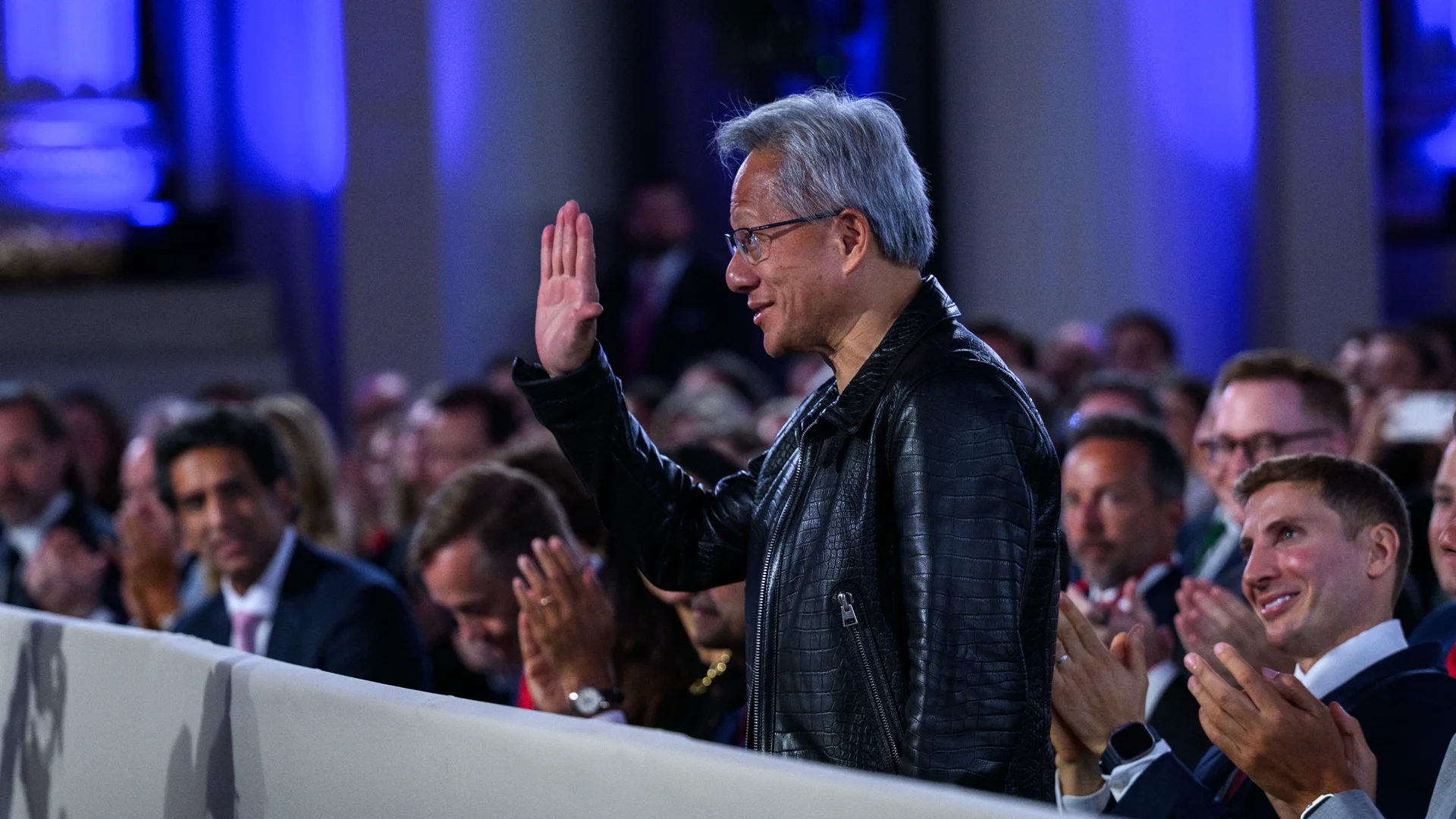
- Cover photo: Jensen Huang at the White House AI Summit in July 2025 — Photo: The White House / Wikimedia Commons (Public domain)