Nvidia Faces Investors Without Huang as Washington Closes the Chip Loophole
Nvidia will report quarterly results on Tuesday in the strangest circumstances of its history: record-breaking numbers, a missing founder, and a government in Washington that has just rewritten the rules for the company's most important market. The chipmaker releases its third-quarter results after the market closes, at about 4.20pm Eastern time, followed by an earnings call at 5pm — its first since Jensen Huang resigned as chief executive on 12 November, ending a 33-year run as the only chief executive the company has ever had. Interim chief executive Colette Kress, the company's finance chief of 13 years, will lead the call, with the board still searching for a permanent successor.
The figures themselves should be strong. Analysts expect revenue of roughly $109 billion, against the company's own guidance of $108 billion, and earnings of $2.47 a share. The quarter ended on 25 October, before Mr Huang's departure, so the results will show what Nvidia delivered under his leadership; the outlook for the current quarter, which Ms Kress will present, is the number investors will scrutinise for what the handover means. Gross margin is expected at about 74 per cent, slightly down from 75 per cent in the previous quarter, as the cost of high-bandwidth memory rises. In the previous quarter, Nvidia reported revenue of $96.2 billion, more than double the previous year's figure, with data-centre revenue of $89 billion.
But the numbers are not what the call is about. Reuters, citing anonymous sources, has reported that Nvidia's board is not considering bringing Mr Huang back — despite a public campaign for his return that has gathered more than 180,200 signatures and the backing of Elon Musk. Mr Huang resigned amid revelations about two extramarital relationships, one with an executive who reported to him, and reports that American intelligence officials said this spring that Alice Huang, a former executive at the Singapore-based computing business Megaspeed, was an asset of China's Ministry of State Security — a claim China has denied. No finding has established that Mr Huang engaged in espionage. Treasury Secretary Scott Bessent has demanded that the board and its outside lawyers answer within ten days whether the company built a corporate culture of complying with export controls, and has said the next chief executive should be recruited from outside. The market reaction has been brutal: the shares closed at $156.14 on Monday, and the company has lost about $800 billion in market value since the relationship became public.
On Monday, Washington moved from words to rules. The Commerce Department's Bureau of Industry and Security issued an interim final rule closing the "cloud loophole" that had let Chinese companies rent advanced American computing power from data centres abroad instead of buying the chips themselves. Data centres will now need a licence before supplying more than 12 million total processing performance of compute — roughly 750 of Nvidia's H100 or H200 chips — to firms in China or other restricted countries, and licences will be required for advanced-chip exports to Singapore, Malaysia, Indonesia, Thailand and Brazil, five countries the department says present a higher-than-normal risk of diversion. Existing operators have 90 days to obtain licences. The rule also formally rescinds the Biden administration's AI Diffusion Rule, which the Trump administration had said it would not enforce.
The rule is the Trump administration's first policy response to the scandal, and it lands in the middle of a public fight inside the administration itself. Mr Bessent said on Friday that the Treasury, the Pentagon, the State Department and the Trade Representative's office had favoured placing Megaspeed on an export blacklist for months, but that the Commerce Department, which controls the list, had not. The allegations centre on Megaspeed, which is accused of arranging to send close to $12 billion of Nvidia's most advanced chips to China between March 2024 and June 2025, despite export controls; the Justice Department is conducting a criminal investigation. Senator Maria Cantwell, the top Democrat on the Senate Commerce Committee, wrote to Commerce Secretary Howard Lutnick on Saturday accusing the department of failing to stem the flow of chips and of suspending a probe into Megaspeed. Mr Lutnick has agreed to testify before the Senate Banking Committee.
Online, the argument over Mr Huang's future is still running hot: a thread on r/stocks about the reported comeback discussions drew 187 comments on Monday, and a Polymarket market puts the chance of Mr Huang rejoining Nvidia at 32 per cent. What happens next comes fast: the earnings call on Tuesday evening, the board's ten-day deadline to answer Mr Bessent, and a 90-day clock for data-centre operators to comply with the new rule. Whether Nvidia can steady itself under an interim chief while its founder's return is ruled out — and whether the chip-diversion allegations prove to be a failure of compliance or something worse — will decide whether this is a leadership crisis or a reckoning for the company at the heart of the artificial-intelligence boom.
- USA Today — Nvidia set for first earnings call since Jensen Huang's resignation
- Saxo — Nvidia earnings preview: The first big test after Jensen Huang's exit
- Nextgov — Commerce Department moves to close AI chip loophole
- Reuters — Senator accuses US Commerce Department of failing to stem flow of AI chips to China
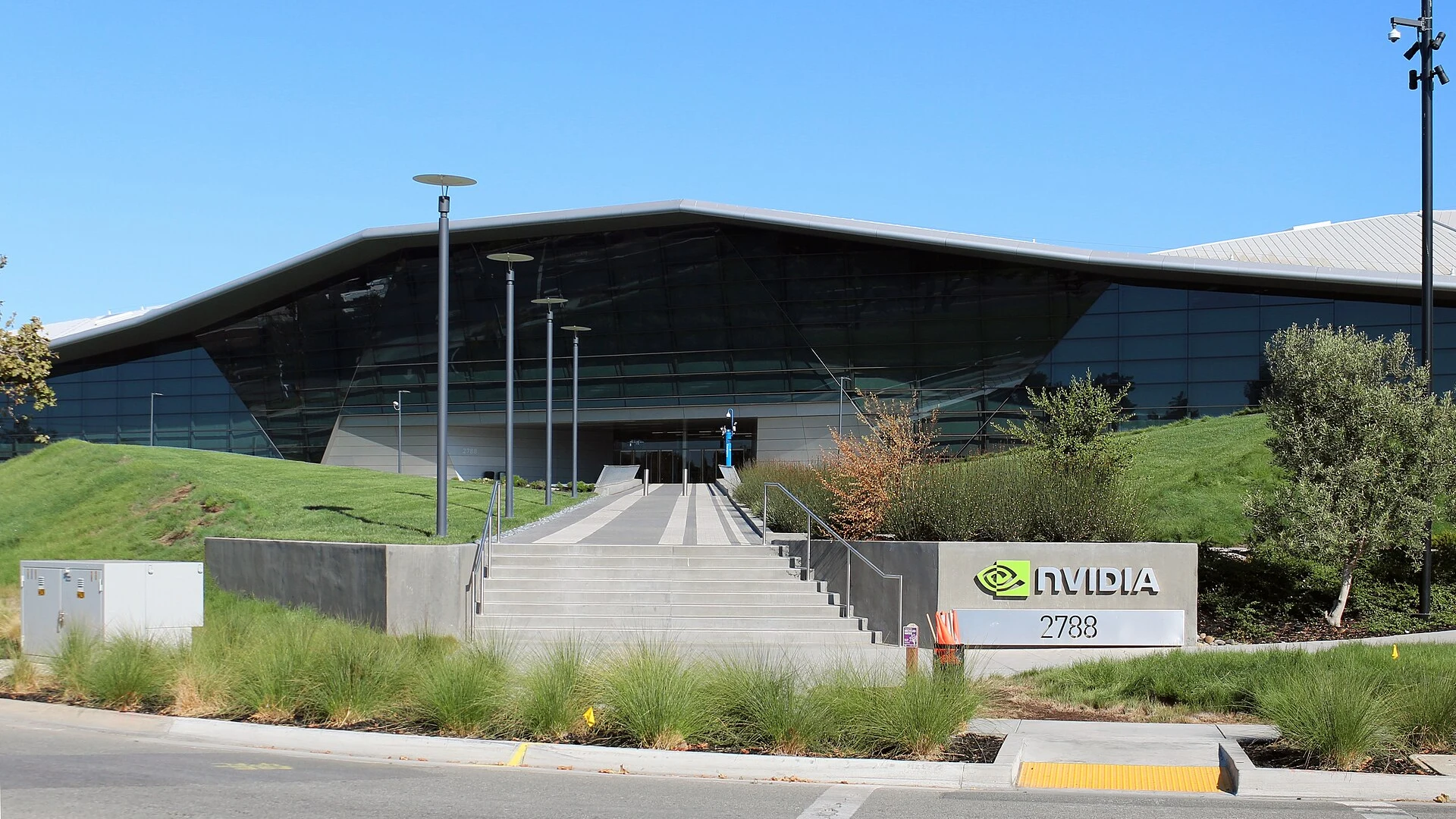
- Cover photo: Nvidia headquarters in Santa Clara, photographed 4 August 2018 — this is not a photo of the November 2026 earnings event — Photo: Coolcaesar / Wikimedia Commons (CC BY-SA 4.0)