Poland, on the Edge of a Constitutional Crisis
On Friday, 30 October 2026, Poland's long-running fight over its courts spilled out of courtrooms and into the street.
Riot police deployed around the Constitutional Tribunal in Warsaw, its president faced suspension, and President Karol Nawrocki turned his plane around in mid-air on his way to Senegal to return home. Opposition politicians called it a coup. Prime Minister Donald Tusk's government said it was restoring the rule of law. What is confirmed is a serious struggle over judicial authority in one of the European Union's most strategically important member states, and there is no independently verified evidence of a military takeover or the overthrow of Poland's national government.
To understand why this is happening now, you have to separate three things: what happened on Friday, what each side claims it means, and the ten-year history that made Friday almost inevitable.
What happened on 30 October
The crisis erupted in the afternoon of 30 October. Judge Anna Korwin-Piotrowska, one of the magistrates elected by the current Sejm, the lower house, in March 2026, signed an order that suspends for one month the functions of Tribunal President Bogdan Święczkowski and Vice-President Bartłomiej Sochański and assumed the direction of the court.
Korwin-Piotrowska was one of several judges elected by the current Sejm majority earlier this year, and she declared that she was assuming leadership as the longest-serving member of the bench. The profiles of both suspended judges disappeared from the institution's website, according to the official agency PAP.
Święczkowski, a former national prosecutor and PiS-era appointee who has led the court since late 2024, rejected the order outright and accused those involved of staging a coup d'état. His circle maintained that he is still president, that the website has been illegally taken over and that whoever acts against the court commits the crime of coup d'état.
The Tribunal's account on X later said Święczkowski remains in office, that Sochański remains deputy, and that Korwin-Piotrowska is not a judge of the court, calling the change to its website an illegal takeover. It also said she cannot act in his place because she has not taken the required oath.
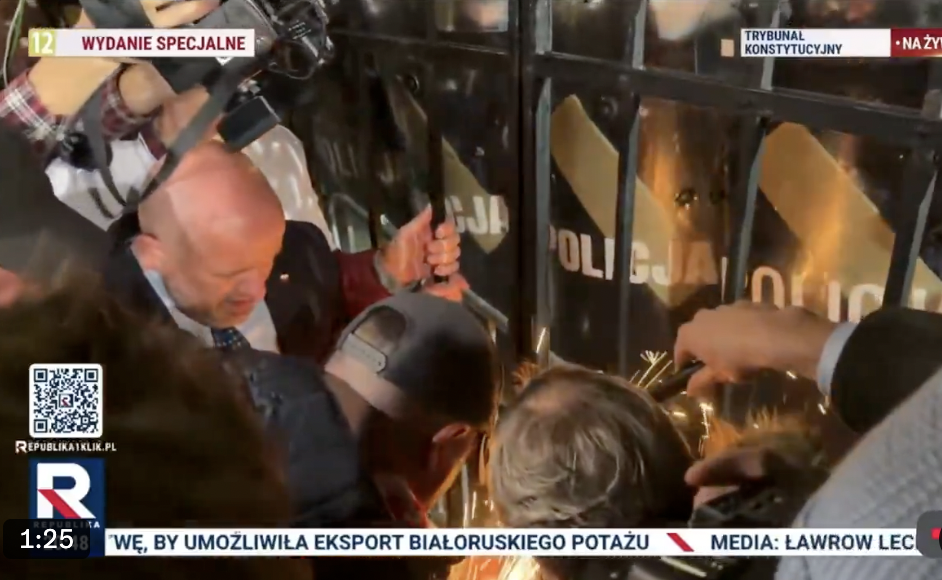
Reports differ on exactly what the police did, and that difference matters. One account said video footage showed police entering the Constitutional Tribunal on Friday evening. Another, citing police, said officers had not entered the building and were limiting themselves to the outer perimeter, after receiving written statements from the Justice Minister and from Korwin-Piotrowska warning of risks to judges and staff. Three people were detained for jumping the fence, according to Reuters reporting cited in the same account, and objects were thrown at officers. A separate report said three people were detained and demonstrators breached a perimeter fence.
What is not in dispute is that riot police were deployed in force outside the Tribunal's Warsaw headquarters, and that members of the opposition Law and Justice, PiS, party gathered outside to challenge the government's intervention.
Justice Minister Waldemar Żurek, who also serves as prosecutor general, said he submitted requests to lift the immunity of Święczkowski and Sochański so that criminal charges could be brought against them for allegedly preventing lawfully elected judges from performing their duties. Another report put the number at five requests to strip judicial immunity.
Korwin-Piotrowska, according to one report, called a general assembly of the court's judges for 3 November. That date is now the next flashpoint: will the assembly meet, who will chair it, and whose rulings, if any, will be treated as lawful?
The president turns back
Nawrocki was en route to Senegal when the crisis escalated. He suspended his official trip in mid-flight, justifying the decision on the grounds that, in a moment like this, the president must be in Poland. According to one report, the aircraft changed direction over Spain and returned to Poland, landing at Warsaw Okęcie airport that evening.
On his return, the head of the presidential chancellery said the president would meet Zbigniew Kapiński, First President of the Supreme Court, right after returning to Poland.
Nawrocki is a PiS ally elected in 2025, and he has been the central obstacle to Tusk's judicial reforms. He declined to administer the oath to five of the eight new judges elected by parliament this year; they instead swore the oath in parliament. In another account, the Sejm has already elected eight judges, but Nawrocki has only accepted the oath of three.
PiS leader Jarosław Kaczyński appeared before the court's headquarters, called what happened an attack on the Constitutional Tribunal, accused the services under Tusk's control of entering by force and asked Nawrocki to intervene. He warned that Poland is becoming a police state.
Tusk replied on X that restoring the rule of law after the years of PiS government is a difficult and sometimes painful process that requires firm decisions, and that there is no other way. In his own post, Tusk said restoring the rule of law is the government's duty after years of what he called PiS-led lawlessness.
A far-right MEP, Grzegorz Braun, likened Tusk's actions to a coup in 1926 and called for Poland to leave the EU outright. That language, from the fringe, shows how quickly a court dispute can be turned into a much larger argument about Poland's place in Europe.
The history: a ten-year war over one court
The conflict does not begin today. In 2015 PiS, then in power, appointed Constitutional judges in a process that the European Court of Human Rights considered irregular in 2021, and Brussels even came to freeze European funds because of the Polish judicial drift.
In more detail, in 2015 the PiS-controlled parliament elected five judges to the tribunal, and three of them filled seats that the previous parliamentary majority had already legally assigned. The European Court of Human Rights ruled in 2021 that those appointments breached fundamental rules of the election procedure. The European Commission blocked Poland's access to billions of euros in EU funds over the judicial crisis, and the funds began to be unlocked in 2024 after Tusk's government took office.
Since Tusk returned to power in December 2023, his government does not recognize the legitimacy of much of that court nor publish some of its rulings. Tusk's government has relied on those rulings to justify withholding publication of the tribunal's decisions, and since taking office in 2023, he has promised to depoliticize the judiciary but has struggled to reverse changes introduced under PiS.
Presidential vetoes by Nawrocki and his PiS-backed predecessor, Andrzej Duda, have obstructed several reform efforts. Nawrocki has also refused to swear in five judges elected by parliament since March, citing alleged irregularities in their selection.
The blockade worsened in 2026. Święczkowski has refused to allow the judges elected by the current majority to assume functions. The immediate struggle grew out of a dispute over appointments to the 15-seat Tribunal, where parliament elected eight judges in 2026, but Nawrocki refused to swear in five of them. The law requires newly elected Tribunal judges to take an oath before the president.
The European Court of Human Rights issued an interim measure directing Polish authorities not to obstruct the judges elected in March from taking up and exercising their duties. That is the legal hook Tusk's government is now using: in its telling, it is not seizing a court, it is enforcing a European court's order and allowing lawfully elected judges to work.
The other side reads the same facts in reverse. In its telling, a judge who has not taken the presidential oath cannot suspend a sitting president, police at a court are an attack on judicial independence, and the government is using European institutions to override the Polish constitution. On 15 October, Święczkowski had already accused the government of conducting a constitutional coup.
That is why the word "coup" is central, but remains an allegation, not an independently established description of what has happened.
There is also a European legal layer that predates Friday. On 18 December 2025, the Court of Justice of the European Union ruled that Poland's Constitutional Court does not meet the requirements of an independent and impartial tribunal. In July, in its annual rule of law report, the European Commission noted that a law reforming Poland's judicial council, which Nawrocki had vetoed in February 2026, would have restored appointment of judicial members by their peers, taking into account European standards.
In other words, Brussels and Luxembourg have already sided, in legal terms, with Tusk's diagnosis. That does not settle the Polish constitutional question, but it explains why Tusk feels he has European backing, and why his opponents feel the dispute is being decided outside Poland.
Why now? Three pressures colliding at once
1. A fragile coalition, a year before an election.
The crisis comes at the worst moment for the prime minister. His coalition has a narrow majority in the Sejm, and Minister Katarzyna Pełczyńska-Nałęcz left the government and the leadership of Poland 2050 on 22 October. The dispute carries additional political significance ahead of parliamentary elections scheduled for next year.
Polls a year ahead of the general election indicate that Kaczyński could bring his party back to power if he allies with smaller far-right groups that have been on the rise in Poland in recent years. Tusk, in this reading, is playing for everything: if he does not break the court blockade now, a future PiS government could use the same court to block him, and if he does break it by force, he hands PiS the "police state" argument for the campaign.
2. The EU argument has just escalated.
On 29 October, a day before the court confrontation, Kaczyński suggested that countries led by nationalist parties could open negotiations to leave the European Union to pressure it to return powers to member states. He said the European Union must be changed, and that EU institutions like the European Commission have too much influence.
He offered several ideas for change, including having national parliamentarians monitor how often EU bodies break EU law, but as a last resort, he suggested that countries seeking reform could conclude a new treaty while simultaneously opening EU withdrawal negotiations, presented as a way to pressure other countries and EU bodies to accept changes.
Tusk responded on X that Kaczyński had just announced that Poland should begin negotiations on leaving the EU. Kaczyński accused Tusk of misrepresenting his intentions, saying they want the union to benefit ordinary citizens, not elites. Foreign Minister Radosław Sikorski said Kaczyński's remarks should help Polish voters understand the consequences of choosing the far-right.
Poland, a key country on NATO's eastern flank and one of the EU's fastest-growing economies, has gained strategic importance in recent years, partly through its crucial role in supporting Ukraine. That is why an EU-exit threat, even as a negotiating tactic, lands so heavily: it is not just about courts, it is about whether Poland stays anchored in the West.
3. Security on the eastern border has changed the stakes.
Poland is not just another European destination. It is a NATO member, an EU member and a strategically important country bordering Ukraine, Belarus and Russia's Kaliningrad region. A prolonged constitutional confrontation could complicate political decision-making and create uncertainty about the authority of national institutions.
Since 2021, Warsaw has been denouncing a coordinated operation by Belarus and Russia to use migration flows as a tool of pressure on the eastern border of the EU and NATO. In September 2025, an incursion of numerous Russian drones into Polish airspace triggered air defences and allied involvement, and NATO described that episode as the largest concentration of airspace violations recorded up to that point and responded by launching Eastern Sentry, an enhanced surveillance activity for the entire eastern flank.
In September 2026, the threat moved even closer. A Russian jet-powered UAV strike on 28 September, approximately 2 km from the Polish border crossing at Dorohusk, marked another episode in which Russia's air campaign against Ukraine produced direct security consequences for Poland. Polish aircraft and air-defence systems were placed on heightened readiness, and operations at Lublin and Rzeszów airports were temporarily suspended.
Poland has responded by deploying Patriot batteries in the Lublin region for the first time, reinforcing border crossings at Dorohusk, Medyka and Korczowa with blast walls and observation posts, and expanding electronic surveillance over more than 100 km of the Ukraine border. Ukraine is now negotiating with Poland and Slovakia to move customs inspections for grain trucks away from exposed border crossings and into the EU, to reduce time spent exposed to Russian drone attacks.
Poland already has temporary land-border controls with Germany and Lithuania, notified to the European Commission for 2 October 2026 through 30 March 2027. The constitutional dispute has not been shown to suspend Schengen travel rights or trigger new EU border restrictions.
In short: Poland is trying to be NATO's eastern shield at the exact moment its own institutions are fighting over who controls its highest court. That is why Brussels, Kyiv and Washington are all watching Warsaw this weekend, not just Polish voters.
What happens next, and what is still unverified
Four things to watch in the next few days:
First, the 3 November general assembly called by Korwin-Piotrowska, and whether Święczkowski and Sochański are allowed back into the building, or barred by police.
Second, the immunity motions filed by Żurek, and whether any court, prosecutor or parliament treats them as valid while the leadership dispute is unresolved. The rival legal claims remain unresolved, and it is not established whether the suspensions are legally effective, what authority police relied on to bar the two leaders, or whether the judges who entered can perform judicial duties.
Third, Nawrocki's next move after meeting the First President of the Supreme Court, and whether he uses presidential powers, vetoes or a formal appeal to try to reverse Friday's orders.
Fourth, the streets. PiS supporters have protested for several weeks in support of the judges the government wants removed, and Friday's deployment was justified, in part, by warnings of threats to judges and staff. Whether protests stay outside the court, or grow into a wider national movement ahead of next year's election, will shape how both sides calculate their next step.
For now, Poland has two competing stories about the same building in Warsaw. One says a government is finally restoring the rule of law after years of court-packing. The other says a government is using police to seize a court it could not control by law. Both stories agree on one thing: the fight is no longer just about judges. It is about who gets to decide what Poland's constitution means, who gets to decide Poland's future in Europe, and whether a country on NATO's front line can hold its institutions together while it holds its border.