Taiwan Votes in Local Elections as Chinese Warplanes Circle the Island
Vote counting was under way across Taiwan on Saturday after polls closed in local elections that will test whether the ruling party can gain ground in races for mayors and council members, as China sent warplanes towards the island in the hours before the vote. Nearly 19.65 million people were eligible to vote for 11,051 local officials across 22 cities and counties, with polling stations open from 8 a.m. to 4 p.m. local time and results expected through the evening. Early counts pointed to gains for the ruling Democratic Progressive Party, with the party and the opposition Kuomintang on course to win three each of the island's six largest cities, and the DPP probably recapturing Taichung, the second most populous city. Formal announcements of the elected candidates are scheduled for 4 December.
The most closely watched contest was the race for mayor of Taipei, where the Kuomintang incumbent, Chiang Wan-an, was leading in the early count after a tough re-election battle with the DPP's Puma Shen, an academic-turned-lawmaker known for his research into Chinese influence operations. Neither camp had claimed victory or conceded defeat. Taipei is traditionally a Kuomintang stronghold, and the DPP has won the capital's mayoralty only once, in 1994; a win for Mr Shen would have ended nearly 30 years of Kuomintang control of the city. The Kuomintang currently holds 16 of the 22 top local posts, and in the last local elections, in 2022, the DPP won in only five of 22 localities. The Kuomintang claimed the first win of the night, with Chen Yu-jen taking Quemoy, while the DPP was on track to keep its southern heartlands of Kaohsiung and Tainan and the Kuomintang looked set to retain New Taipei, the island's most populous city.
China, which claims Taiwan as its territory and has not ruled out force to annex it, was impossible to ignore. Taiwan's Ministry of National Defense said it had detected 33 Chinese military aircraft, including bombers and fighter jets, and eight warships around the island in the 24 hours before the vote, with 27 of the aircraft crossing the median line of the Taiwan Strait, and four Chinese official ships were also tracked, bringing the total to 45 aircraft and vessels. Chinese state media launched a concerted attack on Mr Shen on the day of the vote, and Beijing has repeatedly denounced him as a "separatist". Taiwanese authorities have accused Beijing of attempting to sow distrust in the island's electoral system, allegations China has rejected. The pressure had been building for weeks: China sent spy balloons over Taiwan before the vote, according to The Telegraph, and staged unannounced Pacific drills this month that Taiwanese officials described as "silent intimidation". On Hacker News, one widely shared comment asked the obvious question: "Do they think that Taiwan is going to be intimidated enough by this to vote for the people that Beijing wants to win?"
Voters were also deciding a nationwide referendum on whether to abandon Taiwan's "nuclear-free homeland" policy and use nuclear energy to boost the economy. Taiwan completed its nuclear phaseout in May 2025, when its final operating reactor, at the Maanshan plant, was shut down, and the proposal, initiated by the Kuomintang and backed by the Taiwan People's Party, would reverse that policy. Supporters say additional energy sources are needed to meet the artificial intelligence industry's growing demand for electricity. The referendum, officially designated National Referendum No. 22, requires affirmative votes to outnumber opposing votes and to represent at least 25 per cent of all eligible voters — five million votes out of 20,003,835 — and results are expected later than the mayoral and county races. It is the fourth referendum on nuclear power since 2018.
The vote is widely read as a midterm test for President Lai Ching-te and the DPP ahead of the presidential and parliamentary elections due early in 2028, and manoeuvring for that race will begin in earnest once Saturday's results are in. Mr Lai campaigned for DPP candidates in person, appearing on Thursday night to support his party's mayoral candidate in Taoyuan, and he will almost certainly stand for a second term, the maximum allowed under the constitution, while the Kuomintang has not confirmed its candidate. Campaigning itself focused less on cross-strait ties than on transport, housing, the environment and social welfare, but the betting markets have already made up their minds about the night's shape: on Polymarket, traders put the chance of the Kuomintang winning the most local-government head elections at 94 per cent, against 3.8 per cent for the DPP.
The campaign also produced a moment of levity that travelled well beyond Taiwan. On Reddit's r/taiwan, a post about the television host Kevin Tsai — a household name who presented the late-night talk show Kangsi Coming for more than a decade — going viral with a blunt criticism of Mr Chiang's campaign for blocking Taipei rally venues drew more than a hundred upvotes and dozens of comments, a measure of how closely the island's famously polite entertainment world had been drawn into the contest. What happens next is a matter of margins: the final Taipei result, whether the DPP's apparent gain in Taichung holds, and the outcome of the nuclear referendum, which could reshape Taiwan's energy policy for a generation. Whatever the numbers say, Beijing will be reading them too.
- Associated Press via KTBB — Taiwan awaits local election results as China watches
- Reuters via SRN News — Ruling party set to make gains in Taiwan local elections watched by China
- Reuters via Devdiscourse — Taipei mayor leads vote count in key Taiwan local elections
- Jamestown Foundation — Local Elections to set Stage for Taiwan's Next President
- Polymarket — 2026 Taiwanese Local Elections: Party Winner
- Reddit r/taiwan — Kevin Tsai goes viral on Threads with a shot at Mayor Chiang Wan-an's campaign
- Hacker News — China sends spy balloons over Taiwan before crucial elections
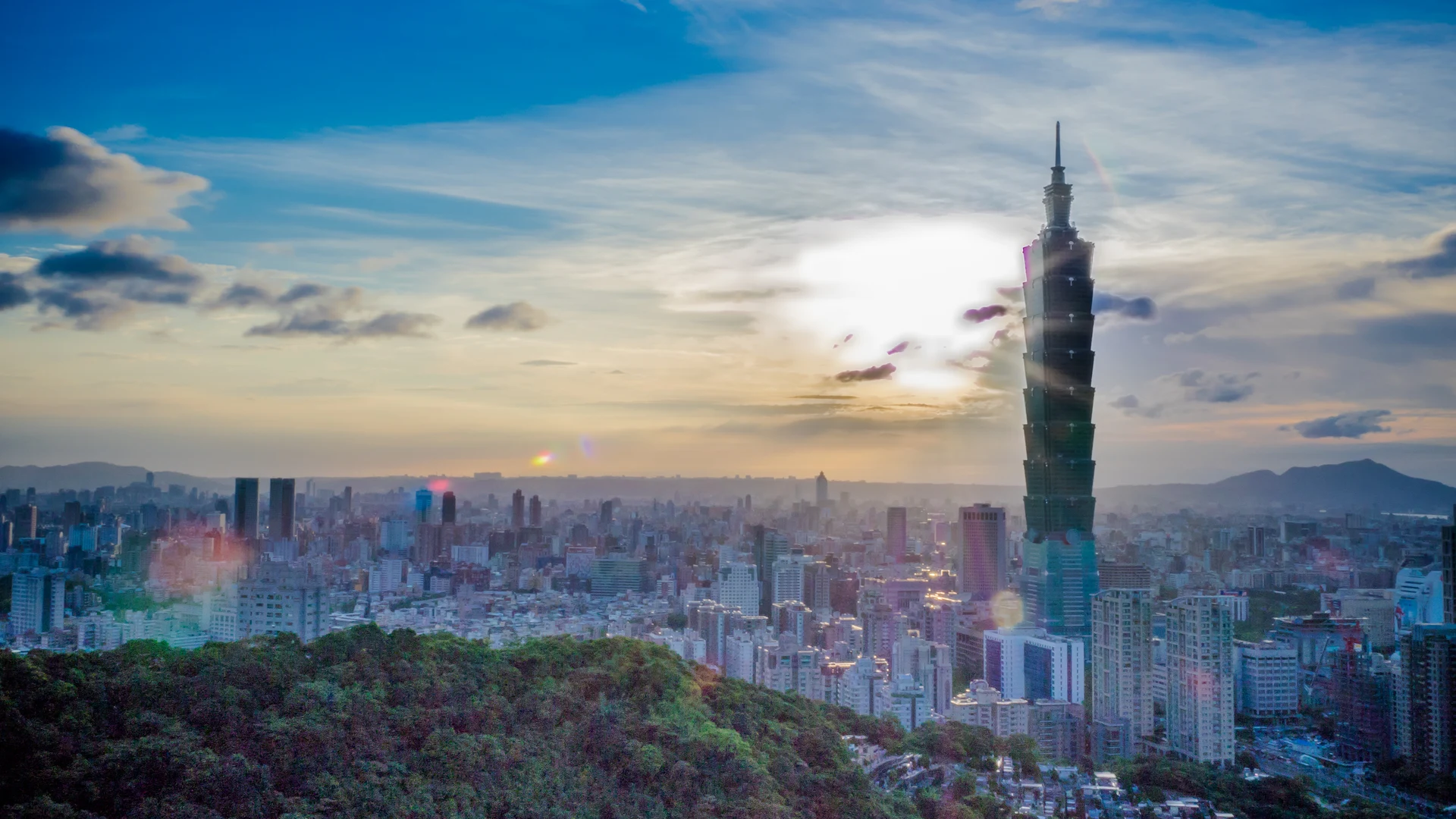
- Cover photo: Taipei 101 at sunset — Photo: 中岑 范姜 / Wikimedia Commons (CC BY-SA 2.0)