The Painting Paris Tried to Destroy With Umbrellas
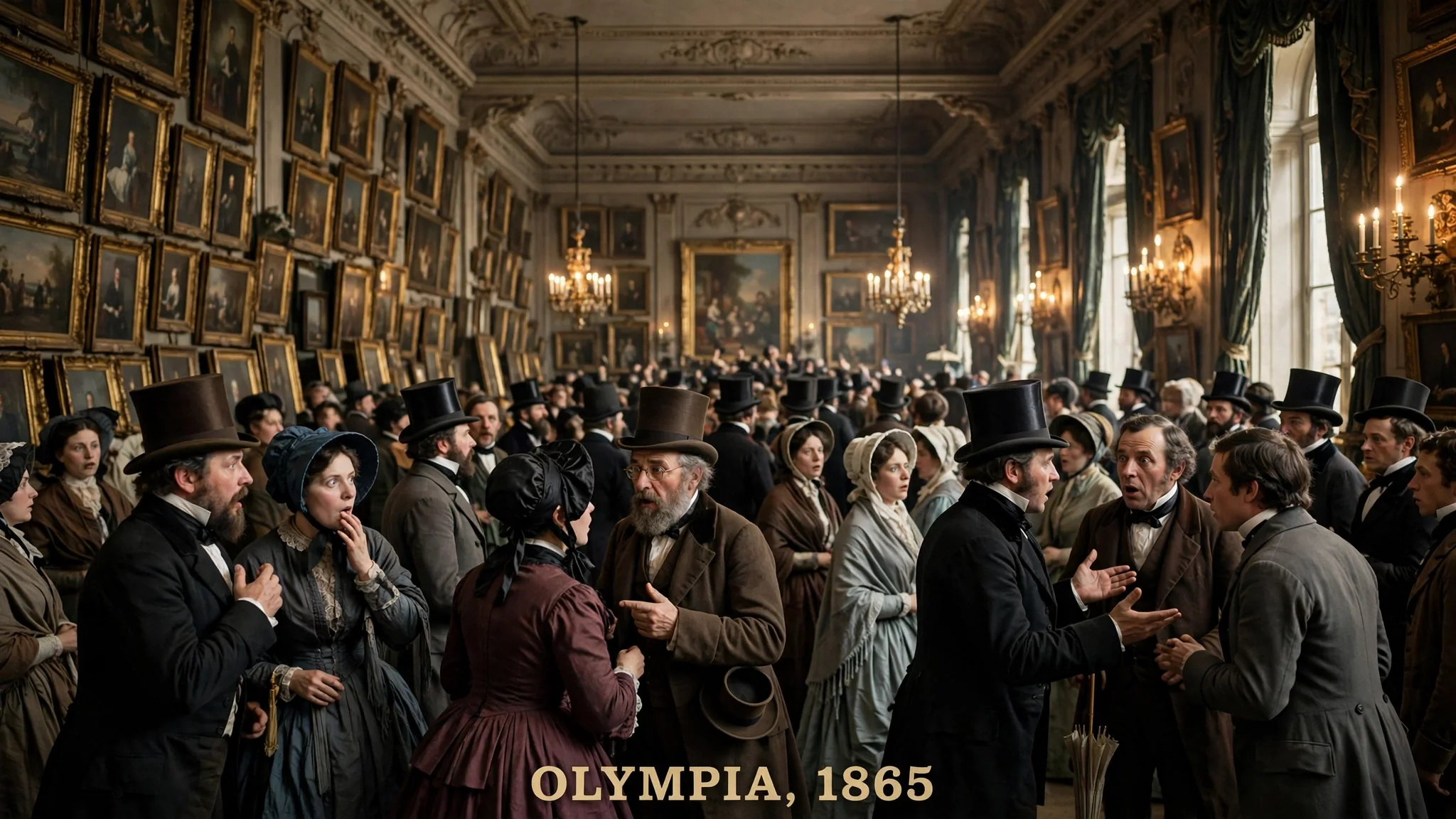
In the spring of 1865, the Paris Salon was the exhibition that could make or break an artist. Visitors came expecting beauty; instead, Édouard Manet’s Olympia, painted two years earlier, confronted them with a reclining woman who looked directly back. The response was furious: contemporary accounts describe shouting and laughter, and reports that visitors tried to strike the canvas with umbrellas before officials raised it out of reach.
The scandal was not simply about nudity. Paris had long accepted idealised goddesses drawn from myth. Manet borrowed the pose of Titian’s Venus of Urbino, but removed the protective veil of antiquity. A black ribbon, pearl earrings, a bracelet and a single slipper made Olympia look unmistakably modern. A maid named Laure presents flowers, while a black cat arches at the foot of the bed. The name itself carried a contemporary association with sex work.
The model was Victorine Meurent, a young working artist and model who had already appeared in Manet’s Le Déjeuner sur l’herbe. Viewers could not treat her as an anonymous classical ideal. Her direct gaze made the encounter feel personal: the subject appeared fully aware of the people looking at her.
Manet was not an outsider unfamiliar with tradition. Born into a wealthy Parisian family and deeply familiar with the old masters, he knew the conventions he was challenging. He painted the figure with flatter contrasts and less academic polish than audiences expected. Critics called the work ugly, vulgar and unfinished; one compared the crowd around it to spectators gathered before a body in a morgue.
The outrage soon became part of the painting’s influence. Émile Zola defended Manet, and younger artists saw in Olympia a way to depict modern life—its commerce, desire and hypocrisy—without dressing it as antiquity. Manet had waited two years to exhibit the work, anticipating the reaction. The gamble nevertheless helped force a wider debate about what art could show and whom it could represent.
Today, Olympia hangs in the Musée d’Orsay. The French state acquired it in 1890 after a public subscription organised by Claude Monet. The canvas has not changed, but its reception has: what once provoked calls of vulgarity is now regarded as a landmark of modern art. Paris first tried to silence the painting; later generations made it one of the works by which the city remembers its own transformation.