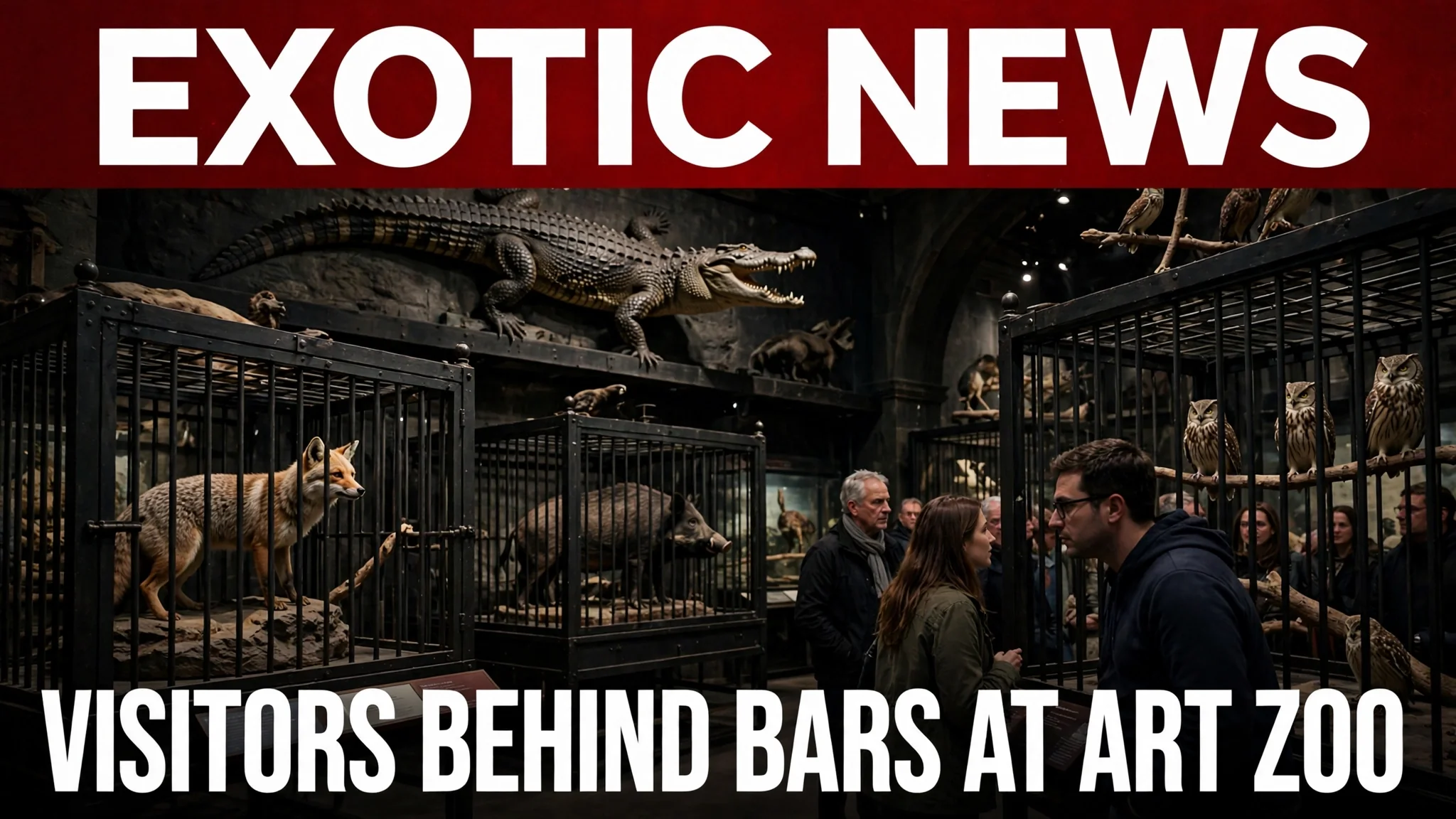
In Amsterdam's Art Zoo, the Animals Roam Free and the Visitors Are Behind Bars
A suspended crocodile with its jaws open greets visitors at Amsterdam’s Art Zoo, looking down from the ceiling of a 17th-century canal house. It is one of hundreds of taxidermied animals in a museum that reverses the familiar natural-history display: the preserved creatures seem to roam freely, while visitors walk through rooms enclosed by dark metal cages.
Created by Dutch artists Jaap Sinke and Ferry van Tongeren, Art Zoo draws on the tradition of the “wunderkammer,” or cabinet of curiosities. Wealthy Europeans assembled such collections in the 16th and 17th centuries, bringing unusual objects from nature together in rooms designed to surprise. The museum’s Herengracht setting gives that historical idea a contemporary, theatrical form.
The artists arrange specimens for drama rather than strict naturalistic realism. A cheetah appears to lounge in an alcove beneath the gaze of a cassowary; a Japanese giant spider crab stretches its legs above a doorway beside mastodon bones that rise almost to the ceiling. Cabinets of unusual fish and illuminated tulips in glass jars add to the carefully staged atmosphere.
The museum also makes room for objects whose histories involve deception. Beneath the crocodile is a display of Jenny Hanivers: ray carcasses altered by 16th-century sailors and presented to collectors as sea monsters. A series of sideways-facing busts of Charles Darwin nods to the naturalist whose name the artists include in their collective, Darwin, Sinke & van Tongeren.
Sinke and van Tongeren drew wider attention when Damien Hirst bought an entire exhibition of their work at a London art fair in 2015. They told the Associated Press that the animals in their collection were not taken from the wild; Sinke said the specimens came from zoos where the animals had died of natural causes. The artists say they seek to know the provenance of the specimens they use.
Art Zoo opened in June 2025, but its uncanny presentation has found a fitting audience during the autumn season. Visitors quoted by the Associated Press described the experience as creepy. That unease is part of the concept: the cages turn the audience into part of the installation, making the human visitor—not the animal—the one being observed.