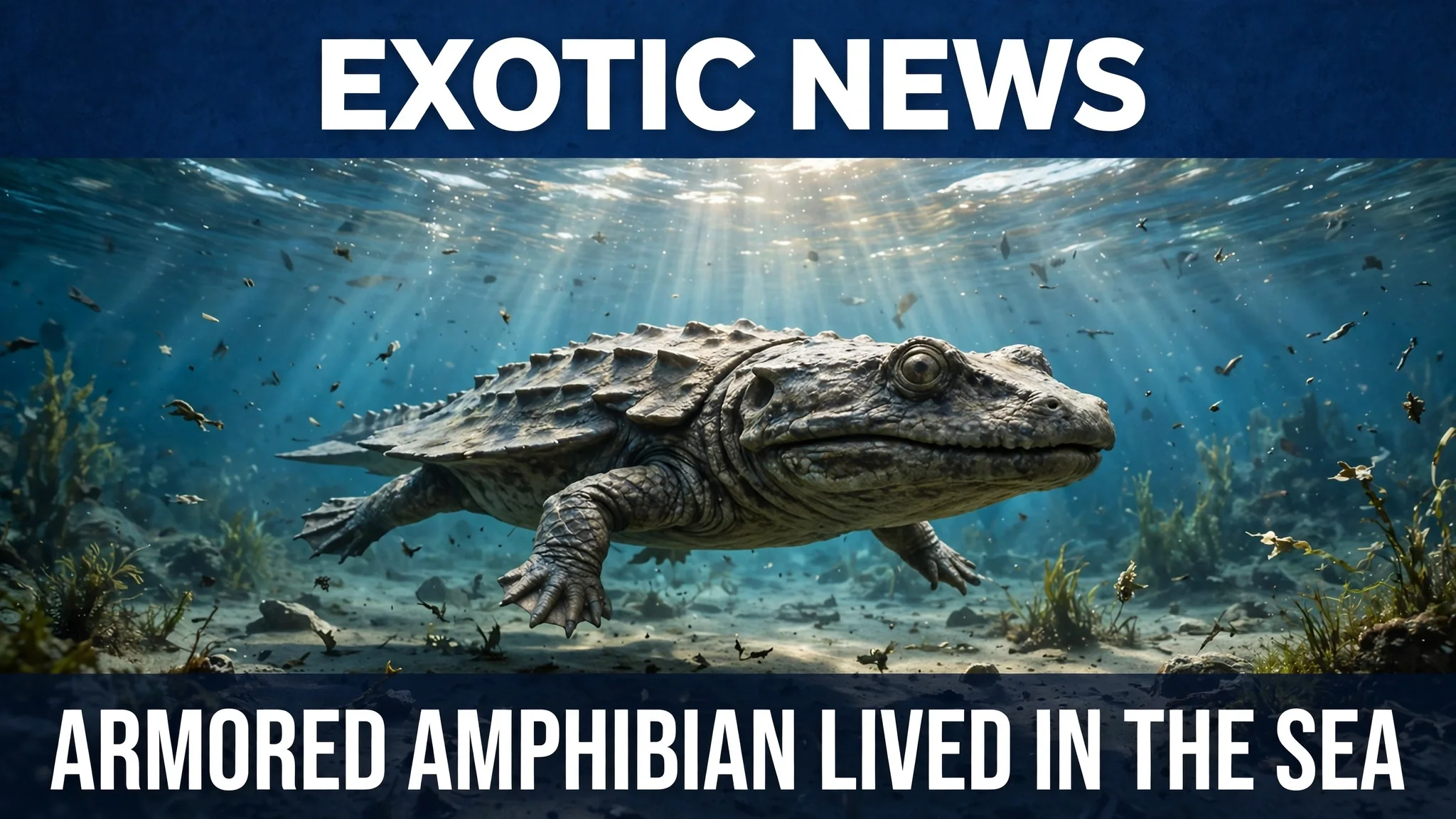
An Armoured Amphibian That Grew Up Drinking Seawater Rewrites an Evolutionary Rule
Two nearly complete fossils from southwestern China have revealed an amphibian adapted to life in the sea about 237 million years ago. The new species, named Gerrothorax maritimus, was a flattened, heavily armoured animal roughly 74 centimetres long. Its description in Nature Ecology & Evolution adds a striking exception to the usual picture of amphibians as animals tied to freshwater or land.
The fossils were found in Guizhou province in marine deposits dating to the Late Triassic. Researchers combined the setting and preservation of the skeletons with chemical evidence from the bones. Their isotope signatures matched those expected for the ancient seawater, supporting the conclusion that the animal developed in a marine environment rather than being washed into the sea after death.
That evidence led the researchers to infer that G. maritimus grew up using seawater. The conclusion is an interpretation of the fossil chemistry and geology, not direct observation of the animal’s behaviour. Together, however, the two nearly complete skeletons and the marine context make a compelling case that this was the first known fully marine stem amphibian.
At around three-quarters of a metre long, the animal had a broad, flattened body and extensive bony armour. Its close relative G. pulcherrimus is known from freshwater settings, making the marine species a rare example of a lineage crossing into a very different habitat. Researchers suggest its armour may have helped it cope with the demands of saltwater life, although the exact physiological mechanism remains uncertain.
The discovery stands out against modern amphibian diversity: no living amphibian species is known to spend its entire life in the sea. Palaeontologist Steve Brusatte described the possibility as potentially revolutionary, while emphasizing that the claim would be a game-changer if the evidence holds. The fossils therefore challenge assumptions about the limits of amphibian evolution without showing that marine life became common among the group.
The marine experiment appears not to have continued. No later amphibian lineage is known to have repeated it, and G. maritimus remains an unusual chapter in vertebrate history. Its bones suggest that, in the deep past, the boundaries between freshwater, land and sea were more open to evolutionary exploration than the living world might lead us to expect.