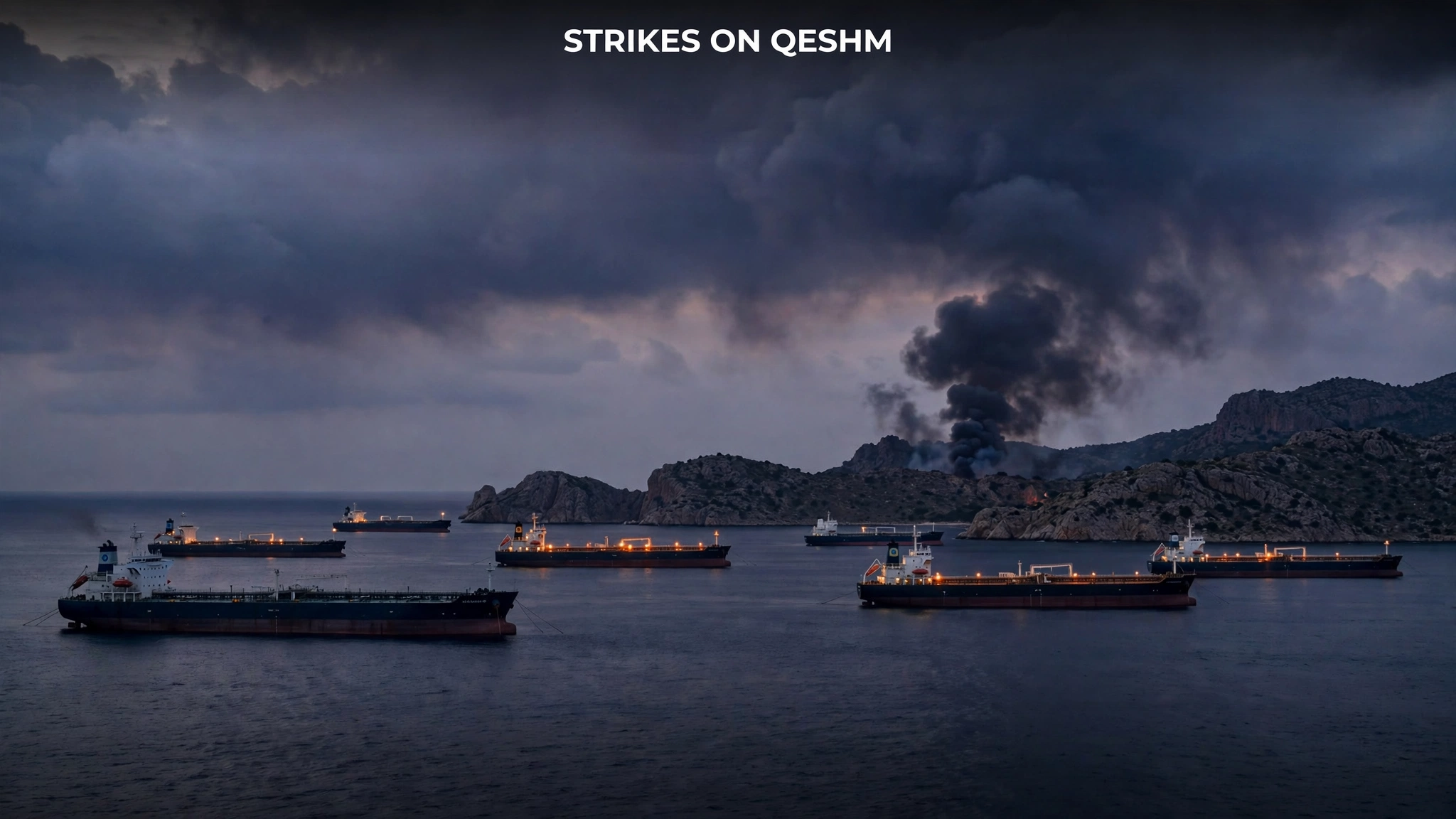
US Strikes Iran's Qeshm Island Again as Trump Calls the Attack "Minor" and Talks Go On
President Donald Trump has confirmed that American forces carried out limited strikes on an Iranian air-defence installation on Qeshm Island in the Strait of Hormuz on Friday evening, describing the operation as minor. Speaking to reporters after landing in West Palm Beach, Florida, Trump said the United States had knocked out what he called a newly built anti-aircraft system. "We do minor strikes," he said. "They built a little bit of an anti-aircraft device and we knocked it out in about 15 minutes, maybe five."
Iranian state media reported two explosions in the Suza area of Qeshm Island, on the island's southern coast. The semi-official Tasnim news agency said initial reports indicated two missiles had struck the island, while the official IRNA news agency cited witnesses who heard an aircraft overhead before two projectiles fell. Iran's state broadcaster IRIB reported that the country's air-defence forces had intercepted and destroyed an American MQ-9 drone over the island. US Central Command said the situation on the island was relatively calm and had no further comment. No official Iranian damage assessment had been released, and neither side had reported casualties.
The strike was the second publicly reported American attack on Qeshm Island in five days. The first, on Monday, November 2, followed a missile fired from Qeshm toward an American aircraft, and that operation also targeted nearby Hengam Island. Friday's strikes were also the first American strikes since Tuesday's midterm elections, in which Republicans lost control of both houses of Congress. The Pentagon and US Central Command had published no detailed account of the operation by Saturday morning, and Washington had not said whether the mission used crewed aircraft, drones or stand-off weapons.
The attack landed as indirect negotiations over the eight-month war continued. Trump told reporters on Friday that his administration was talking to representatives from Tehran and that Washington had made "a lot of progress" in the negotiations, though he gave no details. Qatar, which has been mediating, said diplomatic efforts were still under way, and two Middle East officials told the Associated Press that Iran was reviewing Qatari proposals aimed at bridging differences with the United States over its nuclear programme.
The larger decision Trump promised this week remains unannounced. After his first post-midterm national security meeting on Thursday, he said a decision was coming on whether to resume the war in full until Iran's nuclear programme can be certified destroyed, or to stop short of destroying what is left of the country. The limited strike on Qeshm answers neither question: it is a show of continued military pressure while the talks proceed, and it leaves open whether the next step is escalation or a deal.
The war at sea, meanwhile, has not paused. The United Kingdom Maritime Trade Operations agency said at least 11 ships were attacked in and around the Strait of Hormuz in the week ending November 6, three of which sank, and a Western military intelligence agency has recorded 88 projectile strikes since hostilities resumed in early July. The Islamic Revolutionary Guard Corps separately claimed on Friday that its air defences had intercepted an MQ-1 drone, reportedly the 16th aircraft of that model destroyed since the start of the war, and announced it was building underground sites for missile production and storage. The next reliable indicators will be an operational statement from the Pentagon or Central Command, a verified Iranian damage assessment, and any sign of retaliation.