Duterte to Face His Accusers as Historic ICC Trial Opens in The Hague
Former Philippine president Rodrigo Duterte goes on trial at the International Criminal Court on Monday, in the first trial of a former Asian leader before the Hague-based tribunal and one of the highest-profile cases in its more than two decades of existence. Mr Duterte, 81, faces three counts of crimes against humanity — murder and attempted murder — over killings linked to the anti-drugs campaign he waged first as mayor of Davao City and then as president of the Philippines. He will be asked on Monday whether he pleads guilty or not guilty, his lawyers having told judges that he denies the charges, and the court will then hear opening statements before moving immediately to the testimony of the first prosecution witness. More than 500 alleged victims have been authorised to take part in the proceedings.
The charges relate to 84 murders and two attempted murders between 2011 and 2018, which prosecutors say are only a sample of as many as 30,000 people killed by death squads targeting users and sellers of illegal drugs. The first count covers murders in and around Davao City during his mayoral term, allegedly carried out by the Davao Death Squad from 2013 to around June 2016; the second covers murders of so-called high-value targets across the Philippines during the first year of his presidency, from around July 2016 to July 2017; and the third covers murders and attempted murders during barangay clearance operations from around July 2016 to September 2018. Prosecutors have said Mr Duterte created, funded and armed the death squads responsible for thousands of extrajudicial killings. Philippine law enforcement agencies have acknowledged 6,248 deaths, while the national police's own 2017 year-end report listed 20,322 deaths under the heading "Fighting illegal drugs" for the period from July 2016 to November 2017 alone. If convicted of any of the three counts, Mr Duterte could face life in prison.
Mr Duterte was arrested by the Philippine authorities in March 2025 and surrendered to the court, arriving in The Hague on 12 March, where he has been held at the ICC detention centre in Scheveningen ever since. His lawyers argued that he was unfit to stand trial because of cognitive decline, but on 8 October the chamber found him fit, adopting measures to facilitate his participation, including shortened court sessions to accommodate his age, and the presiding judge, Joanna Korner, has said he is required to be physically present. His defence has said in a pre-trial brief: "There was no state or organisational policy to murder. This is not a crimes against humanity case and, as such, does not belong before this court." In a submission on 25 November, his lawyer Peter Haynes said the defence was not disputing that unlawful killings by police had taken place during anti-drug operations, or that murders had occurred in the period covered by the charges — only that "killings undoubtedly occurred, but they were not crimes against humanity". The trial will open with the prosecution's statement, lasting two hours and 15 minutes, followed by the victims' legal representatives for an hour and a half and the defence for an hour.
For the families of the dead, the opening of the trial is the moment many had stopped believing would ever come. Llore Pasco, a mother who lost her two sons, is travelling to The Hague to attend, and the trial will open on her 73rd birthday. "This is the greatest and most beautiful gift you could give me," she said hours before boarding a plane to the Netherlands. "My only wish is not just justice for my children, but for all those killed during the time of Rodrigo Duterte. I hope the killings stop for the next generation." The hearings, in Courtroom I, will be livestreamed on the court's website and its Facebook and YouTube accounts with a 30-minute delay, and are scheduled from Monday to Friday until 18 December, resuming on 12 January. Amnesty International, which documented patterns of extrajudicial executions during the drug war and concluded they amounted to crimes against humanity, called the trial "a historic opportunity for justice for victims" and "a defining test for the future of international accountability".
The trial is dividing the Philippines. Mr Duterte's daughter Sara Duterte, now the country's vice president, said in a statement on Wednesday that "no foreign court or nation should ever stand above the sovereignty of our country", and his supporters have called for his release. She is herself facing impeachment proceedings in the Philippine Senate, which could remove her from office and disqualify her from politics for life. Mr Duterte remains a popular figure among many Filipinos who credit his hardline approach with making the streets safer, and his lawyers have dismissed as mere rhetoric the language he used during his 2016 election campaign, when he told supporters: "I will do just what I did as mayor. You drug pushers, hold-up men and do-nothings, you better go out. Because I'd kill you." His arrest was carried out by the government of President Ferdinand Marcos Jr, from a clan historically allied with the former president.
The proceedings will also test the court itself at the most difficult moment in its history. The trial opens less than two months after the Trump administration intensified its campaign against the ICC, imposing sanctions against the institution as a whole on 9 October and calling on member states to withdraw from the court and isolate it. The opening coincides with the start of the Assembly of States Parties, the court's annual gathering of member states, which has been relocated from New York to The Hague because of the impact of the American sanctions. Mr Duterte is only the second former national leader to appear before the court for crimes allegedly committed while in power, after Laurent Gbagbo of Ivory Coast, who was acquitted in 2019, while four serving national leaders currently face ICC arrest warrants: Israel's Prime Minister Benjamin Netanyahu, Russia's President Vladimir Putin, the Taliban leader Hibatullah Akhundzada and Myanmar's military leader Min Aung Hlaing. The trial is expected to run well into 2027, and its outcome will be watched far beyond Manila as a measure of whether international justice can still reach the powerful.
- Reuters — Families of slain Filipinos seek justice as Duterte's ICC trial set to start
- VERA Files — Duterte faces victims as historic ICC trial begins
- Amnesty International — Duterte trial a defining test for justice, accountability and future of the ICC
- ICC — Questions and Answers: Opening of the trial in the Duterte case, 30 November 2026
- BusinessMirror — Historic ICC Duterte trial starts Nov. 30
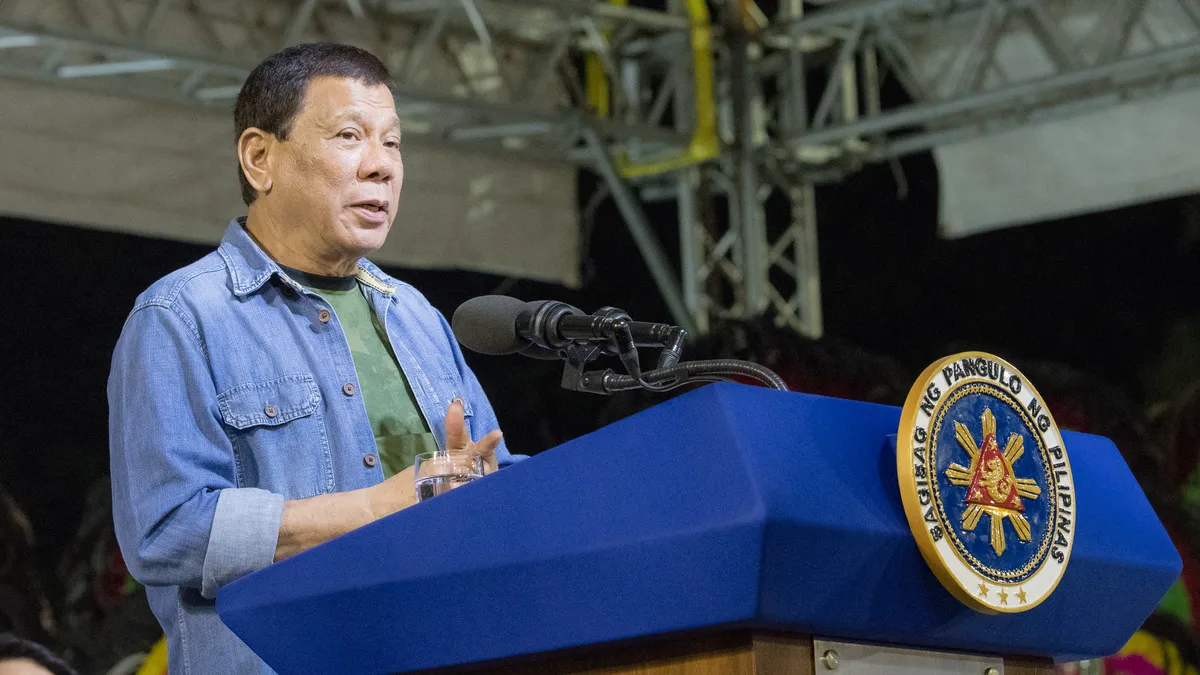
- Cover photo: Rodrigo Duterte speaking at a presidential podium in the Philippines, 22 October 2017 — Photo: Ceslou / Wikimedia Commons (CC BY-SA 4.0)