Netanyahu Offers Rival Eisenkot the First Turn as Prime Minister in a Last-Ditch Unity Bid
Benjamin Netanyahu, Israel's longest-serving prime minister, has offered to let his chief rival, Gadi Eisenkot, serve first as prime minister in a national unity government, a dramatic concession made on Saturday evening as the former military chief closes in on a coalition that could oust him. In a statement on X, Mr Netanyahu said that "unity is the need of the hour", and that he would "set everything aside" to let Mr Eisenkot lead first, serving himself as alternate prime minister, although he did not say how long Mr Eisenkot's initial term would be. He argued that he should lead a unity government, or at least go first in a rotation, because his Likud party won roughly a quarter of a million more votes than Mr Eisenkot's Yashar party. "But given the gravity of the existential danger and the possibility that a government will be formed that lacks the ability to confront it, my responsibility as a leader requires me to set everything aside," he said.
The offer comes a month after parliamentary elections on 27 October left neither of Israel's two major political blocs with a governing majority. Mr Netanyahu's Likud emerged as the largest party in the Knesset, but his coalition won only 53 seats, well short of the 61 needed to govern, while Mr Eisenkot and his allied parties won 48. Israel's president, Isaac Herzog, gave Mr Eisenkot the first chance to form a government, and his mandate expires on 6 December, with the possibility of a two-week extension to 20 December. Mr Eisenkot has vowed to bring a new government to a parliamentary vote as early as next week, and this week he signed coalition agreements with the right-wing Yisrael Beiteinu party and the left-wing Democrats, while holding talks with United Torah Judaism, an ultra-Orthodox party that for years supported Mr Netanyahu. Even with their support, he will still need the backing of at least one of the Arab-majority parties, either the Joint List or Ra'am.
Mr Eisenkot's response was cool but open. He invited Mr Netanyahu and his team "tonight" to conduct "genuine and accelerated negotiations on basic guidelines and policy issues", but said he had already conveyed a "detailed proposal" with "significant compromise positions" a week ago through a secret channel, "to which Netanyahu has yet to respond". He gave Likud 24 hours to demonstrate the seriousness of its offer. Likud later said the two men had spoken and agreed to meet on Sunday morning in Herzliya, a coastal city north of Tel Aviv. Mr Eisenkot had said on Friday that unity was "about substance and values, not about who gets which job or who goes first", and accused Likud of being "unwilling to compromise" and refusing for two weeks "to put a single concrete proposal on the table".
The reactions from Mr Eisenkot's allies split sharply. Yair Golan, head of the Democrats, dismissed the offer on X as a stunt: "Enough with the stunts and tricks. Netanyahu lost. It is our duty to respect the will of the voters and form a government of change and salvation." Former prime minister Yair Lapid called it "yet another transparent con by a serial fraudster who has cheated every partner and broken every agreement", and proposed swearing in an Eisenkot-led government without Mr Netanyahu and only then negotiating for a unity government. But Naftali Bennett, another former prime minister who had used some of the harshest rhetoric against Mr Netanyahu only weeks ago, celebrated the statement as the "right decision", saying it was now "forbidden" to continue discussions about a government without him. A source close to Mr Netanyahu said Mr Bennett had been involved in behind-the-scenes discussions about the statement after holding independent talks with both the premier and his confidant, Ron Dermer.
Much of the scepticism comes from the last rotation deal Mr Netanyahu struck. After the 2020 elections he entered a unity government with his rival Benny Gantz, with Mr Netanyahu serving first, but instead of transferring the premiership as agreed, he refused to pass a state budget, automatically triggering new elections and scuttling the government before Mr Gantz could have a turn. Mr Netanyahu's warning on Saturday was that a government dependent on Arab parties could grant Israeli citizenship to hundreds of thousands of Palestinians under the pretext of family reunification, withdraw Israeli forces from security zones in Gaza, Syria and Lebanon, and ultimately pave the way for an Iranian-backed Palestinian state. He pointed to incidents in the Knesset since its inauguration, including Arab lawmakers walking out during the national anthem at the swearing-in ceremony and the defeat on Wednesday of legislation intended to prevent the return of terrorists' bodies to their families.
What happens in Herzliya on Sunday morning will decide whether the offer is a genuine opening or, as his critics charge, a bid to buy time. If the talks fail, Mr Eisenkot's most straightforward path to replacing Mr Netanyahu still relies on some form of support from the Arab parties, and there was movement there on Saturday night: in an interview with Israel's Channel 12 News, Mansour Abbas, the Arab leader of the Ra'am party, was asked about a bill his party sponsored on a state commission of inquiry into the failures around 7 October 2023, which clearly defines Hamas as a terrorist organisation. "Hamas is a terrorist organization. Don't you see that's what's written there? That's it, event over," he said. Declaring Hamas a terrorist organisation and committing to its dismantling is one of Mr Eisenkot's conditions for joining his government, and Mr Abbas's statement appears to indicate another step toward cooperation. Meanwhile, on Saturday, the foreign ministers of Belgium, France, Norway, Poland, Luxembourg, Britain, Australia and Canada called on the Palestinian Authority to hold elections in the first quarter of 2027, after the Palestinian president postponed a vote scheduled for this year until September 2027. The betting markets have already written Mr Netanyahu off: on Polymarket, traders give Gadi Eisenkot an 89 per cent chance of being Israel's next prime minister, against 8.3 per cent for Mr Netanyahu.
- CNN — Running out of options, Israel's Netanyahu offers power sharing deal to main rival Eisenkot
- Reuters — At risk of losing power, Netanyahu makes long-shot unity appeal to rival Eisenkot
- Breitbart — Netanyahu Offers Rival First Turn as PM to Avert 'Existential Danger'
- New York Post — Netanyahu offers to temporarily step aside in power sharing deal with rival Eisenkot
- The Times — Netanyahu offers to let rival lead Israel first in power-sharing deal
- Polymarket — Prime Minister of Israel after the next election?
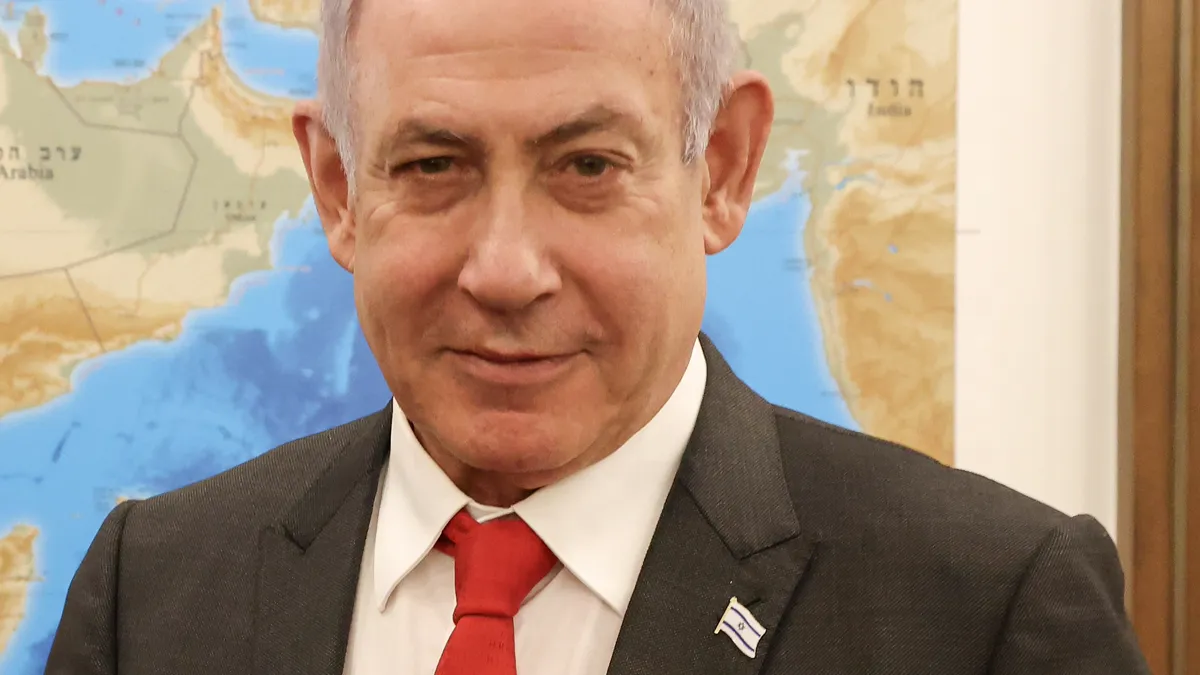
- Cover photo: Benjamin Netanyahu in Jerusalem on 24 January 2024, during a visit by UK Foreign Secretary David Cameron — Photo: UK Government (Foreign, Commonwealth & Development Office) / Wikimedia Commons (CC BY 2.0)