Spain Goes to the Polls as Sánchez Fights for Survival and the Far Right Eyes Power
Spaniards are voting on Sunday in a general election that will decide whether Socialist Prime Minister Pedro Sánchez, one of Europe's last left-wing leaders, keeps his job or hands power to conservative opponents who may need the far right to govern. More than 38.6 million people are eligible to vote, including some 2.6 million Spaniards living abroad and around 1.6 million first-time voters. Polling stations opened at 9 a.m. and close at 8 p.m., when the first exit polls will be released, with the first results expected about an hour later. A party needs 176 seats in the 350-seat Congress for a majority, and the outcome could put a far-right party into national government for the first time since the death of Francisco Franco in 1975 paved the way for the restoration of democracy three years later.
Mr Sánchez called the early election saying he needed a majority after parliament rejected the decrees he proposed to tackle a mounting housing crisis, and the campaign has been dominated by sharply different answers to rising rents and evictions. The final published polls point to a close but clear outcome: the conservative People's Party is forecast at about 32 per cent of the vote and 128 seats, against roughly 31 per cent and 116 seats for Mr Sánchez's Socialists and about 17 per cent and 61 seats for the far-right Vox party, putting the right and far right at 187 to 189 seats. Mr Sánchez insisted on Friday that his own internal data showed he could still secure a majority with smaller left-wing parties, telling supporters in Madrid: "I cannot imagine us losing." Some polls did show the Socialists catching the People's Party, but at the expense of a disillusioned far left whose support he would need once more to form a government.
The prime minister has campaigned on an economic record he presents as the envy of Europe, pointing to one of the fastest-growing economies in the European Union, a rise in the minimum wage and a labour reform that has pushed unemployment to its lowest level in almost two decades. But many Spaniards say they are not feeling the effects of those headline gains, squeezed instead by rising prices for housing, energy and consumer goods. His image has also been tarnished by a slew of corruption scandals involving his inner circle and his family, and by a series of crises including two deadly train crashes, a migrant crisis in the North African enclave of Ceuta and a nationwide power outage. He is criticised, too, for handing an amnesty to the leaders of Catalonia's attempt to separate from Spain in exchange for their support in swearing him in after the 2023 election, when the People's Party won the most votes but fell short of a majority.
His rival, Alberto Núñez Feijóo, has sought to sell himself as a technocrat with his eye on the details, promising to build a million homes over four years and to take a much tougher line on immigration. The People's Party says it would prohibit mass amnesties, allow returns to third countries and introduce a points system for legal immigrants, while Vox, led by Santiago Abascal, wants to deport convicted foreigners and give priority to Spaniards in the queue for housing. Mr Abascal, whose party hopes to almost double the 33 seats it won three years ago, told supporters at his final rally in a Valencia bullring that Mr Sánchez's government had "betrayed" Spaniards. A coalition between the People's Party and Vox is seen as the most likely outcome, although it would involve hard bargaining over how many ministries Vox would get, and analysts say Vox could instead choose to support a People's Party government from outside. The two parties already govern in coalition in four regions.
The vote will be watched far beyond Spain. Mr Sánchez leads one of Europe's few remaining left-wing governments, and a defeat would leave only three countries in the European Union — Denmark, Lithuania and Malta — with centre-left leaders. With France's presidential election five months away, there is a real chance that two of the continent's biggest economies could move to the right in quick succession. The campaign has also exposed an economic fault line: Spain's boom has been fuelled by migrants, and economists fear that the anti-immigration policies of a potential right-wing government could stifle growth, while Mr Sánchez has rowed against the tide by promoting immigration as an economic benefit even as most of Europe seeks to tighten its borders.
What happens tonight will set the course of the next weeks. The exit polls at 8 p.m. will show whether the right's expected majority has held, and the first results an hour later will show whether Mr Sánchez's defiance was justified or whether the polls were right all along. Coalition talks face no formal deadline before the first investiture vote, but if no candidate wins parliament's confidence within two months of that attempt, fresh elections are automatically triggered. Mr Sánchez has described the prospect of a People's Party–Vox coalition as a "regression"; Mr Feijóo, who failed to form a government three years ago despite winning the most seats, told supporters in Seville: "This time, yes, we're going to do it." The betting markets have already made up their minds: on Polymarket, traders now put the chance of a People's Party–Vox majority at 94 per cent, up from 86 per cent the day before, and give the People's Party a 72 per cent chance of winning the most seats. On Reddit, a thread in r/spain warning that migrants had fuelled Spain's boom and that investors feared an anti-immigration government could stifle the economy drew 91 upvotes, a measure of the anxieties the campaign has stirred.
- Reuters — Spain heads to polls with far right in sight of power
- New Kerala — Spain votes Nov 29 as Pedro Sanchez faces Alberto Nunez Feijoo
- BytesEU — Spain heads to polls with far right in sight of power
- LA Post — Spain heads to polls with far right in sight of power
- Polymarket — Spain General Election: PP + Vox Majority?
- Reddit r/spain — Migrants fuelled Spain's boom, now investors fear an anti-immigration government
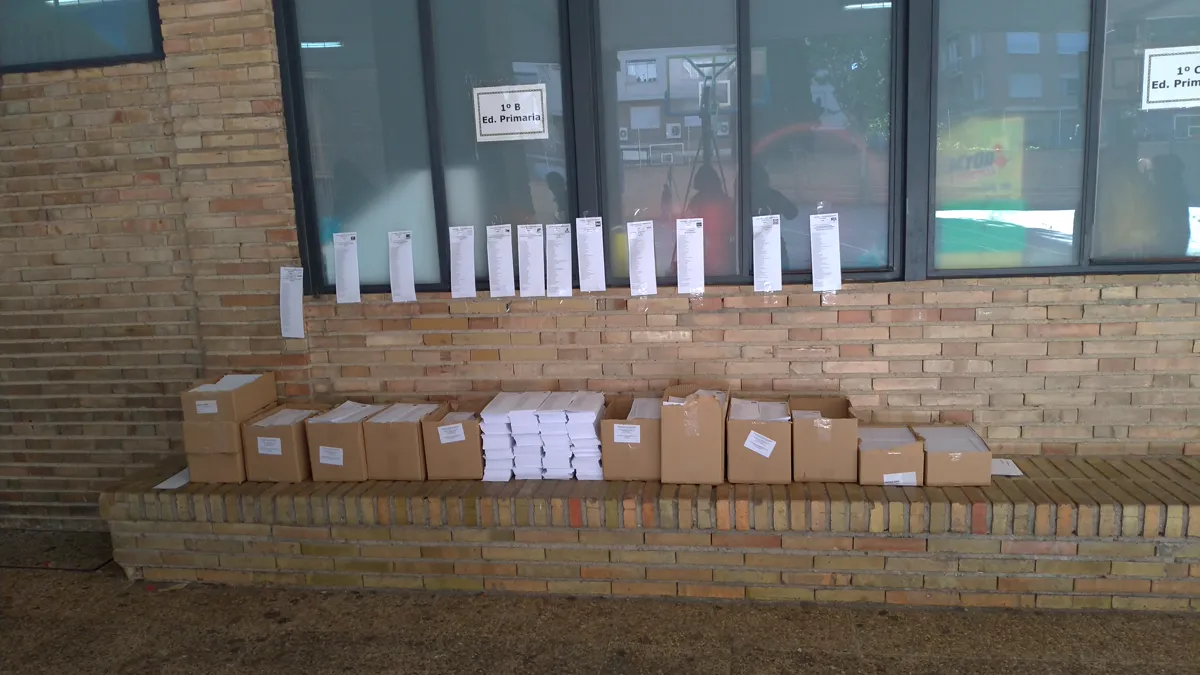
- Cover photo: Ballot papers with party lists handed to voters at a Madrid polling station for the 2019 Spanish general election — Photo: LauraHale / Wikimedia Commons (CC BY-SA 3.0)