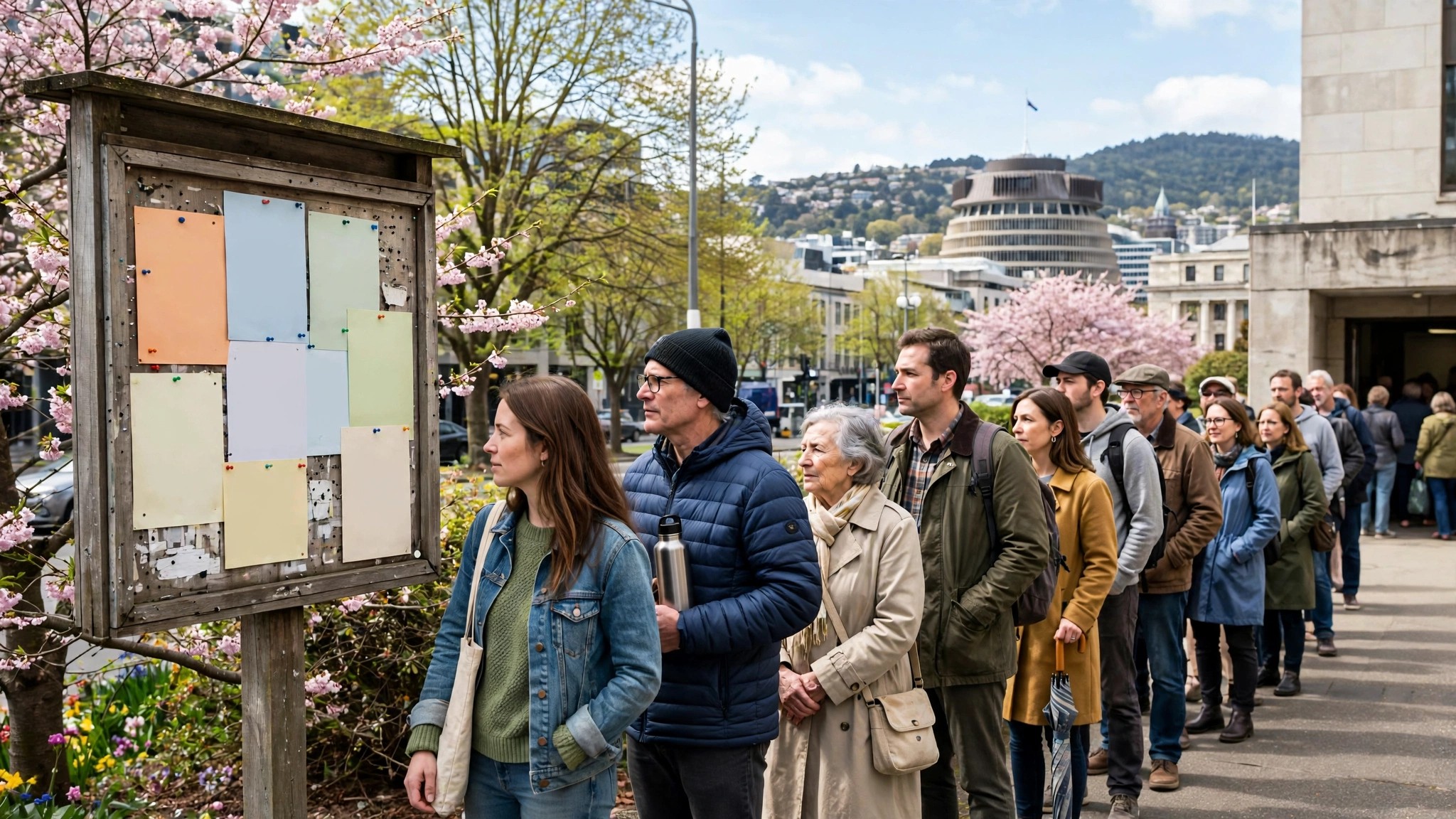
New Zealand Heads to the Polls in a Dead Heat, With a Tiny Centrist Party Holding the Keys to Power
New Zealanders vote on Saturday in a general election that the final polls say is too close to call, after a six-week campaign dominated by the cost of living and the state of the health service. The last poll of the campaign, published by Wellington newspaper The Post on Friday morning, put the centre-left Labour Party on 30.7 per cent and Prime Minister Christopher Luxon's centre-right National Party on 26.4 per cent — a result that would be among the worst in National's 90-year history. The Greens were on 13 per cent, NZ First on 12 per cent, ACT on 9.8 per cent, and the centrist Opportunity Party on 5.1 per cent, just above the five per cent threshold a party must clear to enter Parliament. On those numbers, neither of the two big blocs could govern alone.
The polls, however, do not agree with each other — which is itself the story of this election. The final 1News-Verian poll, released on Tuesday, had National narrowly ahead on 30 per cent to Labour's 29 per cent, with the Greens on 16 per cent and Opportunity on 6 per cent. A Taxpayers' Union-Curia poll put the two blocs dead level on 60 seats each in the 120-seat Parliament, meaning a hung parliament. Across the five most recent polls, Labour averages 29.1 per cent and National 27.8 per cent. The one point on which the pollsters agree is that the result will be decided not by the two big parties but by the small ones — and above all by Opportunity, a centrist party that has never before won seats in Parliament and would, on current polling, hold the balance of power.
That prospect has shaped the final days of the campaign. On Thursday night, representatives of the top seven parties took part in the final televised debate, and in the closing hours candidates have been chasing the undecided voters who will decide whether Opportunity clears the threshold and, if it does, which side it deals with. Under New Zealand's mixed-member proportional system, governments are almost always coalitions, and a party holding the balance of power can extract a high price for its support. If Opportunity falls just short of five per cent, or lands close enough that the result is unclear, the outcome may not be settled until the official count on 27 November, which includes special votes cast from overseas and elsewhere. Prediction markets lean towards the incumbent side holding on in some form: Polymarket traders give the National Party a 66 per cent chance of winning the most seats, and Christopher Luxon a 56 per cent chance of remaining prime minister — though those odds have been drifting in Labour's favour through the week.
The backdrop is a country that, by its own measures, is doing it tough. Unemployment hit 5.7 per cent this week, the highest in nearly 11 years, with long-term unemployment at its worst since 1995. Inflation is running at 3.7 per cent, and per-capita growth has gone backwards under the Luxon government. The Ipsos issues monitor found voters' top concerns to be the cost of living (64 per cent), healthcare (45 per cent), fuel prices (31 per cent), the economy (30 per cent) and unemployment (19 per cent). Labour leads on health, poverty and housing, according to the Curia poll; National leads on the economy, inflation, education, taxes, safety, spending and the environment. The Post's editorial delivered a harsh verdict on the Luxon government's economic record, while its campaign coverage noted that only 15 per cent of voters think National ran the best campaign, and 29 per cent rate it the most negative.
On the ground, the election has also thrown up the kind of small democratic dramas that say something about the state of the system. On Reddit's r/newzealand, one of the most discussed posts of the week told of a lifelong voter who was nearly shut out of the election by a new enrolment cut-off, having assumed his enrolment had carried over from previous elections. Commenters argued that voters should be allowed to enrol on polling day, and that politicians should not be in charge of the election process — a debate about the rules of democracy itself, running alongside the argument about who should run the country. With advance voting already under way and polling booths opening on Saturday morning, the final hours belong to the party leaders: Luxon, fighting to hold a coalition that the polls say is three seats short of a majority, and Labour's Chris Hipkins, who has led his party from behind to a narrow lead in the final poll but still needs the minor parties to get him to 61 seats.
Whatever happens on Saturday night, New Zealanders may have to wait to find out who governs them. If the polls are right, no bloc will have a majority, the special votes will not be counted until 27 November, and the negotiations that follow could stretch for weeks. The last time the country faced such a finely balanced result, the party that held the balance of power took its time and extracted significant concessions. Opportunity, a party built around a single big idea — a fairer tax system — and led into this election with no MPs, no track record in government and everything to gain, now finds itself in the position every small party dreams of: the election's kingmaker, courted by both sides, with the power to decide who forms the next government of New Zealand.