Trump Says the Iran War Could End "Quickly" as Tehran Weighs a US Peace Proposal
President Donald Trump said on Wednesday that the war with Iran could be over "quickly", telling reporters at the White House that talks over the past day had gone "very good" and that a deal was "very possible". The optimism, voiced as Tehran reviews a US peace proposal relayed through Pakistani mediators, is the clearest sign yet that both sides are testing whether the eight-and-a-half-month conflict can be closed by negotiation rather than by further bombing. Trump also made clear the threat has not gone away: he told PBS he was hopeful of an agreement before his scheduled trip to China next week, but warned that if talks collapse, the United States would "have to go back to bombing the hell out of them".
The outlines of a possible deal have begun to emerge in press reporting, though neither government has confirmed them. The Reuters news agency, citing a Pakistani source and a person briefed on the mediation, reported that the two sides were close to agreeing on a one-page memorandum to formally end the conflict, while the US outlet Axios said they were "getting close" to a 14-point document. Under the reported terms, Iran would agree not to develop a nuclear weapon and to halt uranium enrichment for at least 12 years, and the United States would lift sanctions, release billions of dollars in frozen Iranian assets, and reopen the Strait of Hormuz with Iran within 30 days of signing. The war began on 28 February, when the United States and Israel launched joint strikes on Iran, and has since centred on the strait, through which about a fifth of the world's oil and gas passed before the fighting.
Tehran, however, has pushed back hard on the suggestion that an agreement is near. The Iranian foreign ministry's spokesman, Esmaeil Baghaei, said Iran had yet to present its response to the US proposal and that "the investigation into the exchanged texts is ongoing", while a lawmaker on parliament's national security committee, Ebrahim Rezaei, described the American text as "more of an American wish list than a reality". The semi-official Tasnim news agency, citing an unnamed source, said the proposal contained some unacceptable provisions without specifying them, and parliament speaker Mohammad Baqer Ghalibaf mocked the Axios report on social media, writing in English that "Operation Trust Me Bro failed". President Masoud Pezeshkian, meanwhile, accused Washington of pursuing "maximum pressure" while expecting Iran to submit to unilateral demands.
The gap between the two sides' public positions remains wide on the issues that have blocked a deal all along. Al Jazeera's correspondent in Tehran reported that Iran has drawn clear "red lines": its enrichment programme is non-negotiable, and it refuses to transfer its roughly 400 kilograms of highly enriched uranium out of the country. The Revolutionary Guard has announced a new protocol for the strait under which vessels would have to pay in Iranian currency to pass through, and countries involved in the war would have to pay reparations for damage before being granted a transit permit. Israeli Prime Minister Benjamin Netanyahu, who was due to speak with Trump on Wednesday, has said both leaders agree that all enriched uranium must be removed from Iran, a demand Tehran has repeatedly rejected.
The diplomacy is playing out against a military standoff that has eased only slightly. Trump on Tuesday paused the US operation to escort stranded ships through the strait, codenamed "Project Freedom", a day after it began, saying "great progress" had been made towards a complete and final agreement and citing a request from Pakistan and other countries. The operation had sharply raised tensions in the Gulf: the US military said it intercepted Iranian missiles and sank several Iranian small boats that interfered, the United Arab Emirates reported attacks from Iran, and several ships said they were hit by unknown projectiles. Secretary of State Marco Rubio said on Tuesday that Operation Epic Fury, the US-Israel air and naval campaign that began in February, had concluded because its objectives had been achieved, and that no major new strikes were needed. But the naval blockade of Iranian ports remains "in full force", and US Central Command said on Wednesday that its forces had disabled an Iranian-flagged tanker, the M/T Hasna, in the Gulf of Oman after it allegedly failed to comply with warnings.
The wider region is now leaning on both sides to finish the job. Iranian Foreign Minister Abbas Araghchi was in Beijing on Wednesday for talks with his Chinese counterpart, Wang Yi, who called for the war to end and the strait to reopen "as soon as possible". Gulf states that had pressed Trump to hold off new strikes, including Qatar and Saudi Arabia, are pushing for a diplomatic settlement, and Pakistan, which has led the mediation and hosted direct talks in Islamabad in April, remains the channel through which the proposals are moving. Online, the mood has been more sceptical than the official optimism: in a widely shared r/geopolitics discussion of reports that Netanyahu was pressing Trump to attack Iran after the midterms, the most-upvoted comment argued that Trump would escalate regardless of who won, a reminder of how little trust the reported deal commands outside official channels. For now the pause is not a peace deal: no agreement has been signed, Iran has not publicly accepted Washington's conditions, and Iranian officials have publicly denied that talks with the US are even happening. What happens next depends on Tehran's formal response to the American text, and on whether the reported memorandum can survive the two sides' red lines on enrichment and the strait.
- Al Jazeera — Trump says war will be "over quickly" as Iran reviews US proposal
- NPR — Trump says US won Iran war, Iran responds
- AnewZ — Trump pauses Iran strikes, keeps Hormuz blockade
- Al Jazeera — China calls for end to Iran war as Araghchi visits Beijing
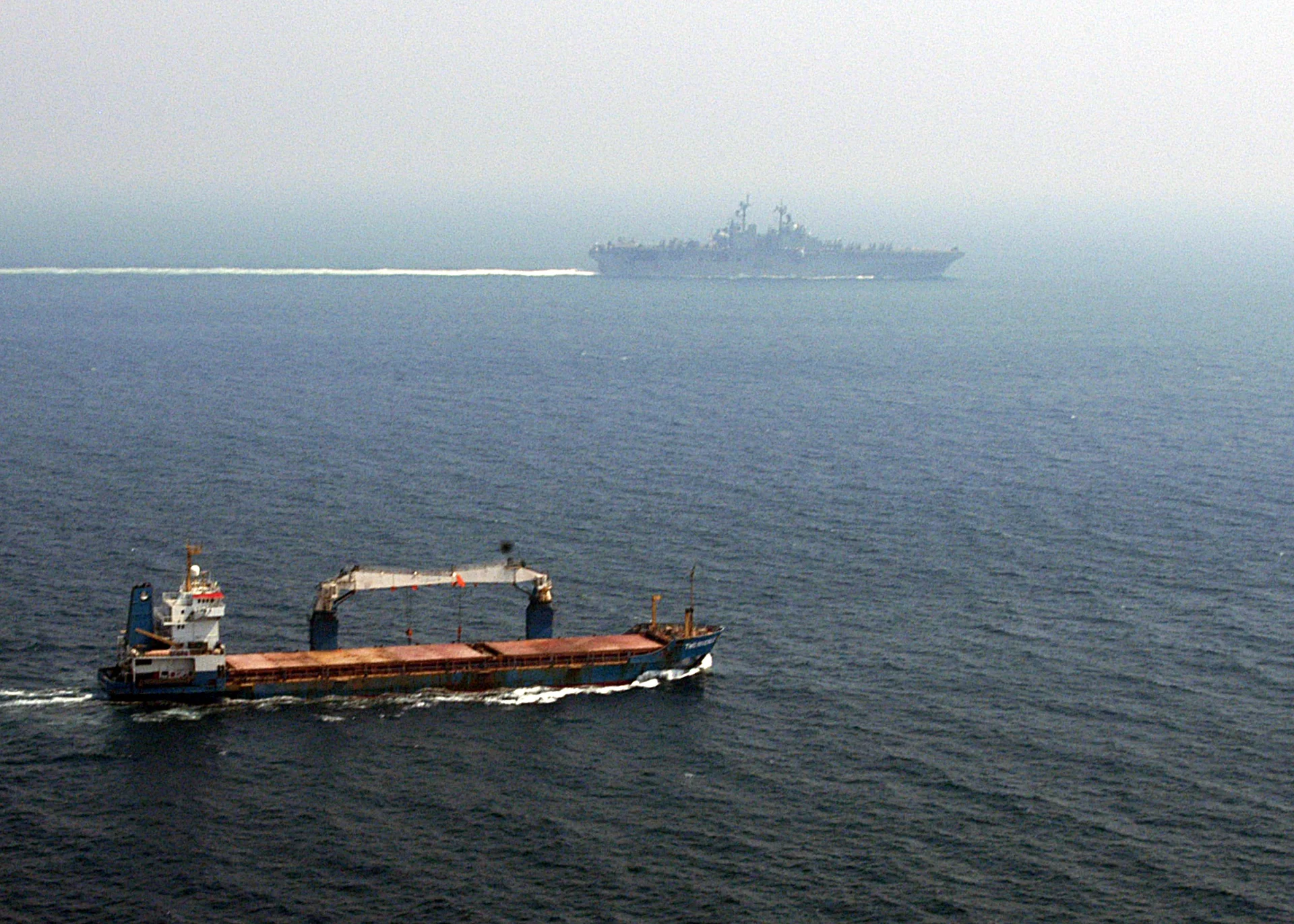
- Cover photo: A merchant ship sails past the amphibious assault ship USS Kearsarge while transiting the Strait of Hormuz, 5 July 2004 — Photo: U.S. Navy photo by Photographer's Mate 3rd Class Angel Roman-Otero / Wikimedia Commons (public domain)