Three Leaders, One Hour, No Deal Expected: Trump, Xi and Putin Meet in Shenzhen
Donald Trump, Xi Jinping and Vladimir Putin sit down together in Shenzhen today for the first three-way meeting of the leaders of the world's three largest nuclear powers, a summit staged on the sidelines of the Asia-Pacific Economic Cooperation forum that has been trailed for a week and is expected to produce no agreement at all. The three men shook hands on Wednesday evening at the summit's welcome reception, in the first photograph of them together, and their formal talks are scheduled for Thursday afternoon, with the Kremlin saying they will last less than an hour. The White House says the meeting will focus on nuclear weapons, Mr Trump says he will raise the wars in Ukraine and Iran, and officials on all sides have been at pains to lower expectations.
Wednesday's choreography was as revealing as anything the formal session is likely to produce. Mr Xi greeted Mr Trump at the airport in Shenzhen, an unusual gesture by the Chinese leader that reciprocated the formalities Mr Trump extended at Joint Base Andrews when the two last met in September, and the two exchanged a brief hug. Mr Putin then made for the American president at the APEC reception, shaking his hand warmly in their first in-person meeting since their summit in Alaska in August 2025. Mr Xi and Mr Putin had already held their own bilateral meeting — their fiftieth since Mr Xi became China's president in 2013 — in which Mr Xi called the Russian leader an "old friend" and urged closer political and military ties between Beijing and Moscow. Russia's Interfax news agency said Mr Trump and Mr Putin did not have a substantive conversation at the reception, and a Kremlin aide said the two leaders were not seated next to each other at dinner and could not talk during the meal.
The stated subject of the trilateral is the world's nuclear arsenals. New START, the last treaty capping American and Russian strategic weapons, expired in February, leaving the two largest nuclear powers without any binding limit on their arsenals for the first time in decades. Mr Trump has said he wants to discuss reducing nuclear stockpiles, but China, whose arsenal is far smaller than either of the other two, has repeatedly rejected joining three-way disarmament negotiations, calling them "neither fair, reasonable nor realistic". A senior administration official who briefed reporters was blunt about what the session would produce: "We do not expect to get to any kind of agreement." The meeting is instead being described as an entry point — a first conversation that could, in time, lead to negotiations on a new arms-control framework.
The wars will be in the room even if they are not on the agenda. Mr Trump has said he intends to raise the war in Iran with both leaders, a conflict that began with American and Israeli strikes on 28 February and has since spread across the Gulf, with the Strait of Hormuz closed and energy prices volatile. On Ukraine, the picture is confused: Mr Trump told reporters before leaving for Asia that "we'll also talk about my favourite subject, Ukraine. Ukraine is losing. Ukraine and Russia are losing 25,000 souls per month", yet American officials have said Ukraine would not be part of the trilateral discussions at all. A separate one-on-one meeting between Mr Trump and Mr Putin is also planned for Thursday, where Ukraine is expected to feature, and Mr Trump holds a bilateral meeting and working lunch with Mr Xi beforehand, a chance to test the durability of a trade truce reached earlier this month. There has been no sign the summit will reopen the questions of trade, tariffs or American super-chip exports to China.
Each leader arrives in Shenzhen wanting something different from the photograph. Mr Trump, days after midterm elections that delivered a sharp rebuke to his party at home, gets to show that he is still the man the other great powers want to do business with. Mr Putin, whose economy and war effort were supposed by his enemies to be collapsing, demonstrates that he is still standing and still a partner in discussions about a new world order. And Mr Xi, as host and ringmaster of the gathering in the southern technology hub, positions China as the convenor of the great-power conversation — with Europe, whose democracies have the most at stake in both wars, notably absent from the room.
What happens next will be measured in readouts, not handshakes. If the three leaders emerge with a joint statement, a timetable for arms-control talks, or even an agreement to keep talking, the meeting will have done more than its billing suggested. If they emerge with nothing but the photograph, it will confirm the sceptics' view that a summit announced with no agreed agenda and no deal expected was always more theatre than diplomacy. Either way, the test comes after Shenzhen: whether the bilateral tracks — Mr Trump with Mr Xi on trade, Mr Trump with Mr Putin on Ukraine, and all three on nuclear weapons — produce anything verifiable, or whether the first trilateral summit of the nuclear age is remembered as the day three presidents stood in the same frame and went home.
- Reuters — Trump's historic meeting with Xi, Putin headlines Asia trip
- The Hindu BusinessLine — Trump, Xi and Putin meeting: Nuclear arms, Ukraine and Iran in focus
- The Times — President Xi forges new world order with Trump and Putin
- ANI via Khelja — Trump arrives in Shenzhen for APEC summit amid historic trilateral plan
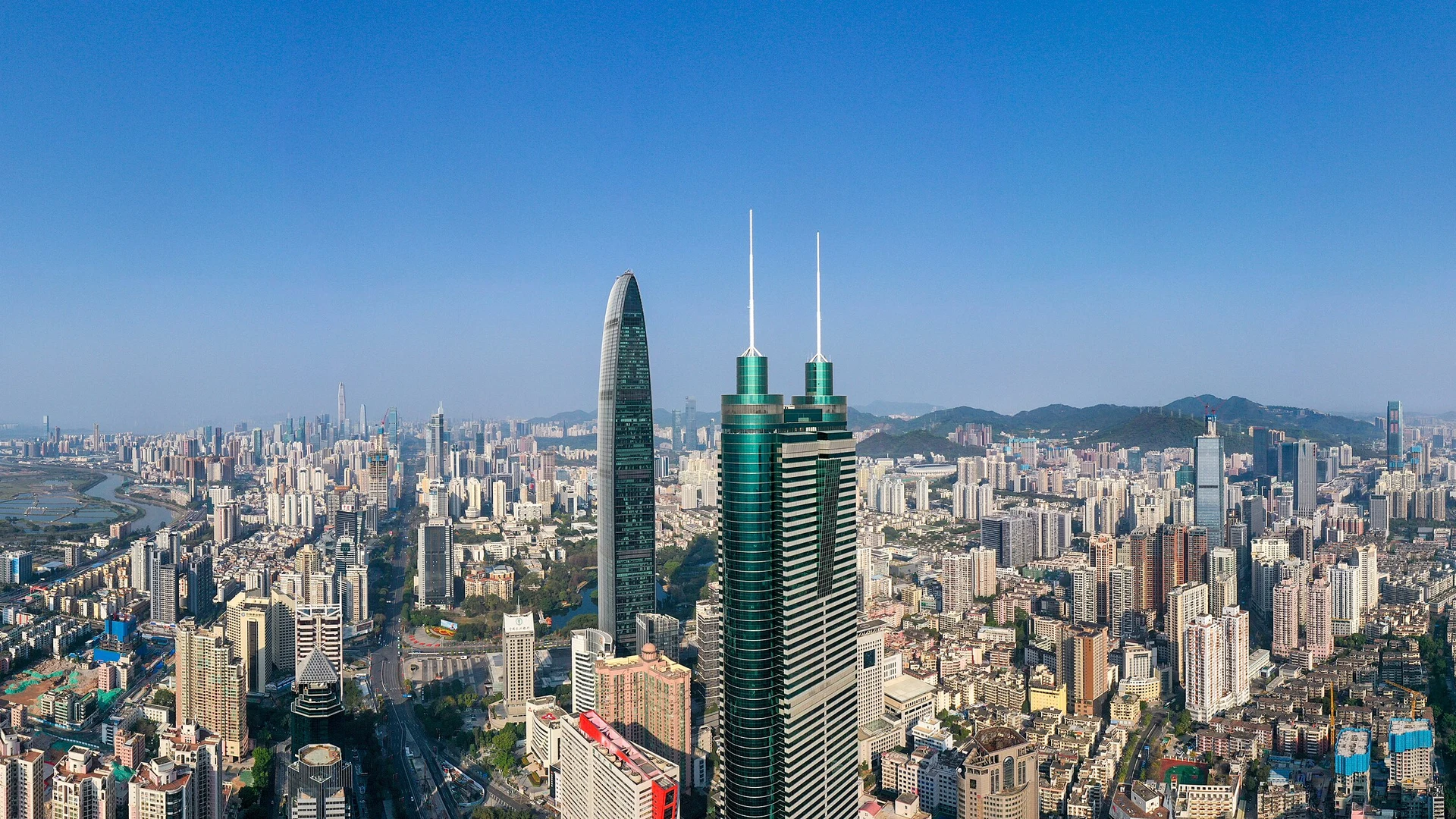
- Cover photo: Panoramic view of Shenzhen from Luohu looking west — Shun Hing Square and KK100 towers in the foreground, Shennan Road in the middle, Shenzhen River on the left, Hong Kong hills beyond. Photographed 14 February 2021 — Photo: Charlie fong / Wikimedia Commons (CC BY-SA 4.0)