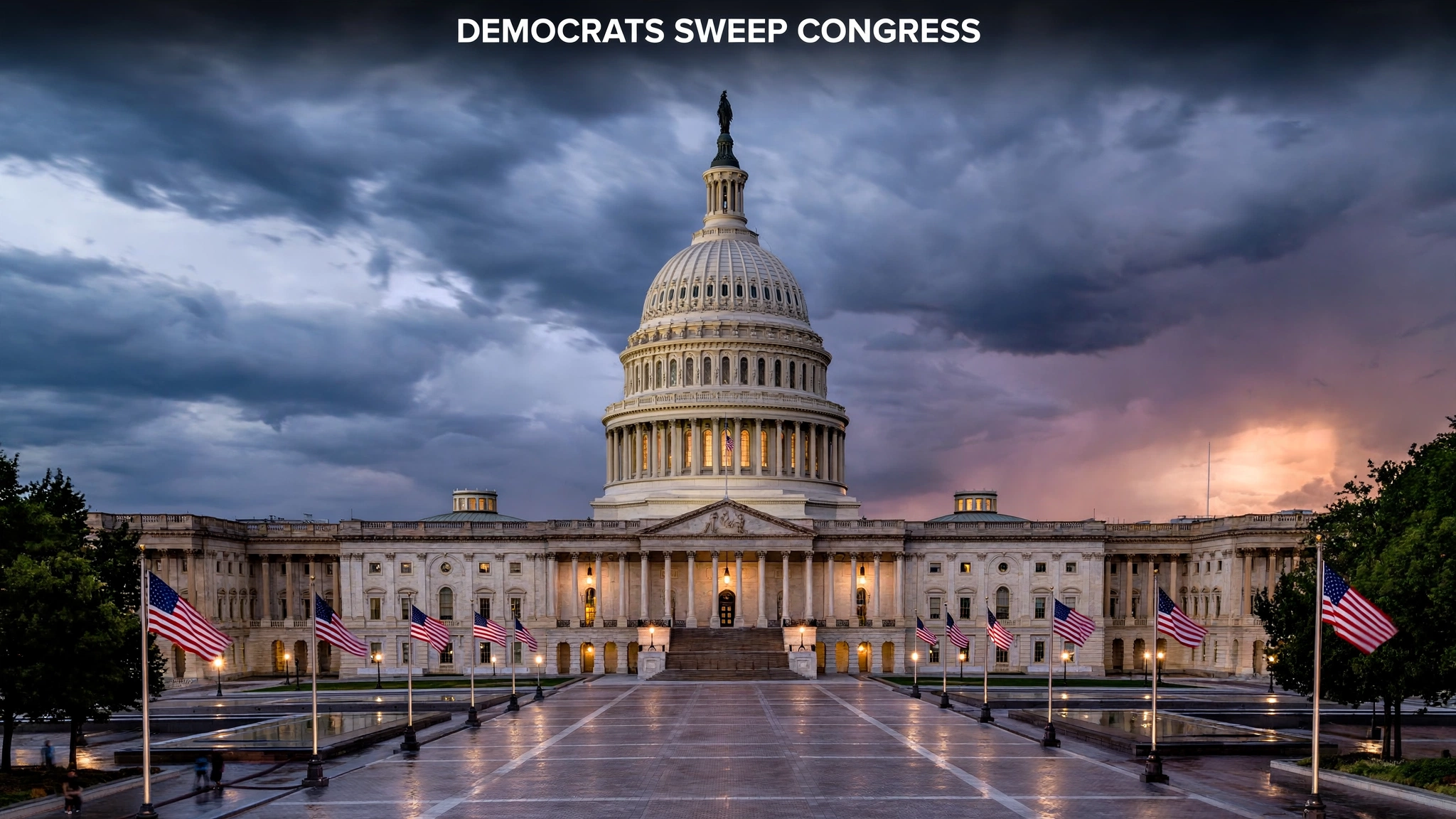
America Turns Blue: Democrats Seize Both Houses of Congress in a Midterm Rout That Rewrites Trump's Final Two Years
The Democratic Party swept to control of both chambers of Congress in Tuesday's midterm elections, ending two years of unified Republican rule and forcing President Donald Trump into divided government for the final two years of his presidency. The scale of the victory stunned even optimistic Democrats: the party flipped at least seven Senate seats and gained at least 40 seats in the House of Representatives, winning in Republican strongholds where such victories had seemed unthinkable only weeks ago. CBS News projected the House for Democrats late on Tuesday night and the Senate shortly afterwards; the Associated Press called the Senate after Democrat Josh Turek defeated Republican Ashley Hinson in Iowa, and the House early on Wednesday.
The Senate map told the story of the night. In Texas, Democrat James Talarico defeated Republican Ken Paxton to flip a seat blue for the first time since 1988. In Kansas, Adam Hamilton became the first Democrat elected to the Senate from the state in almost a century. In South Carolina, Democrat Annie Andrews defeated Darline Graham, the sister of the former senator Lindsey Graham, whom President Trump had backed. Sherrod Brown reclaimed a seat in Ohio, Roy Cooper won the open seat in North Carolina, Troy Jackson unseated five-term senator Susan Collins in Maine, and Turek completed the set in Iowa. Democrats also held seats in Georgia, New Hampshire, Minnesota and Michigan, where Abdul El-Sayed became the nation's first Muslim senator. In the House, the party picked up seats from Indiana to Tennessee and California, where redistricting delivered five more Democratic seats. Democrats also flipped five governorships — in Nevada, Texas, Iowa, Ohio and Georgia. According to the Fox News Voter Poll, Democrats held 54 Senate seats and 228 House seats at the time of publication, with the Alaska Senate race still too close to call.
The driving force, according to exit polling and the first analyses, was the cost of living. Exit polls showed 39 per cent of voters named the economy the most important issue, and the Fox News Voter Poll found widespread discontent over affordability. The war with Iran — eight months old and unpopular — weighed heavily too. Vice President JD Vance wrote on social media that "the reason we lost is the war", and the president himself acknowledged the conflict had hurt his party, telling the Wall Street Journal he would make the same decision again. The result was, in the words of political scientist Ian Bremmer, the biggest loss for a governing party in 50 years.
The consequences for Washington are immediate and far-reaching. House Democratic Leader Hakeem Jeffries, who declared victory on Tuesday night, is expected to become the first Black Speaker of the House when the new Congress convenes in January, replacing Republican Mike Johnson. Democrats will take control of House committees, gaining the power to issue subpoenas and investigate the Trump administration, the president's family and their business interests. Yet the victory has limits that will shape the next two years: Democrats fell short of the two-thirds Senate supermajority needed to remove a president through impeachment, and of the 290 House seats needed to override presidential vetoes. They also fell short of the Senate's 60-vote threshold to overcome a filibuster, meaning most legislation will still need Republican support. What they can do, however, is stop the president's agenda in its tracks — and use tools such as the War Powers Resolution to force votes on the Iran war.
The fallout began within hours. Harmeet Dhillon, head of the Justice Department's Civil Rights Division, resigned on Wednesday in the first post-election departure from the administration. And on Thursday, the president faced a decision he had deferred until after the vote: whether to resume major military strikes on Iran, maintain economic pressure, or pursue a negotiated settlement. Meeting his top national security advisers in the Oval Office, Trump said a decision was imminent. "I would rather not destroy the rest of the country if possible, but maybe I will have to," he told reporters. "You'll know soon enough." His October pledge not to attack Iran before the midterms has now expired, and US Central Command is reported to be finalising preparations for a possible resumption of major combat operations, with the USS Theodore Roosevelt due in the region in mid-November.
Markets, meanwhile, delivered their own verdict on the new political landscape. After rallying on Wednesday — the Dow surged more than 1,000 points — stocks plunged on Thursday in a tech-led sell-off, with the Dow falling more than 1,800 points, the Nasdaq dropping 5.5 per cent, its worst day in 19 months, and the S&P 500 down 4.4 per cent, wiping out trillions of dollars in market value. Investors feared that a Democratic Congress could tighten oversight of the artificial intelligence industry and data-centre construction. Trump blamed the Democrats on Truth Social, writing that the market had suffered "one of the Worst Days in History based on the results of the Election" and that "it wasn't Republicans, it was Dumocrats". Online, the reaction matched the scale of the night: on Hacker News, one of the most upvoted comments called the Democratic flips in Texas, Kansas and South Carolina "an absolute nuke", while a Reddit discussion in r/PoliticalDiscussion drew thousands of responses debating whether the result reflected Trump's record rather than a lasting realignment. Prediction markets had seen a Democratic sweep coming, with traders on Kalshi and Polymarket putting the chance of Democrats winning both chambers at roughly 75 per cent before the results were announced.
What happens next will be defined by two clocks. The first is the legislative one: a Democratic Congress that can investigate and obstruct but cannot, on its own, pass laws or override vetoes, facing a president who has already called the results "crooked" and "so rigged" even as he said he would accept the outcome. The second is the military one: the decision on Iran, which Trump says will come soon, and which could either wind down an unpopular war or escalate it at the very moment his party's defeat has left him, in the words of one Reuters source, with nothing to lose politically. Either way, the midterm rout has redrawn American politics. For the first time in his presidency, Trump faces a Congress controlled by his opponents — and a Democratic Party that, after years in the wilderness, now holds the levers of oversight in Washington and a springboard for 2028.