After Eight Years and 10 Billion Kilometres, BepiColombo Reaches Mercury — With a Glitch
After an eight-year journey across the inner Solar System, the European-Japanese spacecraft BepiColombo has finally arrived at Mercury — only the second spacecraft ever to orbit the solar system's smallest and least explored planet. The European Space Agency confirmed on Saturday 21 November that its module had inserted itself into orbit around Mercury, beginning a months-long series of manoeuvres that will place two scientific probes into their working orbits. But the arrival came with a scare: on Sunday, ESA disclosed that a thruster burn during the capture manoeuvre had come up short after a software issue, and its engineers at the European Space Operations Centre in Darmstadt are now working to understand what happened before the mission's next critical steps.
The journey that ended on Saturday began on 20 October 2018, when BepiColombo launched aboard an Ariane 5 rocket from Kourou in French Guiana. Flying directly to Mercury is impossible — the Sun's gravity makes the trip a problem of slowing down, not speeding up — so the spacecraft spent eight years shedding speed through nine planetary flybys: one of Earth, two of Venus and six of Mercury itself, travelling some 10 billion kilometres in the process. A power problem in September 2024 reduced the performance of its ion thrusters and pushed the arrival back by almost a year, from December 2025 to November 2026. On 3 September this year the Mercury Transfer Module, the propulsion unit that had carried the spacecraft across the Solar System, was jettisoned, leaving the two science orbiters to make the final approach alone. The capture itself was a "weak" one, executed with no live control from Earth because of the eight-minute signal delay: four small thrusters fired for 37 minutes, and confirmation that Mercury's gravity had caught the spacecraft came from Darmstadt hours later.
The glitch, disclosed in an ESA social media post on Sunday, was a reminder of how little margin the mission has. "The spacecraft is safe," the agency said, explaining that during the manoeuvre "the thruster burn was shorter than planned following a software issue", and that teams at ESOC were working to understand what happened, with updates promised for Monday. The spacecraft entered an initial orbit of roughly 590 by 11,640 kilometres, and five further burns at precise times are planned to lower it over the coming weeks. The two orbiters will then separate on 9–10 December: the European Space Agency's Mercury Planetary Orbiter, which will descend to between 400 and 1,500 kilometres to map the surface, and the Japan Aerospace Exploration Agency's Mio, which will swing out to 11,000 kilometres to study the magnetic field and how it interacts with the solar wind. Routine science operations are due to begin in April 2027.
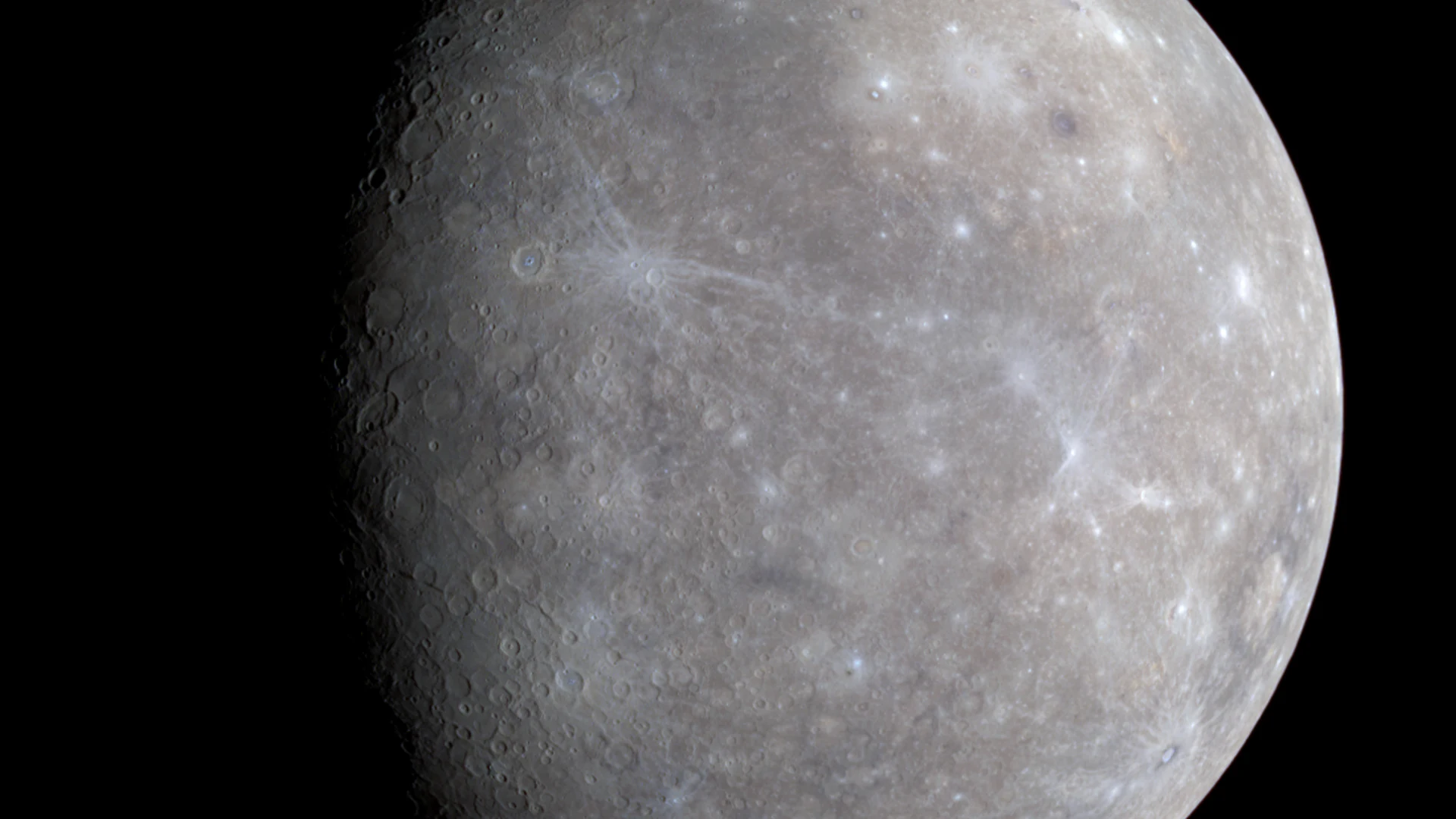
What the two orbiters find matters well beyond Mercury itself. The planet is only slightly larger than Earth's Moon, and it is the least explored of the four rocky planets — visited by just three spacecraft in history, and orbited by only one before BepiColombo, NASA's MESSENGER, which circled it from 2011 to 2015. MESSENGER revealed a world stranger than expected: a giant iron core, water ice hiding in permanently shadowed craters at the poles, a global magnetic field that should not exist on a planet so small, and a surface that swings from 430°C in daylight to minus 180°C at night. Mercury is also, suddenly, a fashionable planet: most of the exoplanets discovered so far orbit very close to their suns, and Mercury is the Solar System's only example of a planet that lives that close to its star. "There's a lot of interest in exoplanets right now, and it's our example in our solar system of a planet that's close to the sun," said Catherine Johnson, a geophysicist at the University of British Columbia and a guest investigator on the mission. The twin orbiters, flying at different altitudes, will for the first time be able to distinguish Mercury's own magnetic field from the short-lived fluctuations caused by the solar wind and solar flares.
The mission is named for Giuseppe Colombo, the Italian mathematician who worked out how to use Mercury's gravity to send spacecraft past it — the technique that made the whole journey possible.
ESA, JAXA and Airbus will brief journalists on the arrival and the road ahead at a hybrid media briefing at the Science Museum in London on Friday 27 November. For now, the mission's engineers have a software problem to diagnose and a schedule to protect: the separation of the two orbiters in December, the descent to science orbits through March, and the start of observations on 6 April 2027, more than eight and a half years after launch. BepiColombo has survived a power failure, a year's delay and a short thruster burn to get here; the next four months will decide whether the most ambitious Mercury mission ever flown can now do the science it was built for — and finally explain how the Solar System's strangest planet came to be.
- Reuters — Spacecraft begins orbit of Mercury, with a glitch reported
- Nature — BepiColombo finally reaches Mercury after eight-year odyssey
- Sky & Telescope — BepiColombo Arrives at Mercury After 8-Year Odyssey
- ESA — Media invitation: briefing on BepiColombo arrival at Mercury on 27 November
- National Geographic — A New Mission Arrives at Mercury, the Solar System's Most Mysterious Planet
- Cover photo: Mercury in full colour, photographed by NASA's MESSENGER spacecraft on its first flyby, 30 January 2008. BepiColombo is only the second spacecraft to orbit Mercury, after MESSENGER — Photo: NASA / MESSENGER / Wikimedia Commons (Public domain)