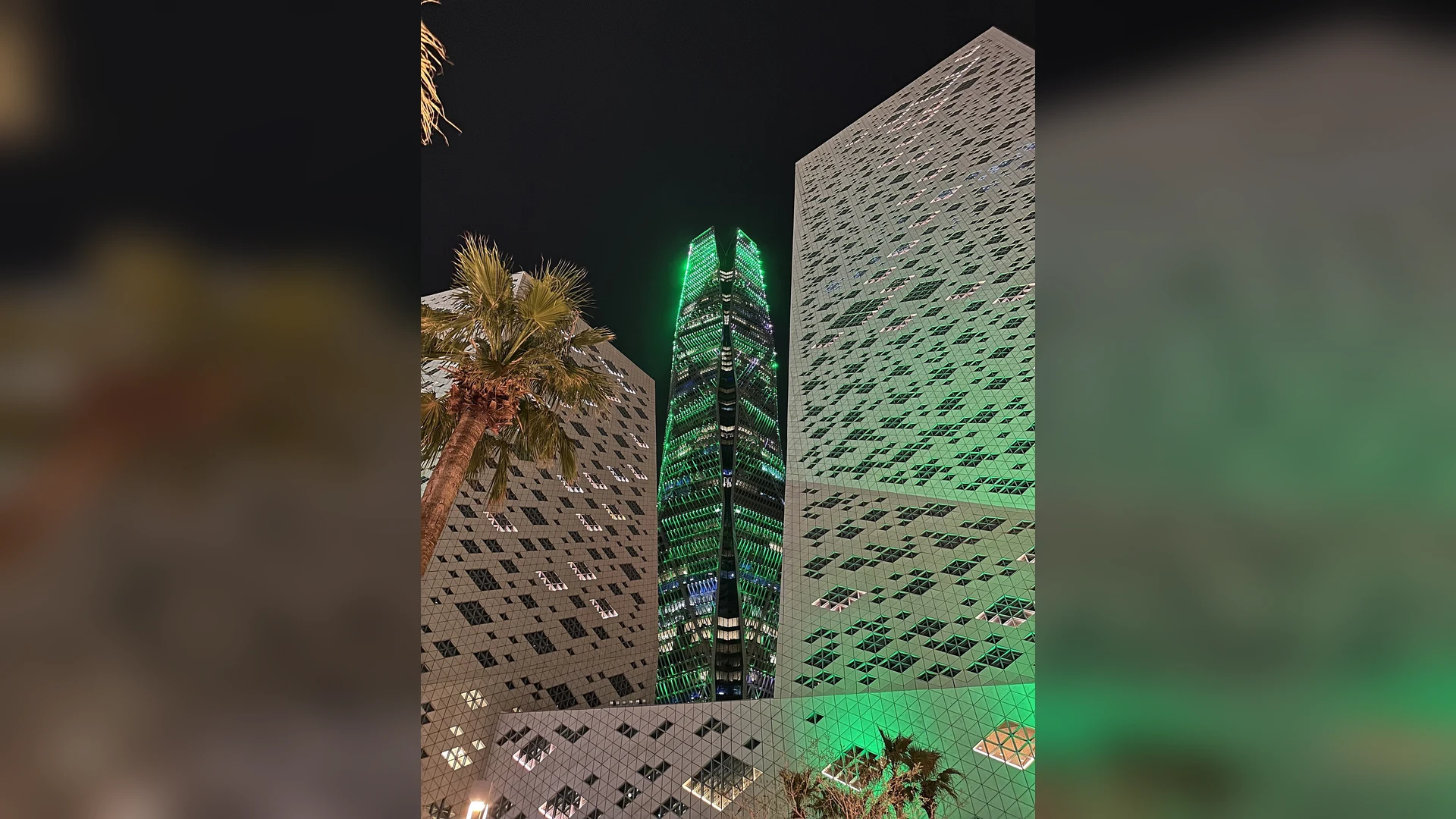
Houthi Missile Hits PIF Tower in Riyadh, the Second Strike on the Financial District in Eleven Days
Riyadh's tallest skyscraper, the headquarters of Saudi Arabia's sovereign wealth fund, was struck early on Thursday by a suspected Houthi missile, blowing out windows across seven to eight floors of the PIF Tower and bending parts of its metal facade. It was the second time in less than two weeks that a Houthi attack damaged a landmark in the capital's King Abdullah Financial District, after a strike on state oil giant Aramco's building on 8 November. Entrances to the district were closed and people were evacuated as ambulances and fire trucks rushed to the scene; there were no immediate reports of casualties.
Three sources familiar with the matter told Reuters that the 80-storey tower, the tallest building in the financial district, had been hit by an incoming Houthi missile. The Saudi-led coalition fighting the Houthis said it had "dealt with a missile threat" launched by the group towards Riyadh, adding that its initial assessment showed debris had fallen and material damage had been reported, though the extent of the damage was still being determined. A source who spoke to Agence France-Presse said the tower's facade was damaged on several floors and windows had shattered. The Public Investment Fund acknowledged receiving a request for comment from Reuters; the Houthis issued no immediate statement on the strike.
Residents of the Saudi capital were woken by a loud boom in the early hours of Thursday, and a witness told the Associated Press that damage was visible to the PIF Tower and that entrances to the district had been closed. The Houthis have repeatedly said they targeted Riyadh and its financial district over the past few weeks, including on Wednesday, according to the Associated Press, though the group did not immediately claim responsibility for Thursday's attack. The Houthi-run Saba news agency reported that Saudi aircraft had carried out airstrikes on the Houthi-controlled Yemeni capital Sanaa early on Thursday, without providing further details.
The strike is the latest blow in the Iran-backed Yemeni group's war with the kingdom, which reignited in July when Yemen's frozen civil war flared again amid the wider United States-Iran war. The Houthis have been firing at Saudi airports and oil infrastructure ever since, and on the ground in Yemen they have seized swathes of territory from the Saudi-backed government, forcing it to stage a major retreat at the weekend. The group has now taken Yemen's entire Red Sea coast, including the strategically vital Bab el-Mandeb Strait at its mouth, and has surrounded the city of Taiz in the highlands overlooking the government's temporary capital, Aden. Britain announced in October that it would deploy jets to help defend Saudi Arabia from Houthi attacks, a step that drew sceptical reactions online about what a small force from Cyprus could achieve where larger efforts had stalled.
The conflict has dealt a heavy blow to Crown Prince Mohammed bin Salman's plans to develop and diversify the economy of Saudi Arabia, the world's biggest oil exporter and a close United States ally. Reuters reported on Wednesday that Saudi officials now foresee the campaign stretching on for up to six months, according to two Western officials briefed by the Saudis on the kingdom's plans, a timeline confirmed by a third source familiar with the plans. The Saudis, who replaced the commander of their coalition fighting in Yemen this week, want to see their allies make gains on the ground before they enter any negotiations with the Houthis. The crown prince met the head of United States Central Command, Admiral Brad Cooper, in Riyadh on Wednesday, Cooper's third publicly reported visit to Saudi Arabia since the Yemen conflict resumed.
The attack also lands in the middle of a wider regional war that began in February, when the United States and Israel attacked Iran, and in which there has been no sign of a breakthrough in negotiations mediated by Qatar. Hostilities in the Gulf have surged again in recent days, with Iran firing at the United States' allies Bahrain and Kuwait and American airstrikes hitting Iran's Qeshm Island in the Strait of Hormuz on Tuesday. Saudi Arabia first entered the Yemen conflict in 2015 at the head of an Arab coalition trying to restore the country's government to power after the Houthis seized the capital Sanaa and much of the country; the two sides fought to a bloody stalemate and in 2022 reached a ceasefire that lasted until this summer.