Nvidia's Board Prepares to Oust Jensen Huang as a Second Affair and a Spy Probe Engulf the AI Giant
The board of Nvidia is preparing to remove Jensen Huang, the co-founder who built the company into the engine of the artificial intelligence boom, after reports of a second extramarital affair — this time with an executive who reports directly to him — turned a personal scandal into a governance and national security crisis. The Wall Street Journal reported on Wednesday that directors were preparing to oust the 63-year-old chief executive and could meet as soon as that evening to decide his future, and that the board had engaged an external search firm to examine potential replacements. Nvidia shares fell about 8 per cent in after-hours trading on the report, extending a slide that has already erased roughly $600 billion of market value this week.
The crisis has built with extraordinary speed. On 29 October, the New York Times reported that Huang had a close relationship with Alice Huang, an executive at Megaspeed, a Singapore-based Nvidia customer, whom US officials had concluded in a classified May memo was a Chinese intelligence asset. The Financial Times later reported that a US government memo said the two had been romantically involved — an account China has denied and Huang has rejected in relation to espionage. On Sunday, Huang acknowledged in a letter to staff that he had been unfaithful to his wife, apologising without naming the person involved, and the board opened an independent investigation. Then on Wednesday, the Times reported, citing five people who worked at the company, that Huang had also had a relationship with Kimberly Powell, Nvidia's vice-president of healthcare, who reports to him.
The board's investigation is now the centre of the affair. Nvidia said on Sunday that its directors had "no reason to believe that either national security or Nvidia secrets were compromised" and expressed confidence in Huang and his leadership team, but on Tuesday the board retained Joon Kim, a former acting US attorney for the Southern District of New York, and the law firm Wachtell, Lipton, Rosen & Katz to conduct what it called a thorough and independent inquiry. The question it must answer is whether Huang was the target of a foreign intelligence effort. Megaspeed is separately under federal investigation over allegations that it diverted highly sought-after US semiconductors to entities in China in violation of export controls, and the Journal reported that the Justice Department is now leading multiple investigations involving Alice Huang, with a congressional subpoena also a possibility.
The market has already delivered its verdict on the uncertainty. Nvidia shares fell by as much as 9 per cent intraday on Monday after Huang's admission and the launch of the investigation, and lost roughly $430 billion of market value across Monday and Tuesday before Wednesday's after-hours drop. In premarket trading on Thursday the stock was down a further 5.9 per cent, at $163.43, against a Wednesday close of $173.73. Analysts at Baird said Huang might have to step down and downgraded the stock, arguing that the odds of a chief executive transition were rising into 2027 and favouring an outside hire. Dan Ives of Yorkville Ives estimated that the company could lose $1 trillion of market value if Huang were pushed out — a measure of how personally investors identify the chipmaker with its founder, who owns about 3.6 per cent of the company and has led it since founding it in 1993.
A shareholder class action filed on Monday in a California federal court added a legal front, alleging that Nvidia and Huang misled investors in their responses to media reports about the affair. Online, the reaction has been a mix of disbelief, gallows humour and genuine unease about what a leadership change would mean for the AI boom: a thread on r/stocks about the second-affair report drew more than 1,600 upvotes and 680 comments, while a Hacker News discussion of the Journal's ouster report ran to nearly 1,500 comments, with one widely noted comment praising Huang's apology letter as unusually direct for a chief executive. Bettors on Polymarket put the odds of Huang leaving his position by resignation or removal by the end of the year at 77 per cent, according to the Journal — up sharply from the 13–14 per cent priced in only a day earlier.
Nothing has yet been decided, and the distinction matters. No final decision to dismiss Huang had been publicly confirmed, no finding of espionage or wrongdoing beyond the admitted infidelity has been published, and the board's own investigation is still under way. The decision rests with an 11-member board that includes Huang himself, guided by lead director Stephen Neal, a trial lawyer who has served as the board's independent counterweight. What happens next turns on the board's meeting and on what Kim's inquiry finds: whether Huang was targeted, whether any company or national security information was compromised, and whether directors conclude that the chief executive who made Nvidia the world's most valuable company can still lead it. For a company whose chips power the global AI build-out — and whose valuation rests so heavily on one man's judgement — the answer will be felt far beyond Santa Clara.
- The Wall Street Journal — Nvidia Stock Falls Afterhours on Possible Jensen Huang Exit
- The Wall Street Journal — The Directors Deciding Jensen Huang's Fate
- CNN — The $1 trillion question facing Nvidia and Jensen Huang: Who lied to whom?
- Decrypt — Pressure Mounts on Nvidia's Jensen Huang Amid Reports of Second Affair
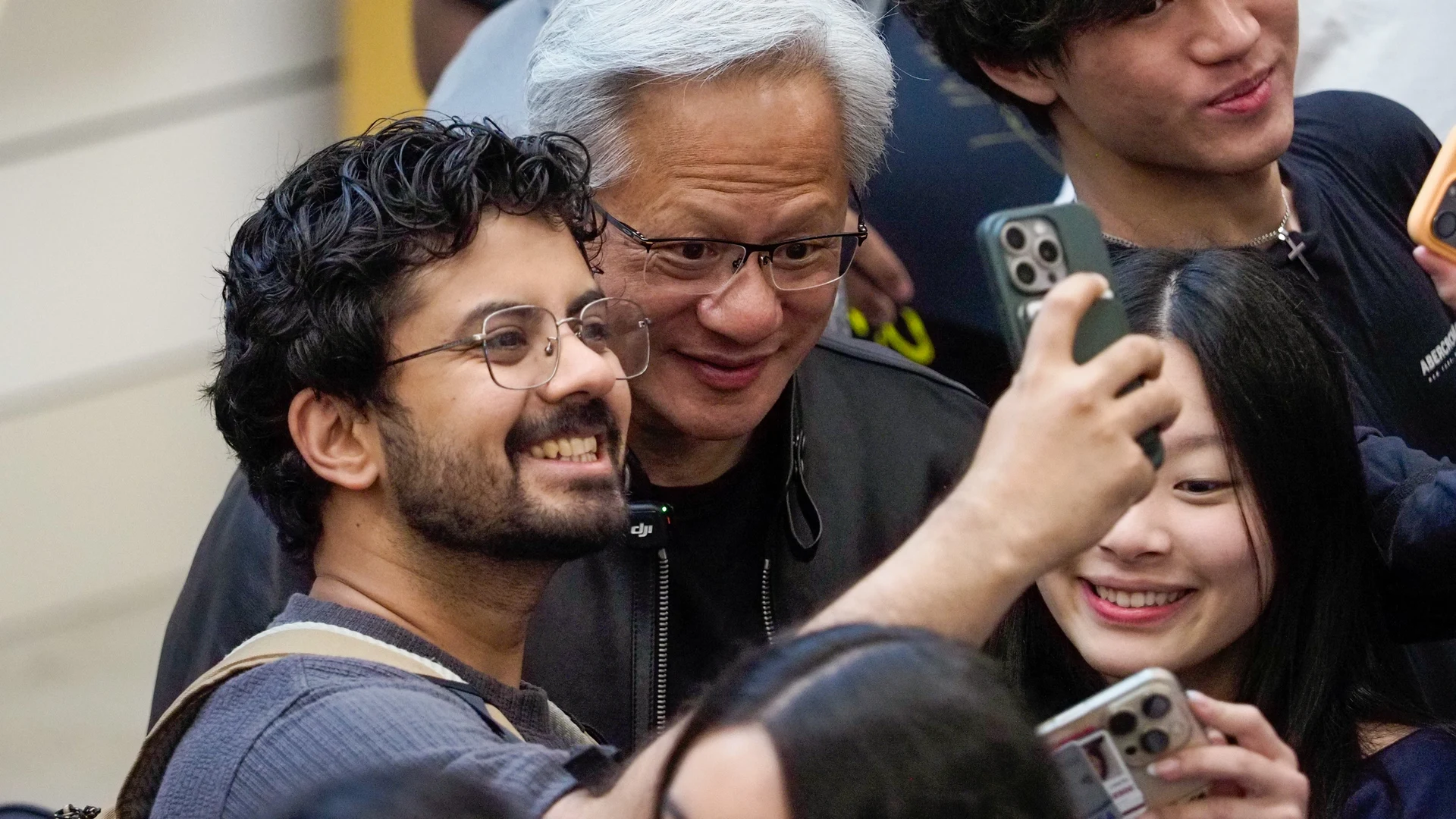
- Cover photo: Jensen Huang, founder and CEO of Nvidia, poses for selfies with students after his talk in Stanford University's CS 153 course, 30 April 2026 — Photo: Anders Eidesvik / Wikimedia Commons (CC BY-SA 4.0)