Two and a Half Million Turn Out as Pope Leo Brings Francis's Homeland the Visit It Never Got
Pope Leo XIV celebrated Mass with an estimated 2.5 million people in the heart of Buenos Aires on Monday, drawing the largest crowd of his pontificate so far and bringing to Argentina the papal visit its people waited nearly 40 years to see. The Mass, held at the Monumento de los Españoles on one of the capital's grand boulevards, was the centrepiece of a four-day visit that has carried the pope across the country his predecessor never came home to: Pope Francis, an Argentine, never returned to his homeland during his 12-year pontificate. Leo's journey, a 12-day apostolic visit to Uruguay, Argentina and Peru running from 6 to 17 November, has been followed at every stop by crowds on a scale the Vatican has not seen in years.
The numbers tell the story of a country determined not to miss its moment. About 2.5 million people attended Monday's Mass in Buenos Aires, according to local authorities, and a further million gathered for a youth prayer vigil at the same monument on Tuesday night. On Tuesday the pope travelled to Córdoba, in the country's centre, where the Vatican estimated 650,000 people attended Mass, and on Wednesday more than two million turned out for Mass outside the Basilica of Our Lady of Luján, Argentina's national Marian shrine, according to local estimates. Throughout the visit, Leo has retraced his predecessor's footsteps: Buenos Aires Cathedral, where Cardinal Bergoglio served as archbishop from 1998 until his election as pope in 2013; the Pequeño Cottolengo Don Orione in Claypole, a home for people with disabilities associated with Francis's ministry; and the Catholic University of Argentina, where Francis once served as grand chancellor and where Leo addressed workers, business leaders, trade unions and popular movements on Monday, emphasising the dignity of work and the responsibility of governments and businesses to protect vulnerable workers.
The visit has also carried a political charge that Leo has not tried to hide. In his first speech after arriving, delivered on Sunday to President Javier Milei, government authorities, civil society leaders and diplomats, he called for the protection of democratic institutions and urged public officials to exercise power in service of the common good. His Monday visit to the disability care home was widely read as a rebuke of the president's policies, which included shutting down Argentina's national disability agency in the name of spending cuts. The reverberations were already visible by Tuesday: four senators from Milei's party began preparing to take up a stalled bill banning online gambling advertisements, a measure Milei has opposed and the Church has promoted as a way to protect children. Argentina's foreign minister, Pablo Quirno, defended the administration's record against critics who read the pope's words as a rebuke of Milei's austerity, while acknowledging that the visit "challenges the entire political class, the leadership class, it challenges us as a society and delivers a message about what we lack".
Nowhere was the weight of Argentina's history more present than in Córdoba. The liturgy was held on the grounds of the Argentine Aircraft Factory, a plant run by the air force for much of the 20th century that built the attack planes Argentina's military first used in late 1975 to strike leftist guerrillas, a prelude to the state terror of the 1976–1983 military dictatorship, in which human rights groups estimate around 30,000 people were killed or disappeared. After Mass, Leo met privately with 20 people chosen by the archbishop, among them Alba Camargo, whose father, stepmother, aunt and uncle all disappeared under the dictatorship. Camargo, who was herself detained by security forces in 1976 at the age of 13, told the pope she had come on behalf of relatives still searching for victims' remains at La Perla, a former clandestine detention centre outside Córdoba, and handed him a folder with photographs of the excavations. She said she hoped the meeting "would bring change" at a time when Milei's government has gutted funding for dictatorship memorial sites and promoted a revisionist account of the military's crimes. "It's exhausting to have people constantly telling you that what you've lived through your entire life isn't true," she said.
Leo himself has made only a passing reference to the dictatorship while in Argentina. In his first speech on Sunday he spoke of a history that included "reasons for gratitude and painful memories", saying it was up to each generation to "discern what deserves to be preserved, to confront past injustices and to add to its shared material and spiritual patrimony", in comments seen as referring to the dictatorship. His most direct message has been aimed at the young. At Tuesday night's vigil he urged the young Argentines to "stand firm" and reject what he called the "idols of our time": success at any cost, money, drugs, pornography and obsession with appearances, popularity or pleasure. "Do not bow down before anything that cannot give you life," he said. "And if you have ever fallen, get back up." Emilia Caroti, a 20-year-old from Buenos Aires who watched the vigil from a nearby park, said her generation was "deeply marked by what we see from the past and the little hope there is for the future, and we hope the Pope can renew our faith in ourselves a bit".
Leo leaves Argentina on Wednesday for Peru, the final country on his South American tour, and the question now is what survives the crowds. Online, the visit has drawn first-hand accounts as well as headlines: in an r/Catholicism thread on the Luján Mass, one of the event's volunteers shared their experience from inside the basilica. The visit has already done something no speech could: it gave Argentina the homecoming Francis never had, with millions turning out not only for a pope but for the memory of one of their own. It has also put the country's politics under a kind of moral audit, from the disability agency to the gambling bill to the memorial sites, with the government publicly conceding that the pope's message exposed what the country lacks. Whether any of that changes policy will be decided in Buenos Aires long after the pope has gone. What is already certain is the scale of it: in four days, more than six million Argentines by local and Vatican estimates turned out to see a pope who, until this week, had never set foot in their country as its shepherd, and who arrived carrying the legacy of the one who never came home.
- Maryknoll Magazine — In Argentina, Leo XIV honors legacy of beloved Pope Francis
- Vatican Press Office — Holy Mass at the Monumento de los Españoles, 9 November 2026
- National Catholic Reporter — Pope Leo urges Argentines to reject the "idols" of money, drugs and pornography
- The Catholic Telegraph — Pope Leo celebrates Mass with 2.5 million people in heart of Buenos Aires
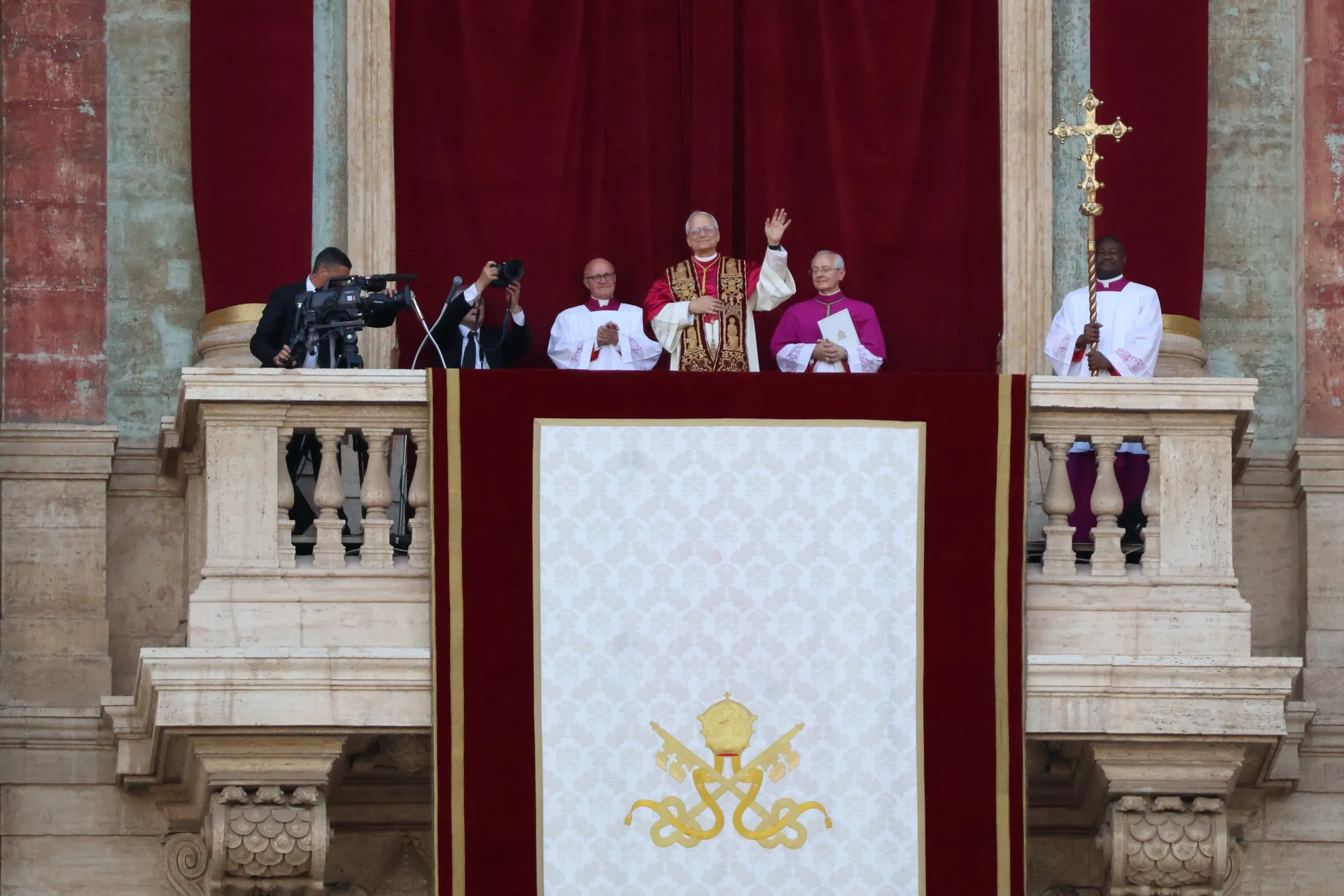
- Cover photo: Pope Leo XIV waves from the loggia of St Peter's Basilica after his election, 8 May 2025 — Photo: Edgar Beltrán, The Pillar / Wikimedia Commons (CC BY-SA 4.0)