Tankers Under Fire Again as Attacks in the Strait of Hormuz Reach a New Peak
Two more tankers were struck in the Strait of Hormuz on Saturday, extending a wave of attacks on commercial shipping that has pushed maritime security incidents to their highest weekly level since mid-October — and left one of the world's most important oil arteries running at barely a third of its normal traffic. The United Kingdom Maritime Trade Operations agency, UKMTO, said a tanker sailing outbound through the strait was hit on its stern by an unidentified projectile about 11 nautical miles north of Khasab, Oman, on Saturday. Hours later it reported a second incident, a tanker hit in its engine room by an unidentified projectile 17 nautical miles east of Khasab. It was not immediately clear whether the two reports involved the same vessel. No casualties were reported in either incident, and the environmental impact remained unknown.
The attacks came a day after another tanker was struck on Friday afternoon, about eight nautical miles north of Khasab, when an unknown projectile hit its port bow and started a fire on board. Iran's Revolutionary Guards said shortly afterwards that a tanker had caught fire after hitting a mine while trying to transit the strait near Khasab, and on Saturday Iran's navy said an oil tanker had caught fire after hitting a naval mine in a restricted area east of the strait. Reuters said it could not independently verify the Iranian account, nor establish whether it referred to any of the incidents reported by UKMTO. Tehran has imposed restrictions on vessels wanting to pass through the strait and has attacked ships it says violated those restrictions, as it seeks to assert control over the strategic waterway and exert pressure on Washington. Khasab lies on Oman's Musandam Peninsula at the entrance to the strait, which carried nearly one-fifth of global crude oil supplies before the start of the Iran war.
The pattern of the past week is what alarms shipping analysts most. According to maritime security analyst Martin Kelly of Orbital Risk Intelligence, shipping experienced 15 attacks and piracy-related incidents over the past seven days, a 50 per cent increase from the previous week and the highest weekly total since mid-October. In the Persian Gulf, the Strait of Hormuz and the Gulf of Oman, he recorded seven strikes involving six vessels. Four tankers were hit within 13 nautical miles of Khasab over three days, including the LPG tanker TARA GAS, which was disabled by a projectile strike on 16 November and hit again the following day, catching fire a second time before being abandoned. The violence has left two seafarers missing and 13 injured. Among the most serious incidents was the 17 November attack on the tanker NAVIG8 MESSI, which suffered a fire after being struck 13 nautical miles north of Khasab; its operator, ADNOC, confirmed that one crew member was missing and 11 others were injured, and the remaining crew were evacuated.
The deteriorating security situation is taking a continued toll on commercial traffic. In its weekly maritime security overview published on Friday, UKMTO reported 115 outbound and 148 inbound transits over the preceding seven days, down from 139 outbound and 169 inbound crossings the previous week. Combined traffic remains approximately 65 per cent below pre-conflict levels. UKMTO recorded six verified attacks across the Strait of Hormuz and the Persian Gulf during its latest reporting period, which covered incidents through 18 November — four in the strait itself and two in the wider Persian Gulf. Since the US-Iran ceasefire agreement expired on 17 August, UKMTO has recorded six total vessel losses, while 22 vessels required assistance and 31 were confirmed to have continued their voyages. The Joint Maritime Information Center continues to assess the threat to commercial shipping in the strait as severe, warning that further deliberate attacks are highly likely.
The surge in maritime violence extends well beyond the Middle East. Six commercial vessels were struck in the western Black Sea over the past week, according to Kelly, including two ships that sank in Bulgaria's exclusive economic zone on consecutive days: the general cargo ship BETUL 8 on 16 November, followed by the LPG tanker GAS HUSKY on 17 November. All 31 seafarers aboard the two vessels were rescued. Maritime security firm Ambrey separately confirmed reports of six vessels struck since 13 November, including four attacked near the Sulina anchorage in Romanian waters and two in Bulgarian waters, and assessed the attacks as part of an escalating Russian campaign involving unmanned aerial and surface vessels. The incidents have raised growing concerns about the safety of commercial shipping in waters adjacent to NATO member states Romania and Bulgaria. Piracy-related activity has also increased in the Gulf of Aden and the western Indian Ocean, where armed skiffs approached or fired on merchant vessels three times during the week.
What happens next will be decided by whether Tehran and Moscow treat the shipping lanes as a pressure valve they can keep squeezing. The attacks are concentrated on the southern shipping lanes off Oman's Musandam Peninsula, particularly against tankers attempting to leave the Persian Gulf, and analysts warn the coming week could bring further strikes. Insurers, shipowners and energy traders are watching the strait — through which a fifth of the world's seaborne oil once flowed — for any sign that the trickle of traffic will stop altogether. The market's verdict is already bleak: on Polymarket, traders give traffic through the strait only about a 3 per cent chance of returning to normal by 31 December. For the crews still sailing those waters, and for the economies that depend on the oil they carry, the question is no longer whether the strait is dangerous, but how long the world can afford to route around it.
- Reuters via gCaptain — Two Tanker Incidents Reported Near Oman; Vessel Hit Mine East Of Hormuz
- gCaptain — Another Tanker Hit in Strait of Hormuz as Maritime Attacks Surge Worldwide
- MarineLink — Tanker On Fire After Struck By Projectile Near Strait
- UKMTO / JMIC — Regional Tension advisory update on maritime security incidents
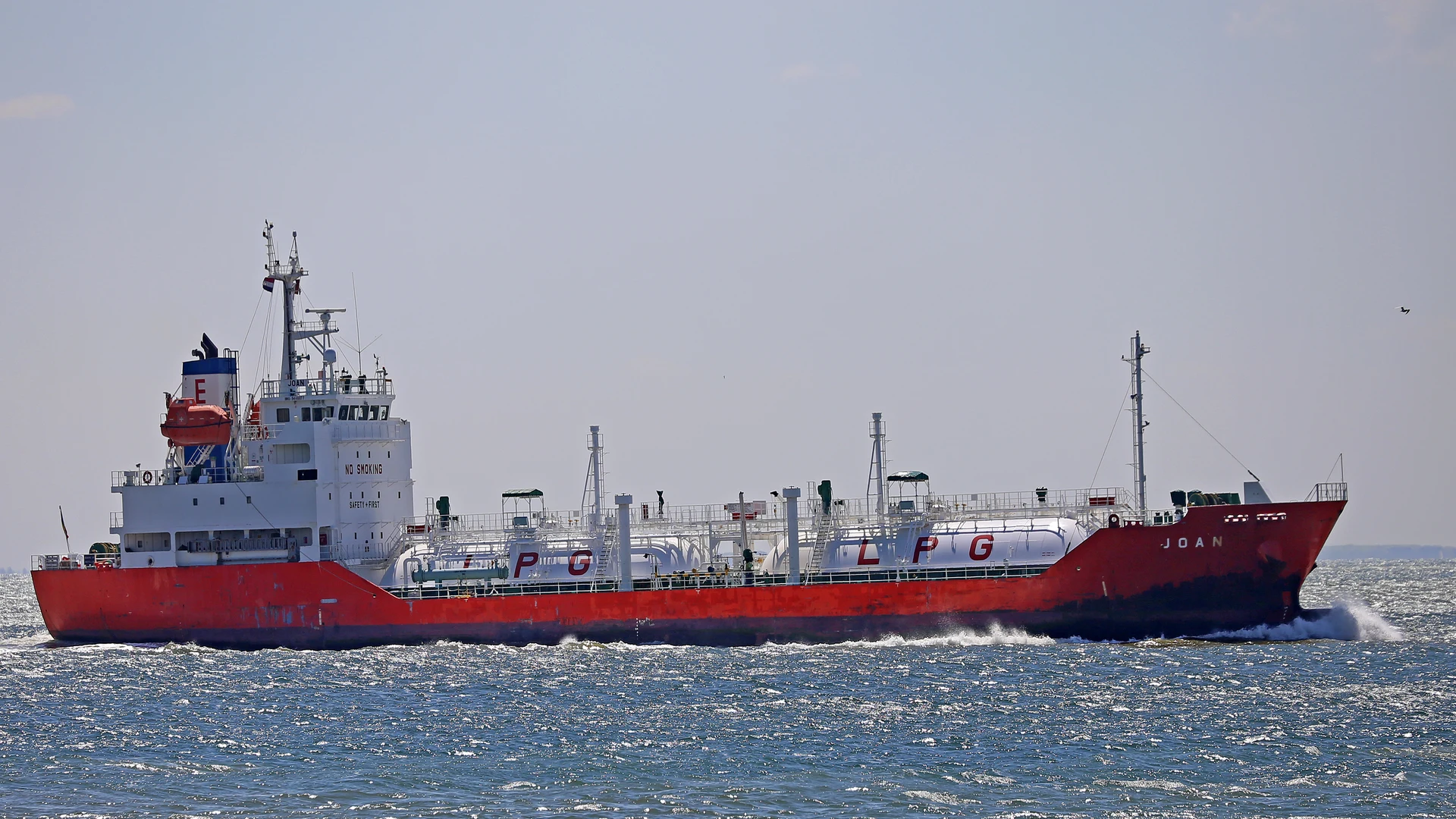
- Cover photo: The LPG liquid gas tanker JOAN (built 2009, Belgian flag) under way at sea, photographed 16 May 2019. The story's attacked vessel TARA GAS is also an LPG tanker; no freely licensed photo of the attacked ships exists, so this is a representative photo of the same class of vessel — Photo: W. Bulach / Wikimedia Commons (CC BY-SA 4.0)